

Listen to the article
Amid concerns that China’s Change’e 6 mission to the moon, launched on May 3, could be a part of a strategy to militarise the moon, Dr John Plumb, the Assistant Secretary of Defence for Space Policy at the U.S Department of Defence, said, “I do not buy the idea of the militarisation of the moon.” He expressed his belief that space could instead serve as a significant platform for diplomacy with China. On the threat of nuclear weapons in space, Dr Plumb said the Defence Department (DOD) was taking the threat of Russia sending a nuclear head into space very seriously,” and added that no space-faring nation should entertain such a capability due to its catastrophic implications. Regarding the threat of cyber-attacks in space, Dr Plumb suggested that constellations of low-orbit satellites could provide a solution to ensuring satellite safety and said that the DOD is exploring other potential applications of low-orbit satellites. – Linda van Tilburg
Space offers a huge opportunity for diplomacy with China
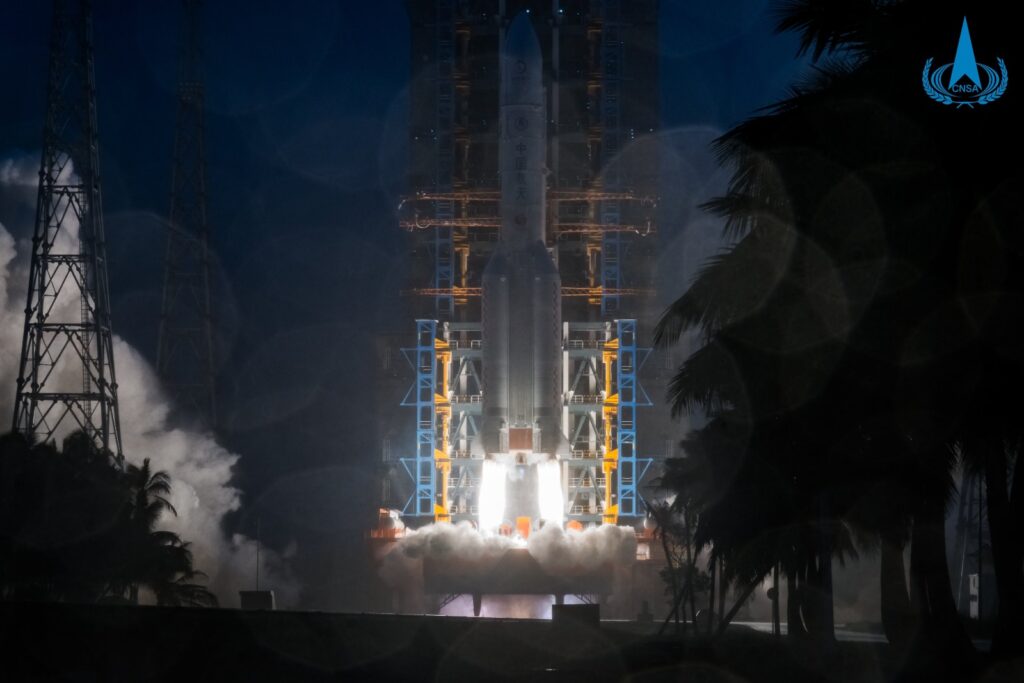
China has launched a second lunar mission, the Chang’e 6, which aims to collect the first-ever samples from the far side of the moon. The Chinese mission will aim to collect with a target of up to 2,000 grams of lunar material. This marks the second successful mission to land on the lunar far side, following the successful touchdown of Chang’e 4 in 2019.
However, there is suspicion in the United States about China’s intentions on the moon. NASA chief Bill Nelson expressed to lawmakers in Washington that Prime Minister Xi Jinping and his government might not be truthful about their intentions.
“We believe that a lot of their so-called civilian space program is a military program. And I think, in effect, we are in a race,” Nelson said during a House appropriations committee meeting.
Nelson voiced his concern that if China were to reach there first, they could claim, ‘This is our territory, you stay out.’
During discussions about NASA’s budget for the 2025 fiscal year, Nelson stated, “I would hope that the Chinese space programme will come to its senses and understand that civilian space is for peaceful uses, but we have not seen that demonstrated.”
Meanwhile, Dr John Plumb, the first Assistant Secretary of defence For Space Diplomacy expressed his scepticism about the idea of the militarization of the moon from the perspective of the U.S Department of Defence.
Dr Plumb told the Space Diplomacy Forum in Washington, held in partnership with National Security News “I do not think that is achievable and I don’t believe anybody could project a military logistics chain all the way to the moon.”
However, he acknowledged that countries might want to use their militaries to understand what other countries were doing in orbits around the moon, but he clarified that this was a far cry from militarisation.
According to Dr Plumb, space should present the United States with a unique opportunity for diplomacy with China, especially as China continues to expand its presence in space.
“As China continues to increase its own presence in space, We both have driving concerns that we need to be talking about. How do we keep the domain stable? How do we avoid collisions? What are the proper ways? And I think that should give us a hook, um, both countries a hook to continue to talk and ideally not take those talks down every time there’s a kerfuffle at higher levels.
He said the Department of Defence would be “all in on helping to drive those conversations.”
Nuclear detonation in space would be devastating
Dr Plumb said that the Defence Department is taking reports of Russia’s intent to send a nuclear warhead into space very seriously. He said, “It is a very serious threat.” The DOD firmly supported the resolution at the UN to reaffirm the commitment to not place nuclear weapons in space. He noted that Putin himself has said, “he has no intention of doing it.”
The Assistant Secretary expressed his confusion about Russia vetoing a resolution that essentially asks Putin to affirm what they have already agreed to. He said, “I don’t think we’ve heard the end of this.”
Dr Plumb continued, stating that a nuclear explosion in space would be devastating and completely indiscriminate. He said, “Nuclear weapons in space recognise no civil, military or national boundaries,” and “could do really lasting damage to low earth orbit in particular.” He opined that no space-faring nation, and frankly no nation who relies on space, which is every nation in the world, should be interested in pursuing such a capability.
Regarding the use of nuclear energy as a power source in space, the Assistant Secretary said the DOD supports making it safe. He mentioned that federal regulations on being able to put nuclear material on a launch are possibly a bit too laborious and require “a lot of very, very careful planning.” Dr Plumb said nuclear energy and nuclear electric propulsion, of which he happens to be a fan, are really useful ways to use power whether in space or “if we’re trying to colonize or even have some type of outpost on the moon or on Mars or something.”
Cyber security is probably the highest level of threat to space systems, potential for “volume kill”
With respect to the threat that cyber-attacks pose to space, Dr Plumb stated they were probably the highest level of threat because, “they can be done from your basement. You don’t need a lot of hardware to do these types of things.” He mentioned what the Department of Defence refers to as a “volume kill”, the possibility that a command-and-control system for a constellation could be hacked, potentially taking down the whole system.
Dr Plumb advised operators and companies building satellites to construct cyber defences into their systems, “From the ground up, which is a lot easier than doing cyber, like patching it back on to systems we built 20 years ago that are still up there.” He added that, “anyone designing hardware today, you just need to assume that your systems have been penetrated by an adversary, which is very different than thinking you could keep them out.”
He said the U.S Department of Defence recognises that there is tension between commercial entities and what his department needs, because the DOD needs, “things to be able to work, not just in peace time, but also in conflict. If they don’t work in conflict, I don’t really want them in my system.”
Innovation in the space domain is happening in the commercial sector
Speaking about the Commercial Space Integration Strategy that was released in March this year by his team, Dr Plumb stated that the fundamental driving force behind the strategy is the clear understanding that “innovation in the space domain is happening in the commercial sector and we have to harness that innovation.”
He noted that the commercial sector is moving rapidly and is actively seeking ways to reduce costs. He highlighted that the proliferation of lower earth orbit is an innovation emerging directly from the commercial sector.
Dr Plumb said that the role of the Department of Defence (DOD) is to participate in this innovation and determine how to utilise it for national security purposes.
Regarding the protection of space assets against attacks, Dr Plumb pointed out that people are not just contemplating the development of weapons, they are actively developing them. The question, he said, is how to defend against a one-on-one attack on a satellite that could cause a devastating loss to the mission at hand.
He expressed excitement about the proliferation of low earth orbit satellite communications, as demonstrated by Starlink. He mentioned that other companies are also entering the field, which unlocks huge potential, particularly in the SATCOM space.
“Having a thousand satellites or 10,000 satellites or whatever the number is, the problem of defence kind of goes away, because if a couple of satellites are neutralized by an adversary, it has almost no noticeable effect on the constellation’s performance,” he said.
Dr Plumb emphasised that the ability to quickly disseminate information is absolutely key to the way the DOD thinks about conflict in the 21st century.
“It’s just an amazing difference what you can do with this much bandwidth through space and at those low latency levels. You’re seeing it play out in Ukraine right now and the department is starting to look at what other things you can do with this. It’s really remarkable,” he added.
Discussing the type of innovation the DOD is seeking in the commercial sector, Dr. Plumb said, “What we’re fundamentally looking for is technology that we can rely on, not just in peacetime, but in conflict technologies and the tech refresh rate should be sufficient that we don’t have to design requirements for 20 years out, maybe five years out, seven years out. If it keeps upgrading, then that gives us a totally different way than we’ve been thinking about doing things ourselves for many years, that quicker refresh rate.”
For cybersecurity, he stated that there has to be a minimum standard for the department to deem it sufficient for their needs.