

Listen to the article
President Donald Trump told Americans the United States is approaching the final phase of its military campaign against Iran, warning the conflict could intensify over the coming weeks while offering limited detail on how or when the war will end.
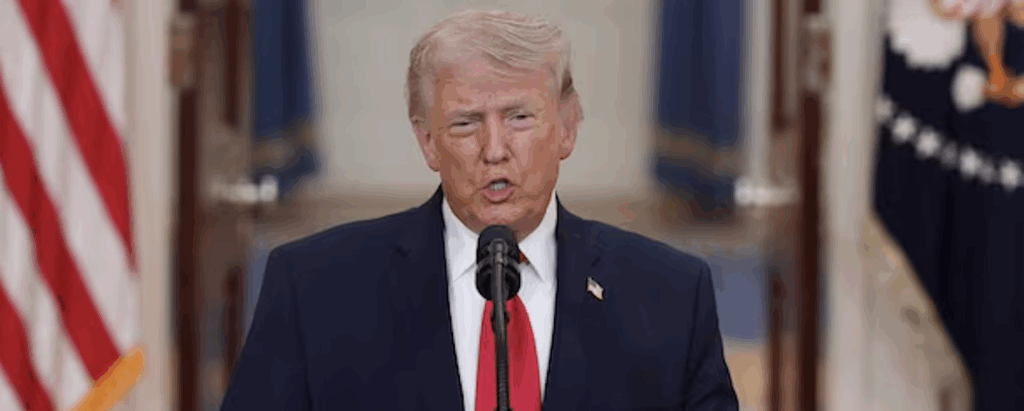
In a 20-minute address delivered from the Cross Hall of the White House on Wednesday night, Trump said the administration’s “core strategic objectives are nearing completion” and projected “another two to three weeks” of operations. He also warned the United States was prepared to escalate further military action, stating: “We are going to hit them extremely hard over the next two to three weeks. We are going to bring them back to the Stone Age, where they belong.”
The speech was Trump’s first formal address to the nation since the start of the war with Iran. He said the purpose of the operation, which he described as “Operation Epic Fury”, was to prevent Tehran from acquiring nuclear weapons and to reduce its military capabilities.
Trump said he wanted to “discuss why Operation Epic Fury is necessary for the safety of America and the security of the free world”, adding that allowing Iran to obtain nuclear weapons would be “an intolerable threat”.
He also linked Iran to regional instability and attacks against Israel, including the October 7 attacks, describing them as “bloody atrocities”.
During the address, Trump claimed US military operations had already inflicted significant damage on Iran’s armed forces and defence infrastructure.
“That means eliminating Iran’s navy, which is now absolutely destroyed, hurting their air force and their missile program at levels never seen before and annihilating their defence industrial base. We’ve done all of it. Their navy is gone. Their air force is gone. Their missiles are just about used up or beaten,” he said.
The president did not provide supporting evidence for the extent of the destruction described, nor did he explain how the operation had affected Iran’s nuclear programme. The administration has previously said US strikes carried out during Operation Midnight Hammer “obliterated” Iran’s nuclear capabilities, although no new intelligence assessments were presented during the address.
Before the conflict began, US intelligence agencies assessed Iran had not yet started building a nuclear weapon but had expanded its stockpile of highly enriched uranium and advanced technical capabilities that could support future weapons development.
Trump repeated his claim that Iran would otherwise have developed “a nuclear weapon like nobody’s ever seen before”.
He also said the United States could bring the conflict to a close even if the Strait of Hormuz remained closed, despite the strategic importance of the waterway to global energy supplies.
“The United States imports almost no oil through the Hormuz Strait and won’t be taking any in the future. We don’t need it. We haven’t needed it, and we don’t need it. We’ve beaten and completely decimated Iran,” he said.
He added that countries dependent on the route should assume responsibility for reopening it.
“And the countries of the world that do receive oil through the Hormuz Strait must take care of that passage. They must cherish it. They must grab it and cherish it. They could do it easily. We will be helpful, but they should take the lead in protecting the oil that they so desperately depend on,” he said.
Despite suggesting the conflict was nearing completion, Trump signalled that additional military pressure was likely. He also said regime change had not been a declared objective of the campaign.
“We never said regime change, but regime change has occurred because all of their original leaders are dead,” he said.
Trump confirmed that 13 American service members had been killed during the conflict and paid tribute to them during the address.
Separately, in a media interview released after the speech, Trump said he would consider withdrawing the United States from NATO and criticised allied contributions to the war effort, describing them as insufficient.
The address came as hostilities continued across the region. Israeli air defences intercepted Iranian missile attacks on the first night of Passover, while Israeli strikes in Lebanon killed at least 50 people within 24 hours, according to local health officials.
Oil markets reacted sharply following the speech. Global benchmark Brent crude and US benchmark West Texas Intermediate both rose after Trump offered no detailed exit strategy and warned of further escalation.
Trump had earlier suggested the conflict could end “within maybe two weeks”. In Wednesday’s address he repeated that timeline but coupled it with a warning of intensified military action.
“We are going to hit them extremely hard over the next two to three weeks,” he said.
Public reaction to the war remains mixed. Recent polling shows 35 per cent of Americans approve of Trump’s handling of the presidency, while 58 per cent disapprove.
The administration has not announced a formal timeline for ending the war.