

Listen to the article
Iran is recruiting petty criminals to carry out attacks on British soil, the head of parliament’s intelligence and security committee has warned.
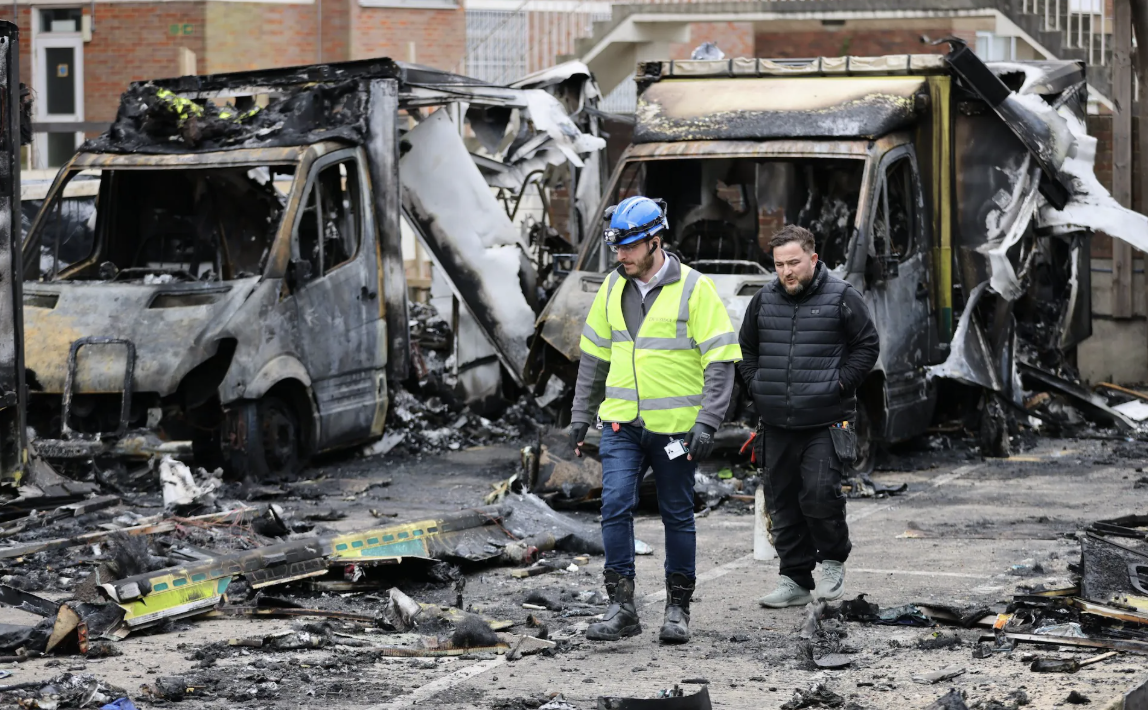
More than 200 additional police officers are being deployed to protect Jewish communities following the arson attack on four charity ambulances on Monday.
Laurence Taylor, head of UK counterterrorism policing, said investigations are ongoing into whether Iran may have been behind the attack in Golders Green in northwest London.
No arrests have yet been made in connection with the incident.
Mr Taylor said there has been a 50 per cent increase in national security investigations into hostile state activity in the UK, with many suspected to be linked to Tehran.
Lord Beamish, who chairs the intelligence and security committee, said Iran is adopting tactics similar to those used by Russia.
He said intelligence shows that individuals carrying out attacks for Iran are not directly employed by Tehran and are not necessarily members of organised crime groups.
The peer, who was previously the Labour MP for North Durham, said this mirrors Russia’s approach, including an arson attack on a Ukrainian owned business in east London in 2024, which led to two men being prosecuted under the National Security Act 2023.
Those two men had been recruited by an individual who had established contact with the Wagner Group, a private military organisation acting as a proxy for the Russian state.
Beamish told Today on BBC Radio 4: “Well, in our report in 2025 we highlighted the Iranian regime, whether it be the IRGC (Islamic Revolutionary Guard Corps) or Iranian security services, do attack dissidents, people who criticise the regime, and target the Jewish community and they do that increasingly not directly, but through proxies.
“What you’re dealing with here is not necessarily just organised crime groups but also people who are just paid.
“So for example, if you look, it’s a type of approach which the Russians are using. So if you looked for example at the attack last year on the warehouse in east London, many of those individuals who are not directly linked to any organised crime groups are just paid money.”
Taylor said counterterrorism police and security agencies are continuing to assess claims by Harakat Ashab al Yamin al Islamia, a group believed to have links to Iran, that it carried out the Golders Green attack.
A report by the Israeli government said it had identified links between the group and the Iranian regime, including the IRGC.
The group, whose name translates as the Islamic Movement of the Companions of the Right, has also claimed responsibility for similar attacks on Jewish institutions in the Netherlands, Belgium and Greece in recent weeks.
In a social media post, Harakat Ashab al Yamin al Islamia said it targeted the Machzike Hadath synagogue in Golders Green because of its connections to Israel.
However, footage from the scene appears to show suspects attacking ambulances owned by a Jewish charity. Unlike previous incidents in other European cities, the video shared by the group does not show the suspects carrying out the attack.
Taylor said it remains unclear whether the group was responsible, adding: “Clearly it’s very worrying both for the community but also for us we need to understand more about that group. You’ll be aware that they have claimed a number of incidents across Europe.
“As I said earlier that is one line of inquiry that we’re undertaking. We work incredibly closely with our security service partners and collectively we are exploring who that group are, what their motivations are, and what level of involvement. They had, if at all, in the Golders Green incident yesterday.”
He pointed to more than 20 Iranian backed plots identified in the UK since October 2024 as evidence of the growing threat.
He said: “They include everything from assassination to kidnap to espionage, and of course potentially creating fear within those Jewish communities. And more broadly, this is an area of ours that we are seeing a very significant increase. In that six months to December last year we saw a 50 per cent increase in our National Security Act investigations, compared to the previous six months, so it’s a threat that we’re acutely attuned to.
“We’re very aware that it requires some different investigative skills and creates some different challenges for us but it is one that we are very keen to attack and target.”
When asked whether the war in Iran is contributing to attacks in the UK, he said: “It’s clear that the impacts from the war, and actually we’ve seen it since the attacks in October 2024, that we have seen an uptick in our caseload, it clearly has an impact. We monitor incredibly closely what that domestic impact could be.
“But global conflict across the world will always have an impact, not just in the Middle East, but we’ve also seen it from Ukraine and other areas. It can tip people into taking action that we wouldn’t want them to do, and it’s something we have to monitor incredibly closely.”