

Listen to the article
There are critical minerals deals to be made in Africa, but the continent must tread carefully to avoid becoming a mere sideshow or collateral damage in the escalating geopolitical battle for resources, warns a leading expert.
Rohitesh Dhawan, President and CEO of the International Council on Mining and Metals (ICMM) and a Senior Associate at the Centre for Strategic and International Studies describes this as a once-in-a-generation opportunity for African nations—provided they negotiate from a position of strength, fully understand the value of their underground wealth, avoid undervaluing their resources, and strategically market their geopolitical assets.
He also emphasised that careful negotiations and neutrality in geopolitical battles will be key. In an interview with National Security News, Dhawan said: “We’ve cracked open the possibilities for deals between countries, which could be highly positive for Africa. However, we also need to remain vigilant, as some of the more negative scenarios could actually exacerbate conflict.”
Dhawan also suggested that South Africa—currently a target of the Trump administration—could ease tensions by putting a deal on the table involving minerals, tourism, and agricultural products.
Dhawan noted that Africa’s geological endowments “are pretty much unparalleled, and there is no route to the energy transition that does not pass through Africa.” He described this as: “An absolutely fascinating time, where in the next five years, we will be shaping the future not just of the industry, but of many supply chains for the next 50 years.”
Global competition for critical minerals
In response to the Trump Administration’s decision to raise tariffs on Chinese goods to 54%, China has imposed export controls on seven categories of medium and heavy rare earth elements. These include samarium, gadolinium, terbium, dysprosium, lutetium, scandium, and yttrium-related items.
Critical minerals, essential for technology, defense, and renewable energy, are estimated to be worth trillions of dollars. This immense value has turned resource-rich nations into focal points for global leaders seeking to secure these essential materials.
Former U.S. President Donald Trump openly expressed interest in securing mineral wealth from Ukraine and the Democratic Republic of the Congo (DRC). He has also shown interest in Canada—a resource-rich nation—and Greenland, which boasts untapped mineral reserves. These regions’ potential for critical minerals has made them central to U.S. strategic plans.
On 20 March 2025, Trump issued an executive order aimed at increasing U.S. critical mineral production. The White House emphasised that 70% of U.S. rare earth imports originate from China, underscoring the urgency of diversifying supply chains.
To reshape the global supply chain in its favour, the U.S. has employed trade tariffs, diplomatic negotiations, and aggressive bargaining strategies. In Ukraine, this has included pressuring the government to grant substantial U.S. control over its mineral and energy assets as repayment for support during the war with Russia. Ukrainian President Volodymyr Zelensky has raised concerns over these shifting terms, particularly the lack of security guarantees.
Other countries, such as Canada and Australia, are under similar pressure to offer the U.S. preferential supply agreements. In Latin America, U.S. influence extends to lithium producers in Chile and Argentina, where trade benefits or sanctions relief have been tied to favourable terms for American investors.
Africa is also a key focus, particularly the DRC, which produces 70% of the world’s cobalt. According to the Cobalt Institute, much of this cobalt is refined in China, making the region a critical battleground in the global race for mineral security.
DRC seeks minerals-for-muscle deal
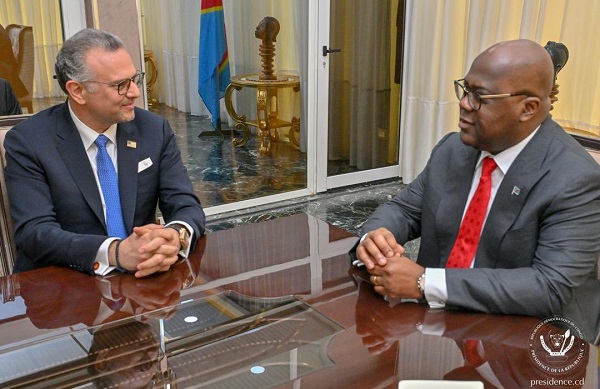
The Democratic Republic of the Congo has indicated “daily exchanges” with the US government, aiming to secure a minerals-for-security deal, according to Congolese officials. The DRC hopes the US will deploy troops to help contain the M23 rebels in the eastern region. However, Daniel van Dalen suggests a more likely scenario is that the US will provide military equipment instead.
According to Rohitesh Dhawan, many African countries, like the DRC, are trying to find their position in this geopolitical scramble.
“It is,” he said, “a great opportunity for countries to step up and become the preferred supplier to nations like the United States. But it requires strong relationships with the Trump administration.”
Dhawan also noted that security deals are not the only way to shape mineral agreements. Some Middle Eastern countries are structuring deals with Africa that combine minerals and agriculture in exchange for investment.
African countries should avoid taking sides in geopolitical battles
Dhawan advised African nations to avoid being drawn into geopolitical battles between superpowers. He suggested they could maintain strong relationships with both the West and China, as well as other nations.
“There are examples of this being done well,” he said. “The renegotiated deal between De Beers and Botswana in recent months is a great example of positive-sum thinking—benefiting the people of Botswana and strengthening relationships with key international players. Namibia is another country that has successfully attracted international investment into its mineral sector.”
However, Dhawan warned of the chilling effect caused by actions such as imprisoning executives, as seen in Mali, or seizing assets and mines, as in Niger. These actions deter investment not only in those countries but across the broader West and North African regions.
South Africa could use minerals, tourism, and agriculture to strike a deal with the Trump administration
Dhawan offered suggestions on how South Africa could structure a minerals deal with the Trump administration to improve their currently strained relationship.
“Tourism is another area. We’re seeing increasing numbers of US tourists visiting South Africa. There’s a deal to be made that protects this mutually beneficial relationship. Agricultural produce is another area with significant potential for win-win solutions.”
However, he emphasised that this would require diplomatic dexterity, which has been lacking in recent years.
“South Africa needs to step up its game in managing these sensitive times.”
Dhawan concluded: “This is really Africa’s moment—if it wishes it to be. But it requires thoughtful and considered action.”
However, he emphasised that this would require diplomatic dexterity, which has been lacking in recent years.
“South Africa needs to step up its game in managing these sensitive times.”
Dhawan concluded: “This is really Africa’s moment—if it wishes it to be. But it requires thoughtful and considered action.”