

Listen to the article
Former Israeli prime minister Ehud Olmert, who led the country during the 2006 Lebanon war, believes that only a “diplomatic agreement” will end the war with Hezbollah.
But Mr Olmert, a former lawyer and soldier, also claimed that efforts for a peaceful resolution to the conflict are being blocked by the current Prime Minister Benjamin Netanyahu, who wants to “present a picture of victory” to restore his reputation following the October 7 attacks.
Mr Olmert, who ordered the invasion of Lebanon in 2006, argued that the current Israeli leader “badly wants the war against Iran”, and that a retaliation attack for last week’s missile barrage is expected soon.
He also suggested that Mr Netanyahu would probably want Donald Trump to win the US presidential election next month, and that by possibly bombing Iran’s oil installations, he would force up global oil prices, harming the US economy and enhancing the former president’s electoral prospects.
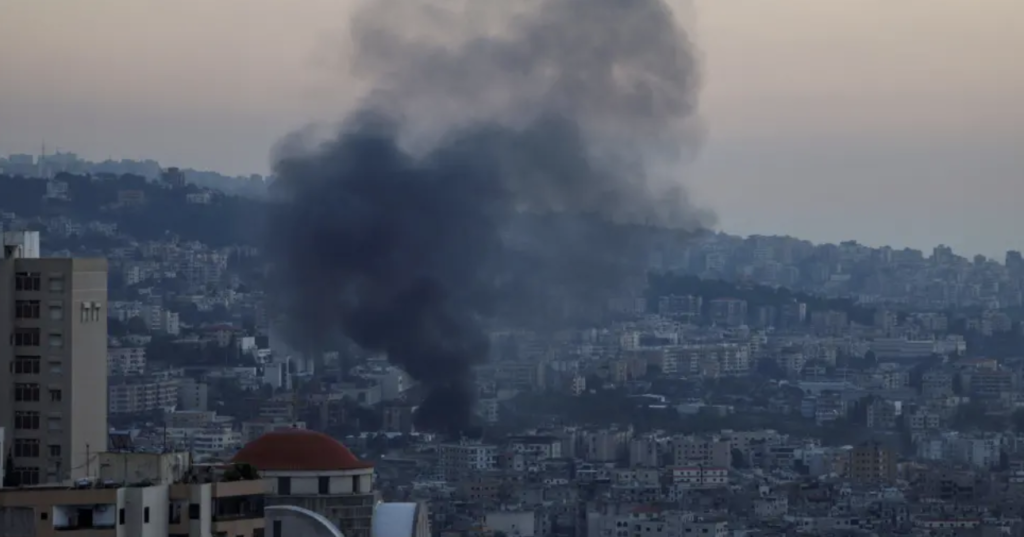
The situation in Lebanon is becoming increasingly tense by the day as attacks on both sides escalate. On Thursday 22 people were killed and more than 100 injured following an Israeli airstrike in Beirut. The attack took place without warning and was the first time Israel is believed to have bombed the Lebanese capital since 2006.
While in northern Israel, a Thai national was killed when an anti-missile was fired by Hezbollah from across the border into Kibbutz Yi’ron.
Meanwhile Israel’s Minister of Defence Yoav Gallant said the recent Iranian attacks on Israel had been “aggressive” but ultimately “failed” since no military assets were damaged.
On the prospect of Israeli retaliation, Gallant said: “Our strike will be powerful, precise, and above all – surprising. They will not understand what happened and how it happened.”

Mr Olmert, who is the last prime minister to discuss a two-state deal with Palestine, maintained that once the current war ends, Israel will have to make a choice either to “fight for ever” or reach an agreement.
“We have to decide, what do we want? To occupy them forever and to fight with them forever?”, he said in an interview with the National.
Israel, Mr Olmert argues, had a right to defend itself after Hezbollah started firing rockets into northern Israel on October 8 in support of its ally Hamas in Gaza. But after the deaths of more than 2,000 civilians in Lebanon, it has become a matter of finding the best way to resolve the conflict.
“If there is a way that we can conclude this confrontation in the north, now by an agreement, a diplomatic agreement, it’s better,” he stated.
Mr Olmert was Israel’s prime minister from 2006 to 2009. He negotiated a peace deal with Lebanon following the stalemate of the month-long war against Hezbollah in 2006. It resulted in UN Resolution 1701, which ended the fighting and brought in the UN Interim Force in Lebanon (UNIFIL), which patrolled south of the Litani River, 30km from the border, and was supposed to keep Hezbollah out of the zone.
Despite both sides breaching the 1701 resolution in the current war, Mr Olmert insists that it is “not dead at all”. “It depends on whether it will be implemented,” he explained. “Part of the agreement has to be a resolution that will be forced not only on us, but on them too.”
Mr Olmert was replaced by Mr Netanyahu after being forced out of office over corruption charges, for which he served 16 months in jail. He says the current prime minister ignored Hezbollah’s breaches of the 1701 resolution.
“When I departed, they found out after a while that they can get away [with the breaches] with Bibi [Mr Netanyahu]. That behind the rhetoric there is not much substance in terms of resilience.”
His disdain for the current leader, who himself is facing a court date on corruption allegations, is clear. He blames Mr Netanyahu for the security failures of October 7 and argues he is using the ensuing war to restore his popularity.
“Bibi badly wants the war against Iran … to drag Israel to the point where the appearance of victory will be accepted by enough people for them to forget the security blunders and present a picture of victory”. Mr Netanyahu, he argued, “believes that he is destined, perhaps by divine providence, to save the Western world” from extremists stoked by Iran.
The US, Mr Olmert said, would come to Israel’s aid if it found itself in a complicated situation, despite Washington’s dissatisfaction with Mr Netanyahu for courting a war with Iran.
While he agreed Israel needed to retaliate to “create an impact that will deter the Iranians” after the recent Iranian attack with ballistic missiles, it has to be carefully calibrated, suggesting targeting “power stations not oilfields”. This might avoid a severe counter-retaliation and make Iranian people ask the question, “why do we need to pay so much for these Palestinians?,” he added.
Targeting oil sites would likely send prices soaring “in a way that can be very, very damaging to the American government”, suggesting that “maybe Bibi wants Trump to win”.
Return Palestinian land
As prime minister, Mr Olmert came close to striking a deal with Palestinian Authority leader Mahmoud Abbas under which a Palestinian state would have been created with Israel relinquishing parts of the occupied West Bank and Jerusalem shared as the capital. With more than 41,900 Palestinians killed in Israeli fire in Gaza, a large number of Israeli fatalities, and the war expanding, the prospect of implementing a two-state solution appears remote.
But the 79-year-old politician considers it the only way to permanently stop the fighting. “When the war ends, Israelis will have to ask themselves, ‘we have destroyed Hamas, we destroyed Hezbollah, now what? Do we continue as the occupiers?’”
There are some far-right extremists, people he labelled “messianic, crazy Jewish ayatollahs”, who want settlements returned to Gaza and expanded into Lebanon. But he said it was impossible to ignore the more than six million Palestinians, and therefore it was in Israel’s interests to find an agreement.
He explained that while he, like many Jews, believes the occupied West Bank to be historically Jewish from biblical times, it would be worth it to give the land up for peace.
“I offered it to Abu Mazen [Abbas] 17 years ago, it was heartbreaking.
“But I was ready to compromise on something that I wholeheartedly believe is mine. For the sake of the future I was ready to make a concession about the past.”