

Listen to the article
By Sean Rayment
China is planning to build a giant space aircraft carrier capable of deploying unmanned fighter jets that could fire missiles from the edge of the Earth’s atmosphere.
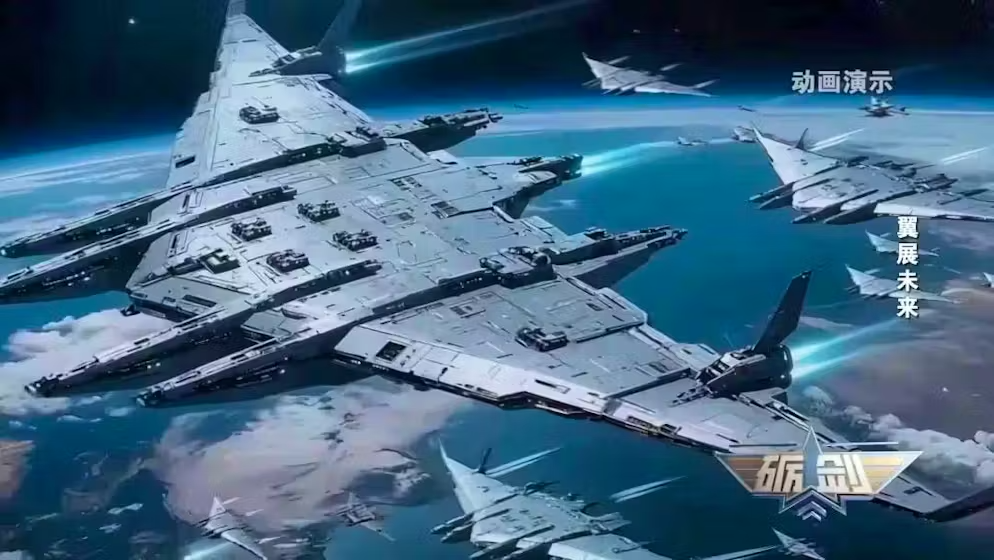
Chinese state media has released a concept video of the futuristic Luanniao, described as the world’s largest warship, travelling through space above existing defensive systems.
The communist state claimed the carrier could become operational within 20 to 30 years.
However, experts were sceptical about the project, with some likening it to a stunt designed to inspire the Chinese public.
Resembling a spacecraft from a Star Wars film, the Luanniao is depicted as a vast grey triangular aircraft carrier measuring 242 metres in length and 684 metres in width. It would have a take-off weight of 120,000 tonnes, significantly more than any comparable craft currently in operation.
According to state media, the Luanniao would be designed to carry up to 88 unmanned Xuan Nu fighter jets.
The aircraft are said to be highly manoeuvrable stealth platforms capable of launching hypersonic missiles, although they would be considerably heavier than conventional drones.
If completed, the spacecraft would “outclass pretty much everyone”, according to Peter Layton, a defence expert and visiting fellow at Australia’s Griffith Asia Institute.
The carrier would be capable of flying above surface-to-air missiles and other fighter aircraft, Mr Layton said, adding: “You are also out of range of the weather, generally speaking, and out of range of most defensive systems.”
The Luanniao could also allow Beijing to position the carrier directly above targets and launch missiles at them.
The project forms part of China’s broader Nantianmen Project, which translates as South Heavenly Gate.
Developed by the Aviation Industry Corporation of China, the initiative encompasses several ambitious plans to expand the country’s air and space capabilities.
One of the most prominent elements is a sixth-generation fighter, known as the Baidi fighter, which is also intended to operate near space. A model of the jet was displayed at China’s International Aviation and Aerospace Exhibition in 2024.
The Luanniao is the latest development in the ongoing space race between the United States and China. Beijing has invested heavily in rockets and satellites in an effort to challenge American dominance.
In 2024, China successfully launched Chang’e-6, a robotic spacecraft that reached the Moon’s far side and returned to Earth with lunar samples. The Chang’e-7 mission, which aims to search for water on the Moon’s surface, is planned for August.
The Luanniao, by far the most ambitious component of the Nantianmen Project, was first conceived more than a decade ago but was dismissed by many experts as a fantasy.
The technology required for an aircraft to hover at the edge of the Earth’s atmospheric boundary while launching missiles towards the surface does not currently exist.
Such a spacecraft would require enormous amounts of fuel and a new propulsion system that has yet to be developed, Mr Layton told The Telegraph.
One way China could achieve a similar effect would be by placing the carrier into orbit, akin to a satellite or rocket. However, in orbit the aircraft would be vulnerable to space debris, which could destroy it in the event of a collision.
Launching the Luanniao into orbit would also require a reusable rocket. China has been working towards this capability for years but has yet to achieve it.
The country is likely still 10 to 15 years away from developing such technology, Mr Layton said.
He added that China often uses projects like this to inspire the domestic audience and present itself as being at the forefront of technological innovation.
Promoting futuristic spacecraft is part of a broader effort to demonstrate to neighbouring countries that China is a leading military power.
“For the external audience, it paints a picture that they are working on technology the region simply cannot aspire to. It is literally Star Wars material,” he said.