Listen to the article
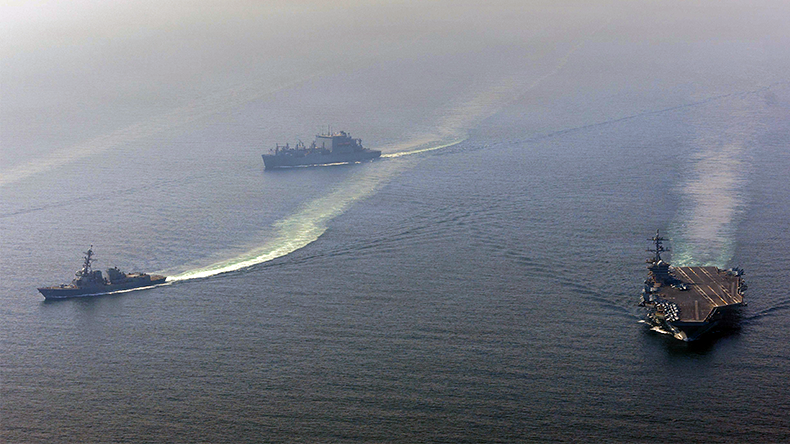
US President Donald Trump has said the country’s navy will protect ships in the Middle East “if necessary” in a bid to stop the energy supply crunch sparked by the US-Israel war with Iran.
A fifth of the world’s oil and gas flows through the Strait of Hormuz, a narrow waterway wedged between Iran and the United Arab Emirates, but traffic has almost entirely halted following Iran’s threats to “set fire” to ships.
President Trump made the announcement as it emerged that the US was also planning to arm Kurdish militias in a bid to create a popular armed uprising against the Iranian regime.
President Trump announced on his media platform Truth Social that the US government will provide risk insurance “at a very reasonable price” to all shipping firms in the region to “ensure the FREE FLOW of ENERGY to the WORLD”.
But experts warn these assurances might not be enough to ease companies’ concerns.
He made the announcement on social media as global oil and gas prices continued to surge, sparking global concerns about the impact on household prices.
An Iranian official on Monday threatened to “set fire” to any ship trying to pass through the Strait of Hormuz and the Iranian military has reportedly fired on several vessels in the area.
Some insurance companies have since hiked the price of policies for ships in the region.
Roughly 200 crude oil and product tankers are now stranded in the Gulf, according to data from Lloyds List Intelligence.
The President said he had ordered the United States Development Finance Corporation (DFC) to provide, “at a very reasonable price, political risk insurance and guarantees for ALL Maritime Trade, especially Energy, traveling through the Gulf”.
He also pledged military escort “if necessary… as soon as possible”.
Oil prices dropped back after the announcement, which came as Mr Trump was due to meet with Energy Secretary Chris Wright and Treasury Secretary Scott Bessent to discuss plans to address the energy issues.
Despite the President’s announcement, Richard Meade, editor-in-chief of shipping journal Lloyds List, said it remained unclear if the US president would be able to address the safety concerns driving the supply crunch.
He noted that Houthi attacks on the ships in the Red Sea in recent years prompted many shipping firms to avoid the passage with longer, more expensive routes, despite intervention by the US military.
“There was never really a point at which insurance alone would have prevented ships from going through the Strait of Hormuz,” he said, adding: “Just because you’ve got a naval escort doesn’t mean to say you’re safe.”
Analysts have warned that a prolonged disruption could send crude oil prices above $100 a barrel, which would have a major impact on petrol prices, even in the US, where significant domestic production has tended to mute the impact of global price movements.
Speaking to reporters at the White House on Tuesday, the President defended the war, saying “something had to be done” about the Iranian regime.
He conceded it might lead to high oil prices “for a little while” but brushed off long-term impact.
“As soon as this ends, those prices are going to drop, I believe lower than even before,” he said.
Meanwhile, the CIA is reportedly planning to arm Kurdish forces to incite a popular uprising against the Iranian regime.
The US administration has been discussing providing military support to Kurdish leaders in Iraq and Iranian opposition groups, sources told CNN.
Iranian Kurdish forces are planning to participate in a ground operation in western Iran in the coming days, a senior Iranian Kurdish official said.
Mr Trump is open to supporting militias to take up arms against Tehran, US officials confirmed, after it was revealed that the US president had spoken directly with Kurdish leaders in Iraq near the Iranian border.
The calls were the result of months of back-room lobbying by Israel, which had cultivated ties with the Kurds in Syria, Iraq and Iran for decades, Axios reported.
Mr Trump’s apparent move to gauge possible local opposition to the Iranian regime suggests that Washington is seeking opportunities to exploit current turmoil further.
US and Israeli airstrikes on Tuesday targeted the institution in Iran tasked with selecting the next supreme leader. Hopes for talks on a ceasefire, meanwhile, have evaporated.
“President Trump has spoken with many regional partners,” White House press secretary Karoline Leavitt said, without confirming reports of calls with Kurdish leaders.
The calls were between unnamed US officials and two prominent Kurdish politicians in Iraq on Sunday, just one day after the US and Israel began bombing Iran, the Wall Street Journal reported.
After launching Operation Epic Fury, Mr Trump urged the Iranian people to rise up and “take over your government.” Back in January, when he was mulling possible US military involvement, he even pledged that “help is on its way.”
The US has now struck more than 2,000 targets in Iran and the Red Crescent organisation has said over 700 people in Iran have been killed since the start of the conflict.