

Listen to the article
By Staff Writer
Blaise Metreweli, Chief of the Secret Intelligence Service’s first speech on how MI6 is keeping the UK safe in a world where the rules of conflict are being rewritten.
In her first speech Ms Metreweli, the head of MI6 also known as C, describes the threats facing the UK now and in the future.
The full transcript of her speech is below:
Welcome inside MI6.
This iconic building, familiar to movie fans everywhere, is the home of Britain’s foreign intelligence agency. But whilst hundreds of my team pass through the entry pods each day, the truth is that most of our work happens many miles away from this place — out of sight, hidden from the world, undercover, recruiting and running agents who choose to place their trust in us, sharing secrets to make the UK and the world safer.
You might pass one of our officers on the street or sit next to them on a plane when you’re about to set off on an adventure of your own, or in a foreign city taking selfies by the sights. Whether it’s in seemingly everyday places, or on the front line embedded with our military, MI6 is there.
In my first few weeks, I’ve heard repeatedly that MI6 is trusted and respected globally — two things that we never take for granted. We are seen as a source of hard power, soft influence and rapid innovation.
I’ve also heard that people want to believe in MI6.
It’s my job to make sure they can.
Today, I want to talk about human agency. We all have choices to make about how we deal with the undercurrents shaping our world — about how, in our new, faster, more dangerous and technology-mediated world, it will be our rediscovery of our shared humanity, our ability to listen, and our courage that will determine how our future unfolds. Conflict is not inevitable.
Understanding human nature is in my bones. From a family shaped by devastating conflict, I grew up with a deep sense of gratitude for the UK’s precious democracy and freedom. I spent much of my childhood overseas, which is where my passion for travel and adventure began. I studied anthropology, and later psychology and AI, exploring how we make sense of the world and each other. It’s why I was drawn to MI6: it offers strong purpose, a chance to serve, and a belief in the positive power of human connection.
Like the Service, I’m operational to my very core. Over nearly three decades, my career has involved recruiting and running agents in hostile territory, and leading operations in war zones to defuse threats and support peace — always in teams, always learning from others.
Over the years, I’ve worked with hundreds of brilliant partners — and indeed occasionally those we’d label as adversaries — across dozens of countries, tackling weapons proliferation and terrorism. During my time at MI5, I saw close-up what it takes to defend Britain from being targeted by hostile states.
You’ll find many like me in my organisation: powerfully motivated to protect our precious country; curious about how our world is changing; joining dots and taking action across domains.
But it was in my last role as ‘Q’, where it was my job to turn emerging technologies from threats to opportunities, that I could most clearly see the world changing. As I dug deep into data and extraordinary innovation, I saw how technology was rapidly reshaping not just our capabilities, but also conflict and trust, truth and global power.
Let me lay out how I see the global issues MI6 must tackle — because the greatest danger we face is to misunderstand the nature of the problem.
Let’s be in no doubt: our world is more dangerous and contested now than it has been for decades. Conflict is evolving and trust eroding, just as new technologies spur both competition and dependence. We are being contested from sea to space, from the battlefield to the boardroom — and even in our brains, as disinformation manipulates our understanding of each other and ourselves. Across the globe, we are now confronting not one single danger, but an interlocking web of security challenges — military, technological, social, ethical even — each shaping the other in complex ways.
We are now operating in a space between peace and war.
This is not a temporary state or a gradual, inevitable evolution. Our world is being actively remade, with profound implications for national and international security. Institutions designed in the ashes of the Second World War are being challenged. New blocs and identities are forming, and alliances reshaping — multipolar competition in tension with multilateral cooperation.
But there’s something distinctive that will make this change unlike any other: the impact of advanced technologies, which will accelerate the pace and scale of every threat and opportunity and, increasingly, individualise them too. Advances in artificial intelligence, biotechnology and quantum computing are not only revolutionising economies but rewriting the reality of conflict, as they ‘converge’ to create science-fiction-like tools.
There’s incredible promise in all this — from green technologies to hyper-personalised medicine — but also peril. AI-powered robots and drones are brilliant for scaled manufacturing but devastating on the battlefield. Discoveries that cure disease can also create new weapons. And as states race for technological supremacy, or as some algorithms become as powerful as states, those hyper-personalised tools could become a new vector for conflict and control.
Power itself is becoming more diffuse and more unpredictable, as control over these technologies shifts from states to corporations — and sometimes to individuals.
At the same time, the foundations of trust in our societies are eroding. Information, once a unifying force, is increasingly weaponised. Falsehood spreads faster than fact, dividing communities and distorting reality. We live in an age of hyper-connection yet profound isolation. Algorithms flatter our biases and fracture our public squares. And as trust collapses, so too does our shared sense of truth — one of the greatest losses a society can suffer.
The defining challenge of the twenty-first century is not simply who wields the most powerful technologies, but who guides them with the greatest wisdom. Our security, our prosperity and our humanity depend on it.
Our world is being remade — and for the first time, we are all at the heart of it.
My Service must now operate in this new context too: not just expert on hostile states, terrorism and proliferation, but fluent in technology, able to anticipate the second- and third-order effects of advances that reshape the world in minutes, not months.
And as China will be a central part of the global transformation taking place this century, it is essential that we, as MI6, continue to inform the Government’s understanding of China’s rise and the implications for UK national security.
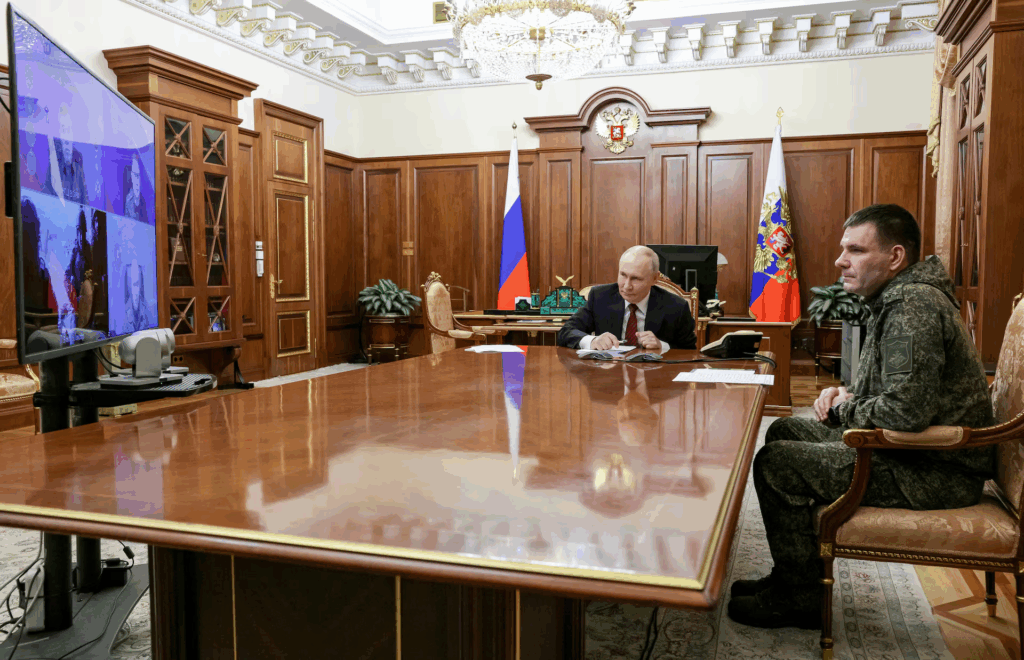
I’m going to break with tradition and won’t give you a global threat tour, but will focus here on Putin’s Russia. We continue to face the menace of an aggressive, expansionist and revisionist Russia, seeking to subjugate Ukraine and harass NATO. I find it harrowing that hundreds of thousands have died — with the toll mounting every day — because of Putin’s historical distortions and his compromised desire for respect. He is dragging out negotiations and shifting the cost of war onto his own population.
But Putin should be in no doubt: our support is enduring. The pressure we apply on Ukraine’s behalf will be sustained, because it is fundamental not just to European sovereignty and security, but to global stability.
Alongside the grinding war, Russia is testing us in the grey zone with tactics just below the threshold of war. It is important to understand these attempts to bully, fearmonger and manipulate, because they affect us all.
I am talking about:
- Cyberattacks on critical infrastructure
- Drones buzzing airports and bases
- Aggressive activity in our seas, above and below the waves
- State-sponsored arson and sabotage
- Propaganda and influence operations that crack open and exploit fractures within societies
Countering this activity is the work of intelligence and security services across Europe and the globe. And as the Foreign Secretary made clear in a speech last week, the UK is defending itself against this Russian information warfare — sanctioning Russian media outlets pushing Kremlin narratives.
The export of chaos is a feature, not a bug, in this Russian approach to international engagement, and we should be ready for this to continue until Putin is forced to change his calculus.
So how should we respond?
It’s no longer enough simply to understand the world. We must shape it too.
MI6 is well positioned to respond to these threats and wider global instability, and we will continue to evolve, just as we have throughout our long history. The UK Government has invested in our intelligence agencies, and we are all using our unique powers to keep the British people safe.
Our ‘open and connected’ partnerships across the UK Intelligence Community — with HMGCC, NSSIF and the wider UK tech ecosystem — will become even more important, because in the digital battleground no single organisation can prevail alone.
As a global agency, MI6’s inbuilt strength is our partners and our people. The risks I have set out require us to work ever more closely with our colleagues in MI5, GCHQ, defence and diplomacy — but also with our Five Eyes partners; with the E3, the EU and NATO; with partners across the Middle East and the Indo-Pacific; and with many valued partners whose identities must remain secret. Together, we integrate our diverse talent, data and tools to meet the threat.
AI is a domain in which we will excel, using technology to augment — not replace — our human skills. Every digital trace, every byte of data, every algorithmic decision has implications for the safety of the courageous people who work with us as officers and agents, and for the UK’s strategic advantage.
Mastery of technology will infuse everything we do — not just in our labs, but in the field, in our tradecraft, and, most importantly, in the mindset of every officer. We will become as comfortable with lines of code as we are with human sources, as fluent in Python as we are in multiple other languages.
Under my leadership, MI6 will continue to attract Britain’s best and most creative minds: linguists and data scientists, case officers and engineers, behavioural experts and technologists.
We need people who walk in the shoes — and get in the heads — of our adversaries. People who think differently, challenge assumptions and act decisively. All can thrive and make a difference at MI6.
At an operational level, we will sharpen our edge and impact with audacity, tapping into — if you like — our historical SOE instincts. We are at our best when we are hustling to make things happen, because our intelligence is most valuable when it changes reality on the ground.
We will take calculated risks where the prize is significant and the national interest clear. We will never stoop to the tactics of our opponents — but we must seek to outplay them.
In every domain.
In every way.
So intelligence must drive action.
Action must deliver advantage.
And advantage must serve Britain’s security and prosperity.
But at the core, our deeper contribution is also our simplest: how we unlock human agency.
Our fast-paced, tech- and threat-infused world now generates more heat than light. As nations retrench and rearm, we are losing opportunities to listen to what is really going on.
Time and again throughout my career, I have seen that this is where MI6 matters most: we listen, and we hear. We understand — because we take time to learn languages and cultures, to master complex technical and historical detail, and to immerse ourselves in what is truly driving a situation.
Across the globe right now, our officers are finding people with the courage to step forward. They are taking time to sit and listen, to break tightening cycles of violence — listening for nuance, for connection, for opportunity.
Over the years, I’ve listened to terrorists who told us how to defuse a bomb because they knew more violence would not help. To proliferators and smugglers who told us where to find dangerous material, motivated by a desire to protect their children’s future. To people trapped in authoritarian regimes who know, deep down, that their humanity is being chipped away — and that telling us what is really going on is an important release, allowing us all to find better ways to navigate our changing world.
So we will work with our agents. And we will continue to engage directly — and with respect — with states and organisations currently working against us. Away from the glare of the media, we will use MI6’s convening power wherever we can to make a material difference, bringing parties together to defuse tensions.
But the response to the increasing risks we face cannot be delivered by the UK intelligence community alone. Wider society has a role to play too. That includes work taking place in schools across the country so our children do not get duped by information manipulation. Let’s all check sources, consider evidence, and be alive to algorithms that trigger intense reactions such as fear.
It also means everyone in society truly understanding the world we are in — a world where terrorists plot against us; where our enemies fearmonger, bully and manipulate; and where the front line is everywhere: online, on our streets, in our supply chains, in the minds and on the screens of our citizens.
We must all stand together against this — as we do today with our friends in Australia after the shocking antisemitic terrorist attack this weekend. My thoughts — and those of my whole organisation — are with the families, friends and loved ones of the victims. Light will always win over darkness.
In rising to meet these challenges, we in MI6 will remain anchored to our values: courage, creativity, respect and integrity. And to our principles: accountability and trust are not constraints on our work; they are the foundations of our legitimacy with the British public.
Recently, I had the privilege of meeting and thanking a foreign agent who has worked with us for decades, taking extraordinary risks to help keep the UK safe. I asked why. They replied simply: ‘Your values. Your integrity and respect. None of us have a future without them.’ That moment reinforced to me that we must remain a deeply human agency.
And so, to sustain that trust, MI6 will continue to be more open — not for the sake of visibility, but because it matters, and, as my MI5 counterpart Sir Ken McCallum said recently, because it is a strength. We will continue the practice of speaking publicly, broaden our channels of engagement, and sustain our focus on attracting the most diverse talent to join our Service.
Transparency does not mean revealing what must remain secret. It means showing the British people who we are, what we stand for, and why our work matters.
We need your trust and support for the difficult and often dangerous work our agents pursue every day of the year.
In an age of uncertainty, one constant remains: the choices made by human beings still determine the shape of the world. Technology can illuminate possibilities — but information requires judgement, complexity demands clarity, and only people can decide which path to follow.
The United Kingdom’s global voice has never rested solely on strength. It has rested on trust, principle, and the ability to understand others as well as ourselves. That, too, is the essence of intelligence: not simply knowing the world, but interpreting it through a uniquely human lens.
Ours is the quiet service — the hidden service. It is rooted in a profound belief that when human beings act with purpose and integrity, they can steady a faltering world. When the Berlin Wall fell, it was our shared belief in freedom that carried Europe forward. When acts of terror targeted open societies, it was intelligence, cooperation and resolve that preserved them. And when adversaries blur fact and falsehood, our task is to defend the space where truth can still stand.
As we step into the future, the tools at our disposal will evolve. But what will always matter most is the human element — the person who stands in the shadows and says: this is right, and that is wrong.
That choice — the exercise of human agency — has shaped our world before, and it will shape it again.
Because, in the end, it is not what we can do that defines us, but what we choose to do.
Thank you.