

Listen to the article
By Isabella Egerton
South Korea’s military is investigating reports that Russia has delivered nuclear submarine reactor modules to North Korea — a transfer that, if confirmed, would represent one of the most serious acts of nuclear proliferation in recent decades.
According to South Korean officials cited by the Korea JoongAng Daily, Moscow shipped two to three nuclear propulsion modules to Pyongyang earlier this year. The modules — reportedly removed from decommissioned Russian submarines — include a reactor, turbine, and cooling system, the critical elements needed to power a nuclear submarine.
The alleged transfer coincided with North Korean state media photographs released in March showing Kim Jong-un touring a shipyard to inspect the regime’s first nuclear-powered submarine. Analysts estimated the vessel under construction could weigh around 7,000 tons and carry up to ten ballistic missiles in vertical launch tubes.
A strategic leap
If substantiated, the handover would mark a dramatic acceleration of North Korea’s naval nuclear ambitions. Nuclear propulsion would allow Pyongyang’s submarines to remain submerged for extended periods, travel far beyond regional waters, and deploy ballistic missiles with global reach.
These capabilities would make North Korea’s nuclear forces much harder to neutralise in a first strike, while ensuring the regime retains a credible retaliatory capability in the event of nuclear war. Operating underwater, the submarines could move undetected by satellite surveillance, giving Pyongyang unprecedented freedom to position and launch weapons.
A quid pro quo
The reactors are widely viewed as payment for Pyongyang’s deepening military support to Russia in its war against Ukraine. Since October 2024, intelligence assessments suggest at least 12,000 North Korean troops have fought alongside Russian forces, with Kyiv warning that up to 30,000 more could follow. Western officials estimate that hundreds have already been killed in combat. In addition, Pyongyang has supplied artillery shells, rockets, and other munitions to Russia.
Moscow’s provision of nuclear propulsion technology — even from retired platforms — would not only breach longstanding United Nations Security Council resolutions but also run counter to the spirit of the Nuclear Non-Proliferation Treaty (NPT). Western governments have repeatedly warned that Russia’s reliance on North Korea for manpower and weapons risks eroding global non-proliferation norms.
Reverse engineering risks
Beyond the immediate transfer, access to working propulsion modules could enable North Korean scientists to reverse-engineer the technology, drastically reducing the time required to field a domestically developed nuclear submarine. The long-term implication is not simply one submarine but a potential programme — a fleet of nuclear-powered ballistic missile submarines (SSBNs) that could fundamentally alter deterrence dynamics in Asia and beyond.
International repercussions
So far, Seoul has stopped short of publicly confirming the transfer, stating only that it has intelligence pointing to the delivery and is “verifying the facts.” The United States and its allies are expected to press the issue at the United Nations and the International Atomic Energy Agency if further evidence emerges.
Analysts warn that such a transfer would force Washington, Seoul, and Tokyo to accelerate their anti-submarine warfare capabilities, deepen trilateral maritime cooperation, and prepare for a scenario in which North Korea can threaten cities worldwide with sea-based nuclear weapons.
The bigger picture
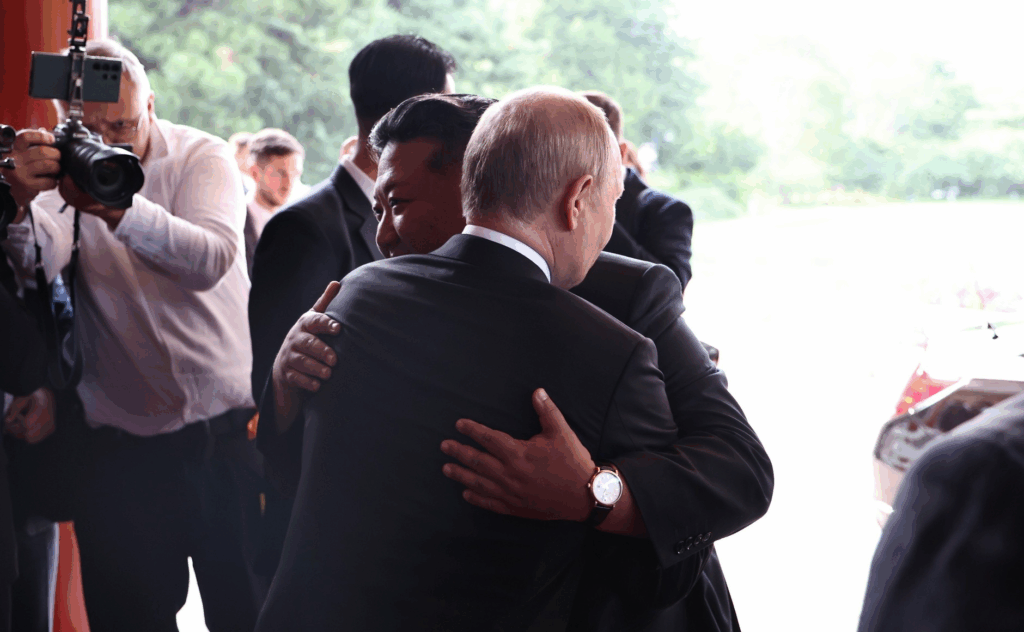
Kim Jong-un’s ties with Vladimir Putin have deepened over the past year, marked by reciprocal visits and pledges of strategic cooperation. Just weeks ago, Kim was hosted in Beijing by Xi Jinping, reinforcing Pyongyang’s bid to exploit its partnerships with Moscow and Beijing to strengthen its hand against the West.
For Russia, desperate for manpower and munitions in Ukraine, the transfer may be a tolerable price. For North Korea, it could represent the long-sought breakthrough: a credible second-strike nuclear capability that would place Pyongyang in a new league of strategic powers.