

Listen to the article
LONDON—Ukraine is making a thousand times more drones now than when Russia invaded four years ago—and NATO must learn how, the alliance’s deputy military commander said Thursday.
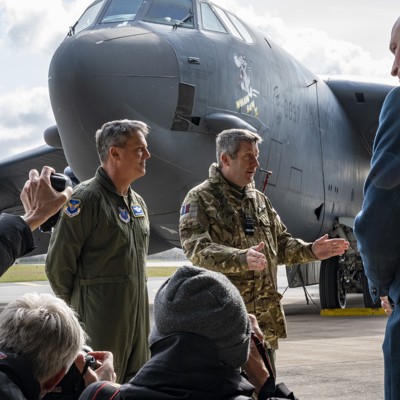
“In 2022, Ukraine produced 5,000 drones, various. In 2026, they will produce, and I’m afraid I can’t give the figure, but let’s just say it is going to be well north of 5 million, of all flavors,” Air Chief Marshal Johnny Stringer told attendees at the Global Air and Space Chiefs Conference “So, for NATO nations, if 32 nations can’t kind of meet those figures, then frankly, what do we do?”
The U.S. war on Iran has shown how quickly a conflict can consume arsenals of costly, exquisite weapons, Stringer said.
“Op Epic Fury has obviously had an impact on munitions as well, so assumptions that we may have had even months, not even a year ago, about what would be available when are now, in a sense, a little bit moot,” he said.
“These things cost a fortune,” he added. “You have to have them, but there’s a bunch of other things you can get in far greater numbers with a little bit more imagination.”
The U.S. military has heavily depleted its critical munition stockpiles during the Iran war. Coalition forces fired over 11,000 munitions in the first 16 days of the conflict, at a cost of about $26 billion, according to a report by the Royal United Services Institute think tank.
The leader of the Royal Air Force struck similar notes in his own speech.
Air Chief Marshal Harv Smyth praised the “overwhelmingly lethality” of the U.S. and allied use of airpower during Epic Fury, but he also pointed out problems with the operation.
“The Iran conflict has also exposed the opposite side to that point: the saturation and sheer weight of modern retaliatory attacks. Air forces had to intercept a torrent of hundreds of ballistic missiles and thousands of attack drones,” Smyth said. “More Patriots were fired in the first few days of this campaign than during the last four and a half years in Ukraine. This is a sobering reminder of the importance of magazine depth, even in a short form.”
The U.S. war also ate into fleets of exquisite aircraft. At least 42 aircraft have been destroyed or damaged, according to a Congressional Research Service report. This includes fighters like the F-35 and critical radar aircraft like the E-3 Sentry airborne early warning-and-control system.
Stringer said countries that are looking at sixth-generation aircraft should be cautious.
“A lot of discussion on sixth-gen seems to be almost solely about flashy aircraft,” Stringer said. “We have to define what we actually mean by sixth-gen air warfare, and then we can build the right mix of systems.”
The U.S. war in Iran has stretched on for more than four months, and no immediate diplomatic end to the conflict has emerged. Stringer ended his speech by pointing to Epic Fury as an example of how the changing threat environment means the U.S. can’t quite manage two ongoing conflicts at once.
“A younger, better-looking, and thinner version of me that joined the air force joined it at a time when U.S. doctrine could reasonably expect to fight and win two separate theater campaigns,” Stringer said. “We are no longer in that place, and what you’re seeing through the likes of Epic Fury, but elsewhere, just geopolitics full-stop, and the demand signals being placed on air and space forces, means that simultaneity is now a thing. It’s not actually an abstract concept. Which means we’re going to have to prioritize. We’re going to have to make choices.”
Gen. Kenneth Wilsbach, the U.S. Air Force’s chief of staff, told attendees that Epic Fury “demonstrated the ability of modern air and space power to generate effects across vast distances at a speed unmatched by any other form of military power.”
Wilsbach also praised allies’ support during the war in Iran, adding, “The most effective air power is combined air power.”
Read the full article here

6 Comments
Solid analysis. Will be watching this space.
Interesting update on Ukraine will build 5M drones in 2026. NATO must learn how: deputy commander. Looking forward to seeing how this develops.
Good point. Watching closely.
This is very helpful information. Appreciate the detailed analysis.
I’ve been following this closely. Good to see the latest updates.
Great insights on Defense. Thanks for sharing!