

Listen to the article
LONDON— Disagreement among allies, uncertainty around the Iran war, and defense spending fluctuations in Europe and the United States will swirl around the Farnborough Air Show in England next week.
Other things will also set this year’s edition of the biennial show apart from its predecessors, industry representatives and aviation analysts told Defense One. Typically, the commercial-heavy air expo is preceded by the Royal International Air Tattoo at the United Kingdom’s Royal Air Force station, one of the world’s largest military airshows. But in late May, RIAT organizers announced this year’s show was canceled to the public. The reason: the war in Iran.
“This has not been an easy decision,” RIAT’s statement read. “It follows extensive discussions with the Royal Air Force and the United States Air Force regarding uncertainty over access to RAF Fairford, given the ongoing situation in the Middle East.”
As a result, the Farnborough International Air Show, which runs July 21 to July 24, will likely absorb much of the focus and presence, said Eric Fanning, the Aerospace Industries Association’s CEO and president. Additionally, the show follows a bumpy NATO summit earlier this month and President Donald Trump’s continued push to have U.S. allies take on more defense spending.In Washington, D.C., the administration’s $1.5 trillion military budget pitched at revitalizing the defense industrial base is in dire straits, in part, due to political disagreements over the Iran war.
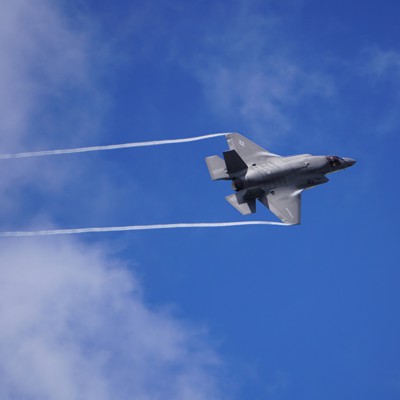
Fanning said government participation is not in flux due to the war in Iran, but it has caused some logistics and planning considerations for military aircraft to be displayed. U.S. Air Force platforms shown at Farnborough this year will include the F-35 Lightning II, the C-130J, the UH-60 Blackhawk, and the CH-47 Chinook helicopter, according to the air show’s website. British, Czech, Italian and Turkish planes will also be displayed.
With RIAT’s cancellation, Fanning said more U.S. defense firms are making an appearance at Farnborough.
“With the cancellation of RIAT, and with everything that’s going on, this is actually, for the U.S., a record attendance,” Fanning said. “There are more U.S. companies that are involved in the air show, displaying at the air show, than have ever before, and it comes on the heels of a pretty big surge in exports from the United States in aerospace — a 25% increase from last year, with the UK as one of the top five export destinations.”
Last year, ahead of the Paris Air Show, Fanning said. “There’s more underlying to this air show than any one I’ve been to before.” Now, he said the environment surrounding Farnborough tops that.
“It’s only intensified,” Fanning said. “There’s so much focus on, pressure on, and questions about the transatlantic alliance and the future of the alliance.”
Over the last year, the Trump administration has pushed for European nations to spend more on their defense while also advocating for other nations to buy U.S. arms, a move which some experts have described as a “contradictory policy.” J.J. Gertler, a senior aviation analyst at the Teal Group, said that’s one of the major trends he’s watching at Farnborough this year.
“Europe has now had a year from when it became clear that the US was not going to be as actively involved in their defense, they’ve had a year plus to get going on their own programs,” Gertler said. “What programs are on display that weren’t there, say, two years ago, and what are their big plans for the future?”
Some allies, like the United Kingdom, have taken note. Last month, the country’s defense secretary resigned and said in a public letter the country is “unwilling” to support a necessary increase in military spending. Shortly after, the country unveiled its $298 billion Defense Investment Plan which pushed investments in space, autonomous systems, and cyber warfare.
“The Government has committed to increasing defence spending to 3 percent of GDP
in the next Parliament, with funding and plans to be set out at the next spending review where defence will be the number one priority,” a summary of the DIP reads. “Alongside NATO allies, the UK has committed to reach 3.5 percent of GDP on defence spending by 2035.”
Other nation’s ambitious defense efforts have fallen short ahead of Farnborough.
Last month, Germany and France dropped their plans to collaborate on a next-generation fighter jet: the Franco-German-Spanish Future Combat Air System, or FCAS. Gertler said he’ll be paying attention to any announcements or moves to push a replacement forward.
“Do we see announced at Farnborough either of their replacement programs, their independent programs to move forward on a next-generation aircraft?” Gertler said. “It’s awfully soon, but then again, they’ve had a lot of time to get ready.”
Read the full article here

6 Comments
This is very helpful information. Appreciate the detailed analysis.
Great insights on Defense. Thanks for sharing!
I’ve been following this closely. Good to see the latest updates.
Solid analysis. Will be watching this space.
Interesting update on Allies and industry will gather at Farnborough Air Show amid Iran war, spending debates. Looking forward to seeing how this develops.
Good point. Watching closely.