

Listen to the article
FARNBOROUGH, England—Two years ago, the Army changed its mind about buying a new attack helicopter. Now, one of the finalists in that canceled effort is pitching its tech to NATO.
“We called that Raider-X for the Future Attack Reconnaissance Aircraft program for the U.S. Army. I ran that aircraft chained to the ground, getting ready to go do a flight test in that aircraft. Our competitor, Bell Helicopter, built the Invictus helicopter. And the Army canceled the program. So we never got to fly that aircraft,” said Bill Fell, test pilot for Sikorsky, a subsidiary of Lockheed Martin.
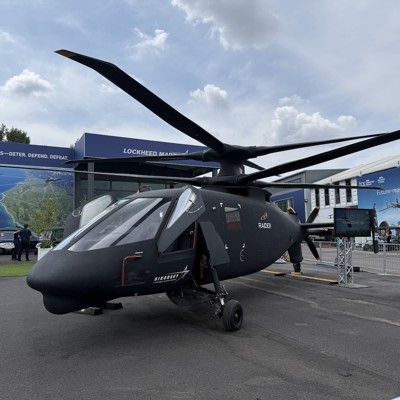
The S-97 Raider helicopter was center stage in front of Lockheed Martin’s megachalet at the international airshow here last week. The display comes as Europe grows its industrial base and NATO increases its defense spending, presenting U.S. companies with the challenge of making their bids more attractive to allies.
Sikorsky is weighing a bid on NATO’s Next Generation Rotorcraft Capability program alongside European-based Airbus and Leonardo with U.S.-based Bell, which were chosen to develop prototype designs for the aircraft. Leonardo and Bell have expressed willingness to collaborate on the program.
Boeing is also considering a bid for NGRC, assessing “the competition as customer requirements and specifications are refined,” a company spokesperson told Defense One.
“We’re looking for the right customer now,” Sikorsky’s Fell said. “We’re looking at the requirements and evaluating that now. We’re also considering a prospective program in South Korea.”
Sikorsky has said it would produce the NGRC aircraft in Europe, similar to other aerospace companies looking to expand business on the continent.
The company flew a bigger version of the aircraft, created with Boeing, called the Defiant in 2019. That helicopter lost its bid for the Army’s Future Long-Range Assault Aircraft program.
The stacked, or coaxial, rotors makes the Raider, which can reach up to 240 knots, visually striking. Russia’s Kamov debuted a coaxial helicopter at Farnborough in the 1990s, versions of which still fly today.
The dual-rotors promote fast, low-altitude flight and prevent retreating blade stall.
“There’s a natural speed limit to helicopters,” Fell said. “The airflows end up being such that the outboard few feet of the retreating disc has to produce the same amount of lift as the advancing disc entire blade does—with much higher velocities over it as well. And so, in normal helicopters, you get in high-speed flight, and eventually you get to the point where you’ve gone so fast that that retreating half of the disc just can’t keep up anymore. It can’t produce the right amount of lift, and we call that retreating blade stall.”
Fell said Sikorsky’s X-2 technology addresses that by having an “advancing half on each side” where the high-velocity airflow that comes over the disc can be counterbalanced or somewhat discounted on the retreating side.
So, going fast isn’t a problem, but the system isn’t as efficient as a tiltrotor.
“This technology is never going to be as efficient as a tiltrotor, and I think the Army wanted the additional speed that they could get out of that, and it also goes fast a little more efficiently,” Fell said.
Raider is for the military customer that wants to go fast and decelerate just as quickly, he argued.
“Any time you’re coming in somewhere where they’re shooting at you, or you are afraid they’re going to shoot at you, you can decelerate more quickly in this aircraft and minimize the amount of time that somebody’s shooting at you. I think that’s a good thing,” Fell said.
Read the full article here

6 Comments
Great insights on Defense. Thanks for sharing!
This is very helpful information. Appreciate the detailed analysis.
I’ve been following this closely. Good to see the latest updates.
Good point. Watching closely.
Interesting update on The Army didn’t want this striking rotorcraft, but could it be what NATO needs?. Looking forward to seeing how this develops.
Solid analysis. Will be watching this space.