


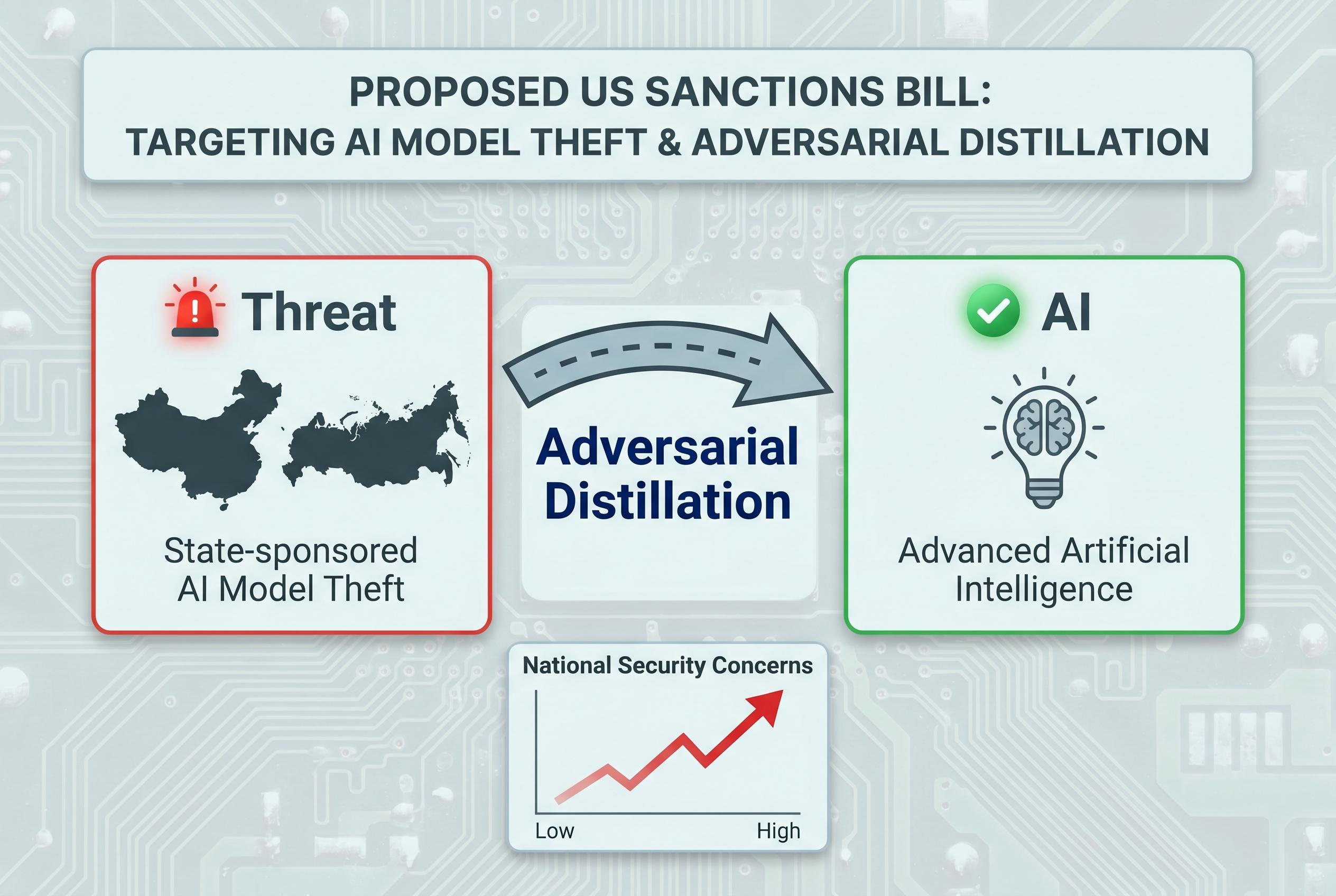
US Republicans move to curb foreign copying of American AI through new sanctions bill targeting China and Russia, highlighting rising national security concerns over adversarial distillation techniques.
Republicans in the US House of Representatives are pushing a new sanctions bill aimed at foreign companies that they say are unlawfully copying advanced American artificial intelligence systems, with China and Russia the main targets. According to Bloomberg, the proposal would compel the administration to identify organisations using unauthorised extraction or imitation techniques on US-built models and could open the door to penalties through the Commerce Department’s blacklist as well as emergency powers under a 1977 law.
The legislation, called the American AI Model Theft Prevention Act, has been introduced by Bill Huizenga with backing from John Moolenaar, who chairs the House Select Committee on China. The measure is expected to go before the House Foreign Affairs Committee next week, underscoring how quickly AI intellectual property has become a national security issue on Capitol Hill.

At the heart of the dispute is a technique known as adversarial distillation, in which a new model is trained on the outputs of an existing one in order to imitate its capabilities at far lower cost. American developers including OpenAI, Anthropic and Google have said that Chinese firms are using that approach to build cheaper rival systems, with OpenAI specifically accusing DeepSeek of improper use of ChatGPT results. The companies behind the Frontier Model Forum have also said they are working to detect and disrupt such activity, which one report in the Los Angeles Times said could be costing US firms billions of dollars a year.
Supporters of the bill argue that copied models do not just threaten commercial returns; they can also strip away safety features built into the original systems. Industry warnings have focused on the risk that distilled versions may be easier to censor, harder to secure and less reliable at blocking harmful requests. The draft legislation would push the Commerce Department to treat such conduct as industrial espionage and would encourage the Justice Department to consider criminal cases where appropriate.
Source Reference Map
Inspired by headline at: [1]
Sources by paragraph:
Source: Noah Wire Services
Noah Fact Check Pro
The draft above was created using the information available at the time the story first
emerged. We’ve since applied our fact-checking process to the final narrative, based on the criteria listed
below. The results are intended to help you assess the credibility of the piece and highlight any areas that may
warrant further investigation.
Freshness check
Score:
7
Notes:
The article references a Bloomberg report from April 16, 2026, detailing the proposed legislation. Similar reports from The Times of India and The Business Times also cover the same topic, with publication dates of April 16, 2026. This suggests that the narrative is fresh and original. However, the article’s reliance on a single Bloomberg report raises concerns about source independence. Additionally, the article includes a source reference map, indicating that the content may be aggregated from multiple sources. The earliest known publication date of substantially similar content is April 16, 2026. Given these factors, the freshness score is moderate.
Quotes check
Score:
6
Notes:
The article includes direct quotes attributed to Bloomberg, but no direct quotes from the Bloomberg report are provided in the search results. This raises concerns about the accuracy and verification of the quotes. Without access to the original Bloomberg report, it’s challenging to verify the authenticity of the quotes. Therefore, the quotes cannot be independently verified, leading to a reduced score.
Source reliability
Score:
5
Notes:
The article cites Bloomberg as the primary source, which is a reputable news organization. However, the article also references The Times of India and The Business Times, which are less well-known and may have limited reach. The reliance on a single Bloomberg report and the inclusion of lesser-known sources raise concerns about source independence and reliability. Additionally, the article includes a source reference map, indicating that the content may be aggregated from multiple sources. Given these factors, the source reliability score is moderate.
Plausibility check
Score:
8
Notes:
The article discusses proposed legislation in the US House of Representatives aimed at sanctioning foreign companies accused of unlawfully copying American AI systems, with China and Russia as primary targets. This aligns with recent reports of similar legislative efforts and industry concerns about AI model theft. For instance, a report from The Business Times on April 16, 2026, covers the same topic. The claims made in the article are plausible and consistent with current industry discussions. However, the lack of direct quotes and reliance on a single source raises some concerns about the depth and breadth of the reporting.
Overall assessment
Verdict (FAIL, OPEN, PASS): FAIL
Confidence (LOW, MEDIUM, HIGH): MEDIUM
Summary:
The article discusses proposed legislation in the US House of Representatives aimed at sanctioning foreign companies accused of unlawfully copying American AI systems, with China and Russia as primary targets. While the claims are plausible and align with recent industry discussions, the article’s reliance on a single Bloomberg report and the inclusion of lesser-known sources raise concerns about source independence and reliability. The lack of direct quotes and independent verification further diminishes the credibility of the content. Therefore, the overall assessment is a FAIL with medium confidence.
