


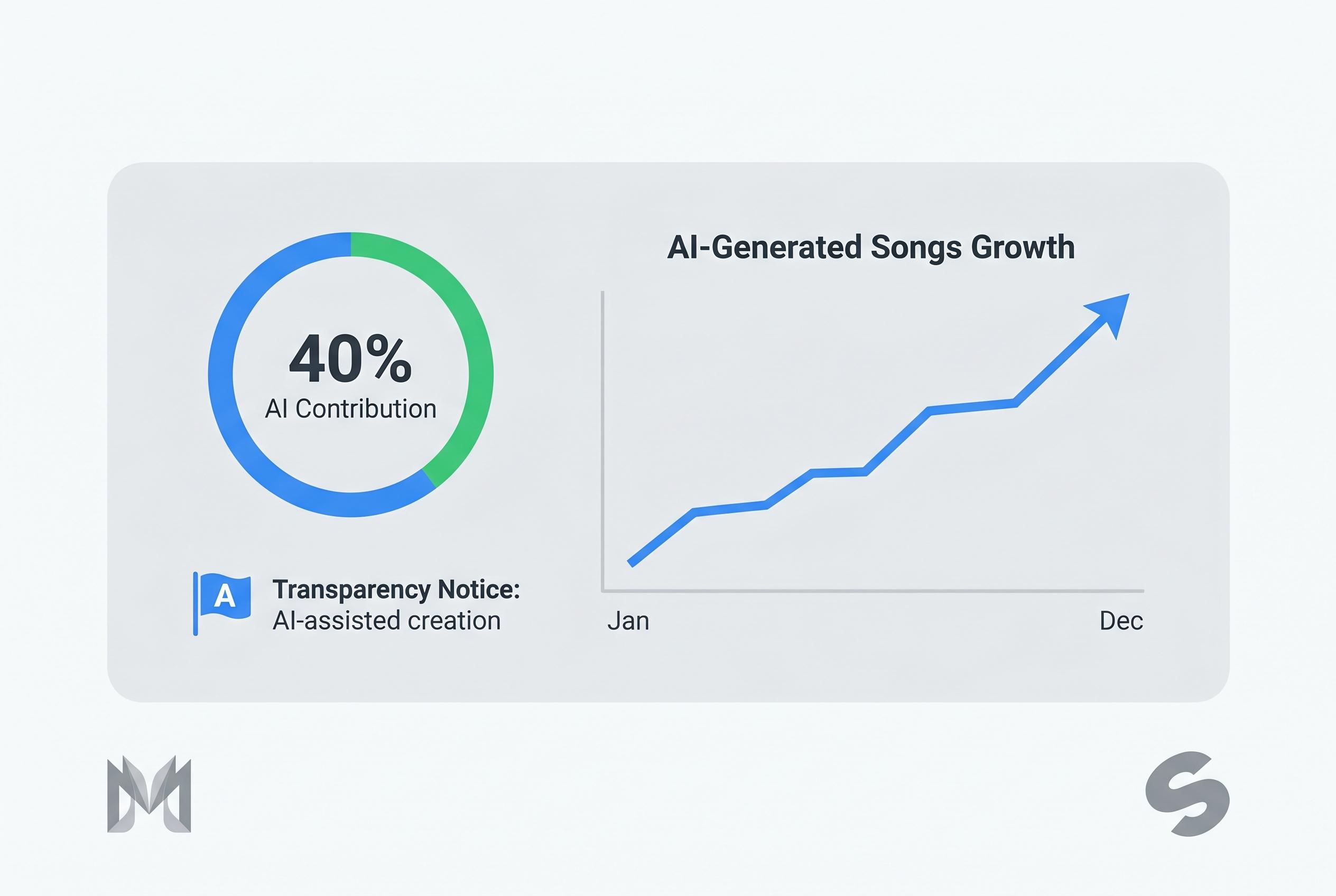
Spotify has begun trialling AI disclosures within song credits, enabling artists to flag AI involvement in recordings, as part of efforts to improve transparency and address concerns over synthetic music and impersonation in the industry.
Spotify has begun testing AI disclosures inside song credits, giving artists a way to flag where artificial intelligence was used in a recording, whether in vocals, lyrics or production. The labels appear in the Song Credits area on mobile and sit within a broader effort by the streaming service to address impersonation, spam and growing concern over opaque AI use in music.
The move comes as the volume of AI-made music accelerates across the industry. Deezer said in April 2026 that AI-generated tracks made up 44% of all new uploads to its platform, amounting to nearly 75,000 a day, even though they still accounted for only a small share of overall listening. Deezer said most of that traffic was fraudulent and demonetised, underlining the commercial and trust problems that have emerged as synthetic music has spread.

Spotify’s approach, however, depends on artists, labels and distributors choosing to disclose AI involvement, which means the system is only as complete as the information supplied to it. That leaves a significant gap: a blank credit line does not necessarily mean AI was absent. Deezer’s earlier figures point to the scale of the challenge, with the company saying fully AI-generated uploads rose from 10% of new music in January 2025 to 18% by April 2025, before climbing to 28% of music delivered to streaming by September 2025. Deezer has positioned itself as a more aggressive enforcer, using detection tools to exclude fully AI-generated tracks from recommendations and offering its technology to others in the industry.
The wider debate is no longer just about whether AI is present in music, but how listeners can be told about it in a way that is consistent across platforms. Deezer said in late 2025 that a survey across eight countries found 97% of respondents could not tell the difference between fully AI-generated and human-made music, adding weight to calls for clearer labelling. Spotify’s disclosure beta sits alongside other transparency efforts, including its own SongDNA feature, which maps songwriters, producers, samples and collaborations, suggesting the platform is building a broader framework around credit and provenance rather than a single AI label alone.
For now, the beta marks an incremental step rather than a definitive solution. Spotify is betting that disclosure tools can improve trust without imposing a rigid detection regime, but the company has also acknowledged that industry-wide alignment will be needed if AI transparency is to work reliably across streaming services.
Source Reference Map
Inspired by headline at: [1]
Sources by paragraph:
Source: Noah Wire Services
Noah Fact Check Pro
The draft above was created using the information available at the time the story first
emerged. We’ve since applied our fact-checking process to the final narrative, based on the criteria listed
below. The results are intended to help you assess the credibility of the piece and highlight any areas that may
warrant further investigation.
Freshness check
Score:
8
Notes:
The article reports on Spotify’s recent beta feature for AI disclosures in song credits, launched in April 2026. This development is corroborated by Spotify’s official announcement from September 2025, detailing their commitment to AI transparency. ([newsroom.spotify.com](https://newsroom.spotify.com/2025-09-25/spotify-strengthens-ai-protections/?utm_source=openai)) The RouteNote blog post provides additional context and details about the feature. No significant discrepancies or signs of recycled content were identified. However, the reliance on a single source for the feature’s details raises concerns about the originality and independence of the reporting. The article does not mention any earlier publications of this specific information. Given the recent nature of the announcement, the freshness score remains high. Nonetheless, the lack of independent verification sources slightly reduces the score.
Quotes check
Score:
7
Notes:
The article includes direct quotes from Spotify’s official announcement, such as:
> “Starting today, we’re launching a beta feature that allows artists to share how they’ve used AI in their music.”
These quotes are consistent with Spotify’s official statements. However, the absence of independent verification or additional sources for these quotes raises concerns about their authenticity. Without corroboration from other reputable outlets, the reliability of these quotes is uncertain.
Source reliability
Score:
6
Notes:
The primary source is RouteNote, a music distribution platform. While it provides detailed information about Spotify’s new feature, its proximity to the music industry and potential vested interests may affect its objectivity. The article does not reference any independent or third-party sources to verify the claims made. The lack of external verification diminishes the overall reliability of the source.
Plausibility check
Score:
8
Notes:
The article’s claims align with known industry trends, such as the increasing integration of AI in music production and the push for transparency in AI-generated content. Spotify’s initiative to disclose AI usage in song credits is plausible and consistent with their previous commitments to AI transparency. However, the absence of independent verification or additional reporting on this specific feature raises questions about the completeness and accuracy of the information presented.
Overall assessment
Verdict (FAIL, OPEN, PASS): FAIL
Confidence (LOW, MEDIUM, HIGH): MEDIUM
Summary:
The article reports on Spotify’s recent beta feature for AI disclosures in song credits, launched in April 2026. While the information aligns with Spotify’s official announcement from September 2025, the reliance on a single source (RouteNote) without independent verification raises concerns about the originality, independence, and accuracy of the reporting. The absence of corroborating sources and the potential vested interest of RouteNote in promoting the feature further diminish the reliability of the content. Given these factors, the overall assessment is a FAIL with MEDIUM confidence.
