


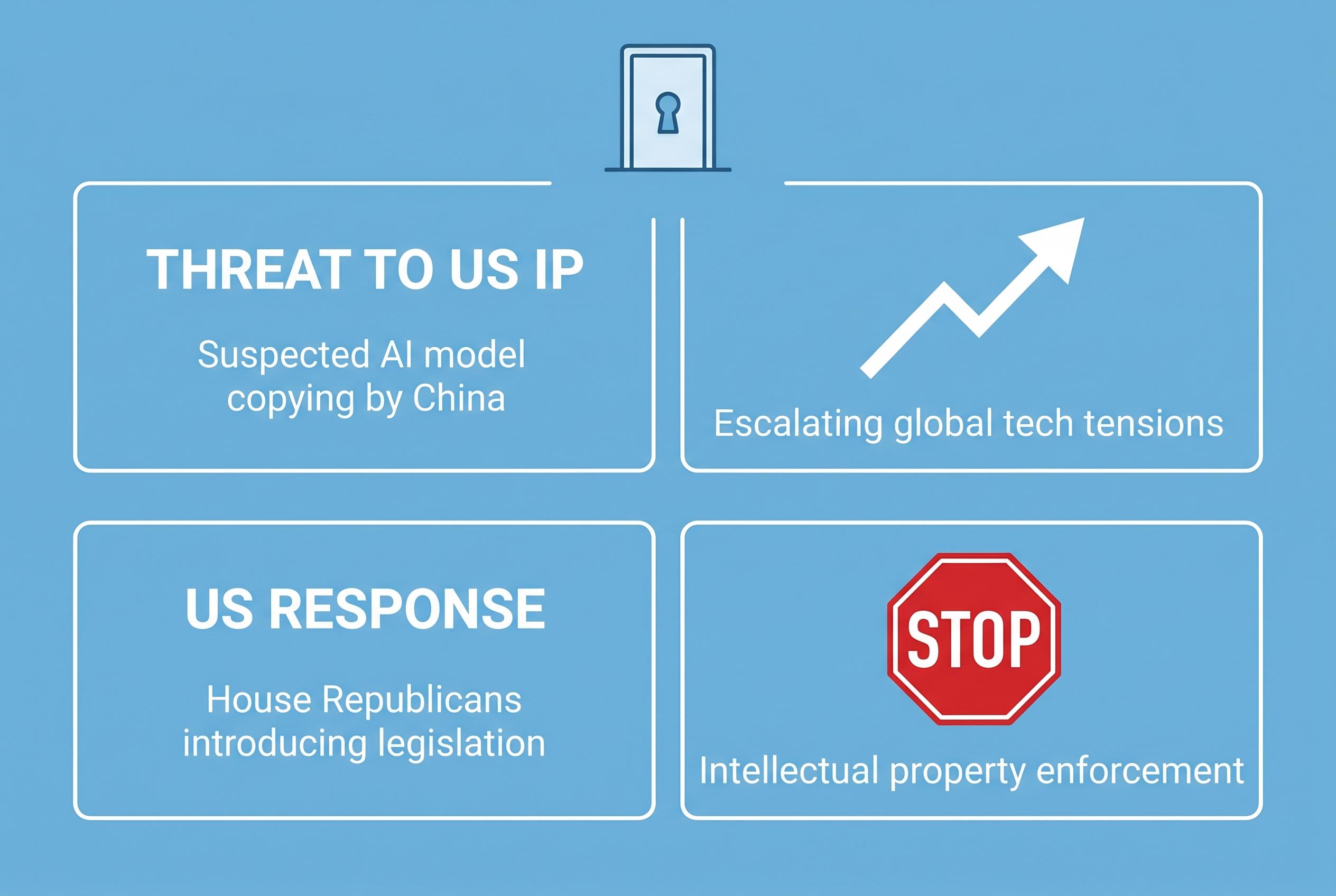
House Republicans plan legislation to target Chinese and Russian entities accused of copying US AI models, signalling an escalation in the tech competition and intellectual property enforcement.
House Republicans are moving to tighten pressure on Chinese artificial intelligence firms that Washington suspects of copying US-made models, in a sign that the fight over AI competition is broadening from chips and exports into model theft and reuse.
According to Bloomberg, Rep. Bill Huizenga of Michigan has drafted legislation that would require the government to identify Chinese and Russian entities using so-called query-and-copy methods against American AI systems. The proposal would also open the door to sanctions, including placement on the Commerce Department’s blacklist and restrictions under presidential emergency economic powers first created in 1977. The bill, titled the Deterring American AI Model Theft Act, is expected to come before the House Foreign Affairs Committee next week.

The move comes after a series of allegations from US AI companies that Chinese developers have been using their systems to build cheaper rival products. Anthropic said in February that Chinese startups created 24,000 fraudulent accounts to train competing models on its technology, while Google’s Threat Intelligence Group has warned of rising model extraction and distillation attacks. In its own research note, Google said companies offering AI models as a service should actively monitor access patterns that may indicate attempts to replicate protected capabilities.
Bloomberg said the bill could affect companies including DeepSeek, Moonshot and MiniMax, names that have already surfaced in accusations of model borrowing. Anthropic has argued that these practices amount to industrial-scale copying rather than ordinary model development, and that the techniques are being used to sidestep both export controls and commercial restrictions. Huizenga described the issue as a form of economic coercion and intellectual property theft, saying American AI systems are generating sensitive cyber capabilities that should not be allowed to fall into Chinese hands.
Source Reference Map
Inspired by headline at: [1]
Sources by paragraph:
Source: Noah Wire Services
Noah Fact Check Pro
The draft above was created using the information available at the time the story first
emerged. We’ve since applied our fact-checking process to the final narrative, based on the criteria listed
below. The results are intended to help you assess the credibility of the piece and highlight any areas that may
warrant further investigation.
Freshness check
Score:
8
Notes:
The article was published on April 16, 2026, and reports on recent legislative developments concerning Chinese AI firms allegedly copying US models. The content appears to be original and timely, with no evidence of prior publication or significant recycling from other sources. However, the article heavily relies on a Bloomberg report from the same date, which may indicate limited independent sourcing.
Quotes check
Score:
7
Notes:
The article includes direct quotes attributed to Rep. Bill Huizenga and references statements from Anthropic. While these quotes are consistent with other reports from the same date, they cannot be independently verified without access to the original sources. The reliance on a single Bloomberg report raises concerns about the originality and independence of the quotes.
Source reliability
Score:
6
Notes:
The primary source is a Bloomberg report, which is a reputable news organization. However, the article’s heavy dependence on this single source, without additional independent verification or corroboration, reduces the overall reliability. The lack of diverse sources and the absence of direct access to the original statements from Rep. Huizenga and Anthropic further diminish the source reliability.
Plausibility check
Score:
7
Notes:
The claims about Rep. Huizenga’s proposed legislation and Anthropic’s allegations against Chinese AI firms are plausible and align with known industry concerns. However, the article provides limited details on the legislative process and lacks direct quotes from the involved parties, making it difficult to fully assess the accuracy and depth of the reporting.
Overall assessment
Verdict (FAIL, OPEN, PASS): FAIL
Confidence (LOW, MEDIUM, HIGH): MEDIUM
Summary:
The article presents timely information on legislative actions concerning Chinese AI firms and their alleged use of US models. However, it heavily relies on a single Bloomberg report, lacks independent verification, and provides limited direct quotes from the involved parties. These factors raise concerns about the originality, source independence, and overall reliability of the content. Editors should exercise caution and seek additional independent sources before publishing.
