


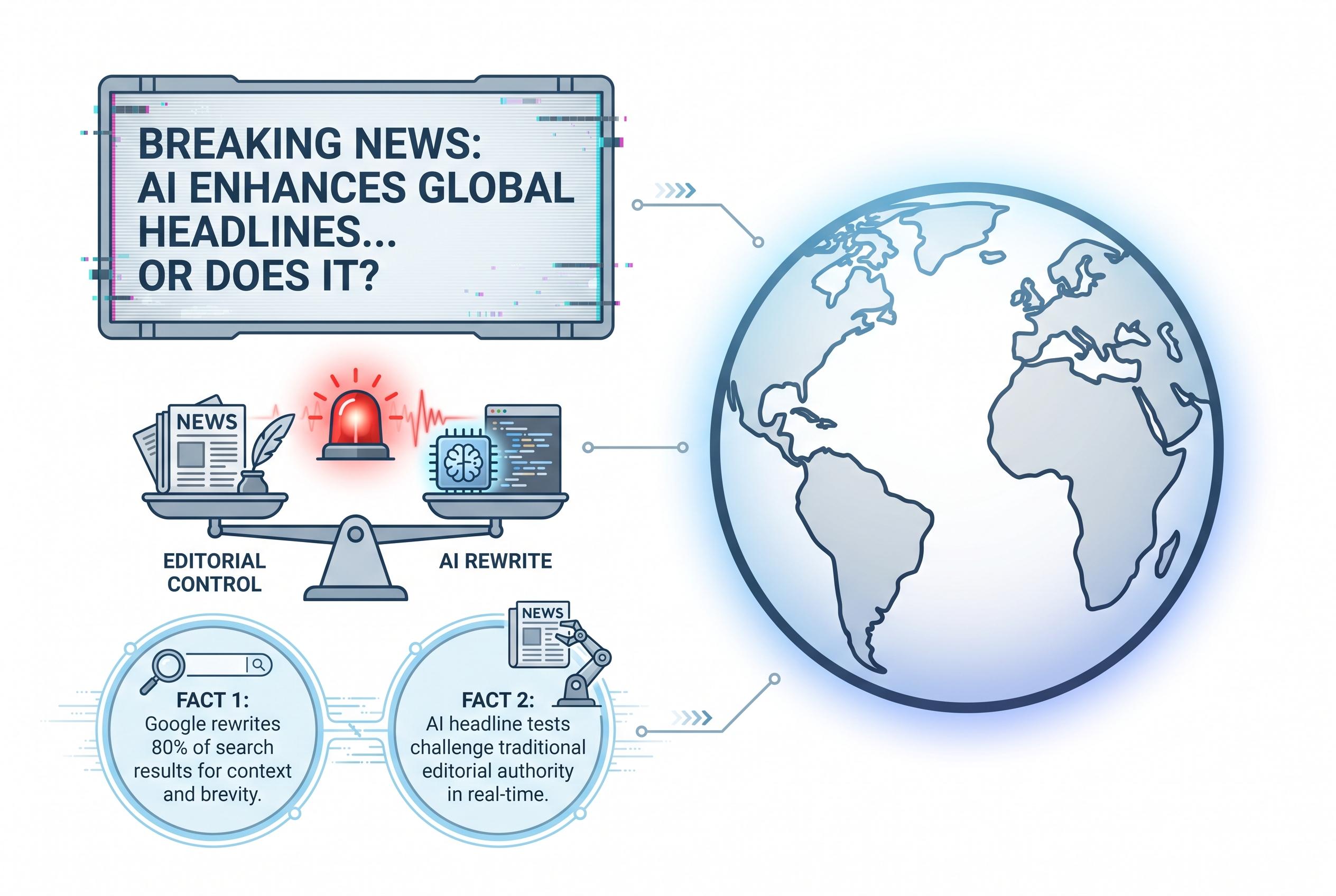
Google’s experiments with AI-powered headline rewrites and summarisation in search results are raising concerns among publishers, reshaping how news is presented and challenging traditional editorial authority amid legal and regulatory pressures.
Google’s growing habit of rewriting and repackaging news headlines is unsettling publishers who have long relied on search traffic as a form of audience currency. What once felt like a straightforward bargain, in which outlets optimised their stories for Google in return for visibility, is increasingly looking one-sided: the search giant is now shaping how articles are presented to users, sometimes with AI-generated language that newsrooms say strips away context and weakens their ability to market their own reporting. According to CJR and industry commentators, that shift is forcing SEO teams to rethink not only tactics but their place inside the newsroom.
The latest flashpoint came when Google was reported to be testing headline rewrites in search results using large language models. The Verge found that one of its article titles had been altered by Google in a way that changed both tone and emphasis, prompting criticism that the company was effectively editing publishers’ work without permission. Google has said the experiment was limited, that it was designed to help users find relevant pages, and that it has no immediate plan to roll it out more broadly, though it continues to run large numbers of live tests.

That experiment follows earlier changes in Google Discover, which began using headline summaries in January and has already produced visibly wrong or misleading wording in some cases. Reporting cited by CJR and others showed examples where Discover supplied titles that did not match the underlying article, intensifying publisher concerns that AI systems are not just surfacing journalism but actively rebranding it. For news organisations, the issue is not only accuracy; it is also the loss of editorial control over how a story is framed before a reader ever clicks through.
The problem is sharpened by the scale of Google’s other AI features. AI Overviews, introduced in 2024, now place machine-written summaries at the top of search results, and a New York Times report last week suggested that about one in ten answers in those summaries was incorrect. Google is also testing Web Guide, a search tool built around Gemini that replaces its existing ranking approach with AI-generated groupings and descriptions. Together, these products suggest a broader shift away from Google acting as a neutral index and towards a more editorial role in presenting information.
That transformation is feeding legal and regulatory pressure. Last month, a judge dismissed an antitrust case brought by two small publishers, who argued that Google had monopoly power in search and had become “America’s largest news publisher” by exploiting their work. In remarks reported by the Seattle Times, one of the plaintiffs said Google was using its search and AI tools to benefit from publishers’ labour without paying for it. Press-freedom advocates, including Reporters Without Borders, have also criticised the headline-rewriting tests as an intrusion into editorial territory that platforms should not occupy.
For SEO editors, the practical response is becoming diversification. Journalists who once focused almost entirely on pleasing Google are now being pushed to look at Reddit, direct audience relationships and other referral channels, even as search remains important. Shelby Blackley of The Athletic and Jessie Willms, who co-founded the newsletter WTF Is SEO?, argue that the role is changing from one of search optimisation alone to one of broader audience strategy. Their view is that the old assumption of partnership with Google is fading, and that newsrooms need to treat visibility, trust and distribution as connected rather than separate problems.
Source Reference Map
Inspired by headline at: [1]
Sources by paragraph:
Source: Noah Wire Services
Noah Fact Check Pro
The draft above was created using the information available at the time the story first
emerged. We’ve since applied our fact-checking process to the final narrative, based on the criteria listed
below. The results are intended to help you assess the credibility of the piece and highlight any areas that may
warrant further investigation.
Freshness check
Score:
8
Notes:
The article was published on April 16, 2026, and discusses recent developments regarding Google’s AI-driven headline rewriting in search results. Similar reports from March 2026 indicate that this is a recent and ongoing issue. ([techrepublic.com](https://www.techrepublic.com/article/news-google-search-rewriting-headlines-ai/?utm_source=openai))
Quotes check
Score:
7
Notes:
The article includes direct quotes from Shelby Blackley and Jessie Willms, co-founders of the newsletter WTF Is SEO?. These quotes are consistent with their public statements in other sources. However, the exact dates of these statements are not specified, making it difficult to verify their freshness.
Source reliability
Score:
9
Notes:
The article is published by the Columbia Journalism Review (CJR), a reputable publication known for its in-depth analysis of media and journalism. The information aligns with reports from other reputable sources, such as The Verge and TechRepublic. ([techrepublic.com](https://www.techrepublic.com/article/news-google-search-rewriting-headlines-ai/?utm_source=openai))
Plausibility check
Score:
8
Notes:
The claims about Google’s AI rewriting news headlines are plausible and supported by multiple reputable sources. ([techrepublic.com](https://www.techrepublic.com/article/news-google-search-rewriting-headlines-ai/?utm_source=openai)) The concerns raised by industry professionals about the impact on journalistic integrity are reasonable and consistent with the reported developments.
Overall assessment
Verdict (FAIL, OPEN, PASS): PASS
Confidence (LOW, MEDIUM, HIGH): MEDIUM
Summary:
The article provides a timely and well-sourced analysis of Google’s AI-driven headline rewriting in search results. While the direct quotes from industry professionals are consistent with their public statements, the lack of specific dates for these statements introduces a slight uncertainty. Overall, the article is credible and offers valuable insights into the ongoing developments in news SEO.
