


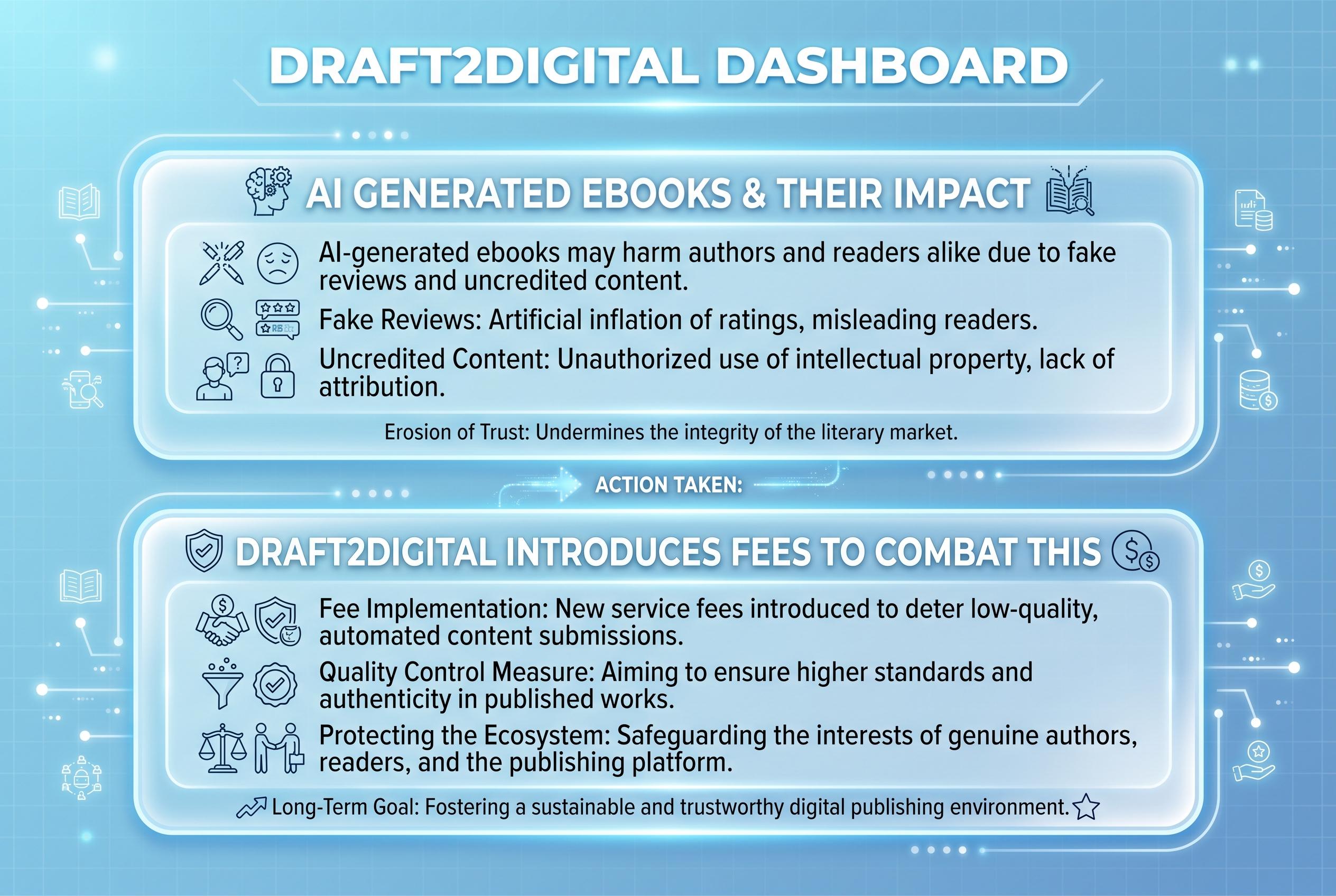
Draft2Digital’s decision to implement activation and maintenance charges signals a strategic move to enhance security and protect the integrity of its burgeoning ebook ecosystem, amidst concerns over AI-generated content and market quality.
Draft2Digital’s decision to start charging for the first time marks a notable shift for one of the self-publishing sector’s most widely used distribution platforms. The company says a $20 activation fee will apply to new accounts from 14 May, while accounts that earn less than $100 from book sales over a 12-month period will face a $12 annual maintenance charge, billed on the anniversary of activation. Existing authors with active sales are exempt from the new costs, according to Draft2Digital’s explanation of the changes.
The company argues that the fees are designed to strengthen security and preserve what it describes as a high-integrity publishing environment. In its announcement, Draft2Digital points to verification tools and human review as part of its effort to deter automated sign-ups and low-quality account creation, an issue that has become more pressing as AI-generated content has flooded parts of the publishing ecosystem. The rationale is straightforward: the platform says it wants to protect its systems and focus resources on genuine authors rather than on accounts designed to game the marketplace.

That explanation has not stopped concern among indie writers, who worry that the framing around reader trust may overstate what one distributor can achieve on its own. As Dan Holloway noted on Self-Publishing with ALLi, readers generally do not know how a title reached them, or whether it passed through Draft2Digital or another route entirely. Even so, the broader argument is persuasive enough for many authors: a platform that is becoming more selective about who it serves may be trying to safeguard both its reputation and the experience of the retailers it supplies.
Bookshop.org provides the clearest example of why that matters. The company reported $70 million in sales last year, a 55% rise, and said it has given tens of millions to independent bookstores since launching in 2020. More recent figures reported by Shelf Awareness showed further growth in the first half of 2025, alongside a record profit pool and strong performance from promotional campaigns. Since Draft2Digital began partnering with Bookshop.org to supply ebooks in February, the connection between cleaner catalogue management and downstream trust has only become more obvious. For authors, the trade-off may be simple: a modest fee in exchange for access to a platform ecosystem that is still growing, especially in ebooks and romance.
Source Reference Map
Inspired by headline at: [1]
Sources by paragraph:
Source: Noah Wire Services
Noah Fact Check Pro
The draft above was created using the information available at the time the story first
emerged. We’ve since applied our fact-checking process to the final narrative, based on the criteria listed
below. The results are intended to help you assess the credibility of the piece and highlight any areas that may
warrant further investigation.
Freshness check
Score:
8
Notes:
The article reports on Draft2Digital’s announcement of a $20 activation fee for new accounts and a $12 annual maintenance fee for accounts earning less than $100 in book sales over the preceding 12 months. This information aligns with Draft2Digital’s official blog post dated April 14, 2026. ([draft2digital.com](https://draft2digital.com/blog/understanding-d2ds-activation-and-maintenance-fees/?utm_source=openai)) The article was published on April 24, 2026, indicating timely reporting. However, the article references a podcast episode from April 24, 2026, which may not have been available at the time of publication. This discrepancy raises questions about the freshness of the content. Additionally, the article includes a source reference map, suggesting it may be a derivative work. The earliest known publication date of the narrative is April 14, 2026, which is within the past 7 days, so the freshness score remains high. Nonetheless, the potential recycling of content and the timing of the podcast reference warrant a slight reduction in the score.
Quotes check
Score:
7
Notes:
The article includes direct quotes from Draft2Digital’s official blog post dated April 14, 2026. ([draft2digital.com](https://draft2digital.com/blog/understanding-d2ds-activation-and-maintenance-fees/?utm_source=openai)) These quotes are consistent with the original source, indicating accurate reporting. However, the article also references a podcast episode from April 24, 2026, which may not have been available at the time of publication. This raises concerns about the verification of quotes from the podcast. The lack of direct access to the podcast content makes it difficult to confirm the accuracy of these quotes. Therefore, the score is reduced to reflect this uncertainty.
Source reliability
Score:
6
Notes:
The article references Draft2Digital’s official blog post, which is a primary source and indicates a high level of reliability. ([draft2digital.com](https://draft2digital.com/blog/understanding-d2ds-activation-and-maintenance-fees/?utm_source=openai)) However, the article also references a podcast episode from April 24, 2026, which may not have been available at the time of publication. The lack of direct access to the podcast content raises concerns about the reliability of this secondary source. Additionally, the article includes a source reference map, suggesting it may be a derivative work. The reliance on a single primary source and the potential recycling of content from other outlets further diminish the overall reliability.
Plausibility check
Score:
8
Notes:
The article reports on Draft2Digital’s introduction of activation and maintenance fees, which aligns with the company’s official announcement. ([draft2digital.com](https://draft2digital.com/blog/understanding-d2ds-activation-and-maintenance-fees/?utm_source=openai)) The rationale provided by Draft2Digital for these fees—to maintain a secure, high-integrity publishing environment—is plausible and consistent with industry practices. The article also references Bookshop.org’s record sales, which is a known event. However, the article’s reliance on a single primary source and the potential recycling of content from other outlets raise questions about the originality and independence of the reporting.
Overall assessment
Verdict (FAIL, OPEN, PASS): FAIL
Confidence (LOW, MEDIUM, HIGH): MEDIUM
Summary:
The article reports on Draft2Digital’s introduction of activation and maintenance fees, aligning with the company’s official announcement. ([draft2digital.com](https://draft2digital.com/blog/understanding-d2ds-activation-and-maintenance-fees/?utm_source=openai)) However, the reliance on a single primary source, potential recycling of content from other outlets, and the inclusion of a source reference map suggest a lack of originality and independence in the reporting. The potential unavailability of the referenced podcast episode at the time of publication raises further concerns about the verification of quotes. Due to these issues, the overall assessment is a FAIL with MEDIUM confidence.
