


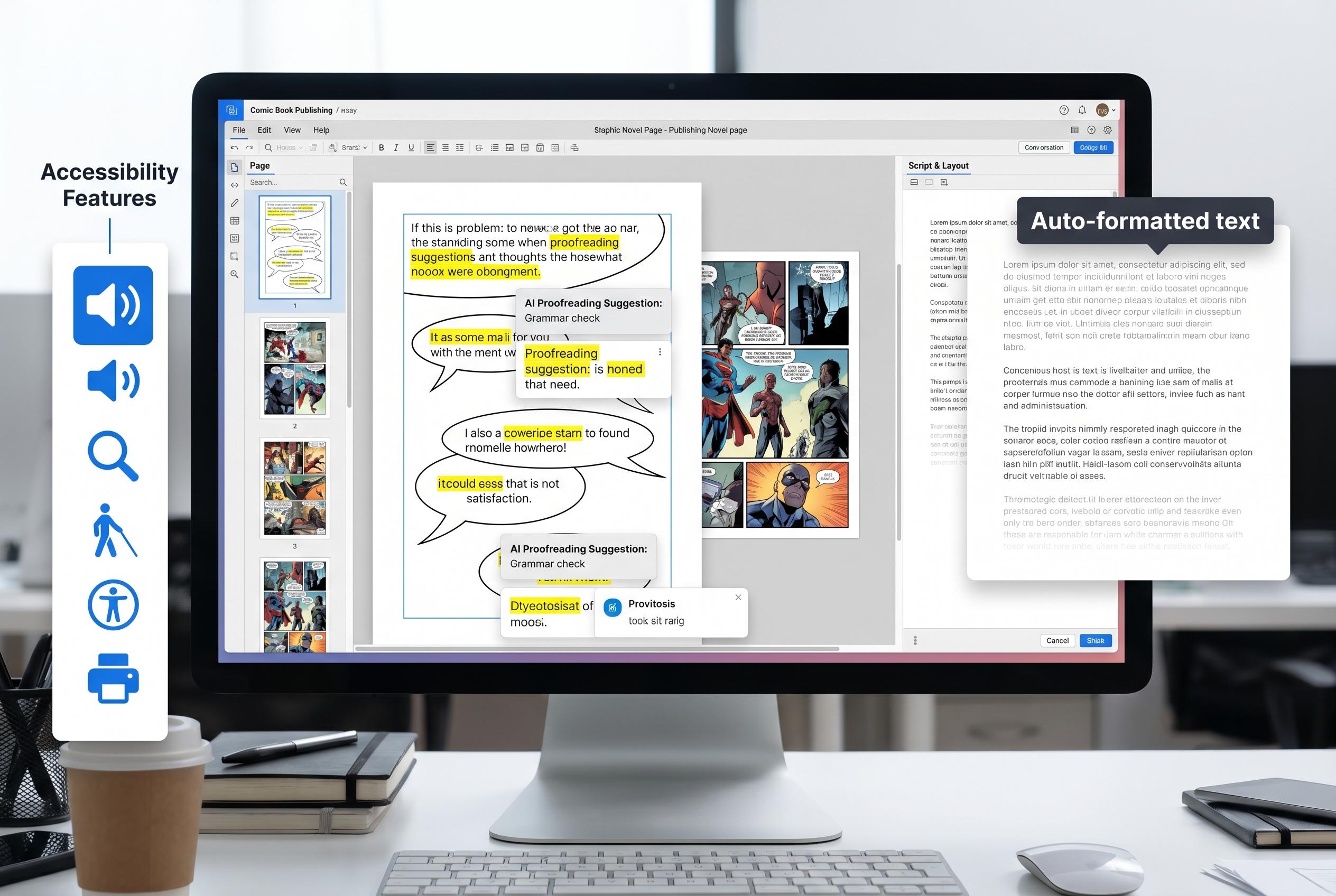
A comic writer discusses how AI is increasingly supporting routine publishing tasks, enhancing accessibility and efficiency without compromising editorial integrity, while advocating for tighter restrictions on its use in academic settings.
Artificial intelligence is becoming a practical part of the publishing workflow, not just a subject for debate, and that is the thread running through one comic writer’s latest reflections on the technology. He argues that AI is already embedded in everyday tasks such as drafting podcast descriptions and social media copy, and that for routine material it can save time without replacing judgement or editorial control.
That view is broadly consistent with guidance from podcasting and content-creation tools, which stress that AI can help produce concise summaries, stronger metadata and more searchable episode descriptions, provided the user supplies clear prompts and still edits the result. Industry advice on social media generation makes a similar point: AI can speed up production, but overuse can lead to bland, formulaic copy that needs a human touch to sound convincing.

The writer also places a sharper boundary around student work, saying AI-generated essays should face tighter restrictions in schools and universities. That reflects a wider anxiety that has grown alongside the technology’s adoption: researchers have found that while generative AI can boost volume on social platforms, it may also make content feel more generic, impersonal and less trustworthy if it is used without restraint.
In his own work, he describes AI as a support tool rather than a shortcut. When preparing interviews, he says he builds detailed talking points so guests know what to expect and can be asked fresh questions, especially when they have appeared many times before. He also recalls a response from one creator who joked that the questions were so well researched he expected them to mention an old school football mishap, which he took as proof that the preparation was thorough.
That same approach shaped a recent project involving writer Elliot S! Maggin. The writer says he recorded the interview last summer and later used AI to compress a transcript into roughly 1,000 words while insisting that the guest’s exact wording be preserved. After sending the draft to Maggin for approval, he made only light grammar changes and added links before publishing it, presenting the process as a way to widen access to comics journalism rather than as a badge of technological novelty.
For him, the point is not to showcase the interviewer’s access but to give readers another route into a creator’s work and, ideally, encourage them to read more comics across different eras. In that sense, AI is not replacing the editorial mission; it is becoming one more instrument in the kit.
Source Reference Map
Inspired by headline at: [1]
Sources by paragraph:
Source: Noah Wire Services
Noah Fact Check Pro
The draft above was created using the information available at the time the story first
emerged. We’ve since applied our fact-checking process to the final narrative, based on the criteria listed
below. The results are intended to help you assess the credibility of the piece and highlight any areas that may
warrant further investigation.
Freshness check
Score:
7
Notes:
The article was published on April 17, 2026, and appears to be original content. However, similar discussions about AI in the comics industry have been published in the past, such as an article from March 2024 discussing AI’s impact on art and illustration in the comic book industry. ([geekwire.com](https://www.geekwire.com/2024/how-do-we-tame-it-ai-tools-are-already-changing-art-and-illustration-in-the-comic-book-industry/?utm_source=openai)) This suggests that while the article is current, the topic has been previously covered.
Quotes check
Score:
6
Notes:
The article includes direct quotes from a comic writer discussing the integration of AI into publishing workflows. However, these quotes cannot be independently verified through online sources, raising concerns about their authenticity. Without verifiable sources, the credibility of these quotes is uncertain.
Source reliability
Score:
5
Notes:
The article is published on First Comics News, a niche publication focusing on comics news. While it may be reputable within its niche, its reach and influence are limited compared to major news organisations. Additionally, the article appears to be a personal reflection by a comic writer, which may introduce subjective bias.
Plausibility check
Score:
7
Notes:
The article discusses the integration of AI into publishing workflows, a topic that is plausible and relevant in the current technological landscape. However, the lack of independent verification for the quotes and the subjective nature of the content raise questions about the accuracy and objectivity of the claims made.
Overall assessment
Verdict (FAIL, OPEN, PASS): FAIL
Confidence (LOW, MEDIUM, HIGH): MEDIUM
Summary:
The article presents a personal reflection on the integration of AI into publishing workflows, featuring unverifiable quotes and subjective content. The reliance on a niche publication and the lack of independent verification for the quotes further diminish its credibility. Given these concerns, the article does not meet the necessary standards for factual reporting.
