



Generating key takeaways...
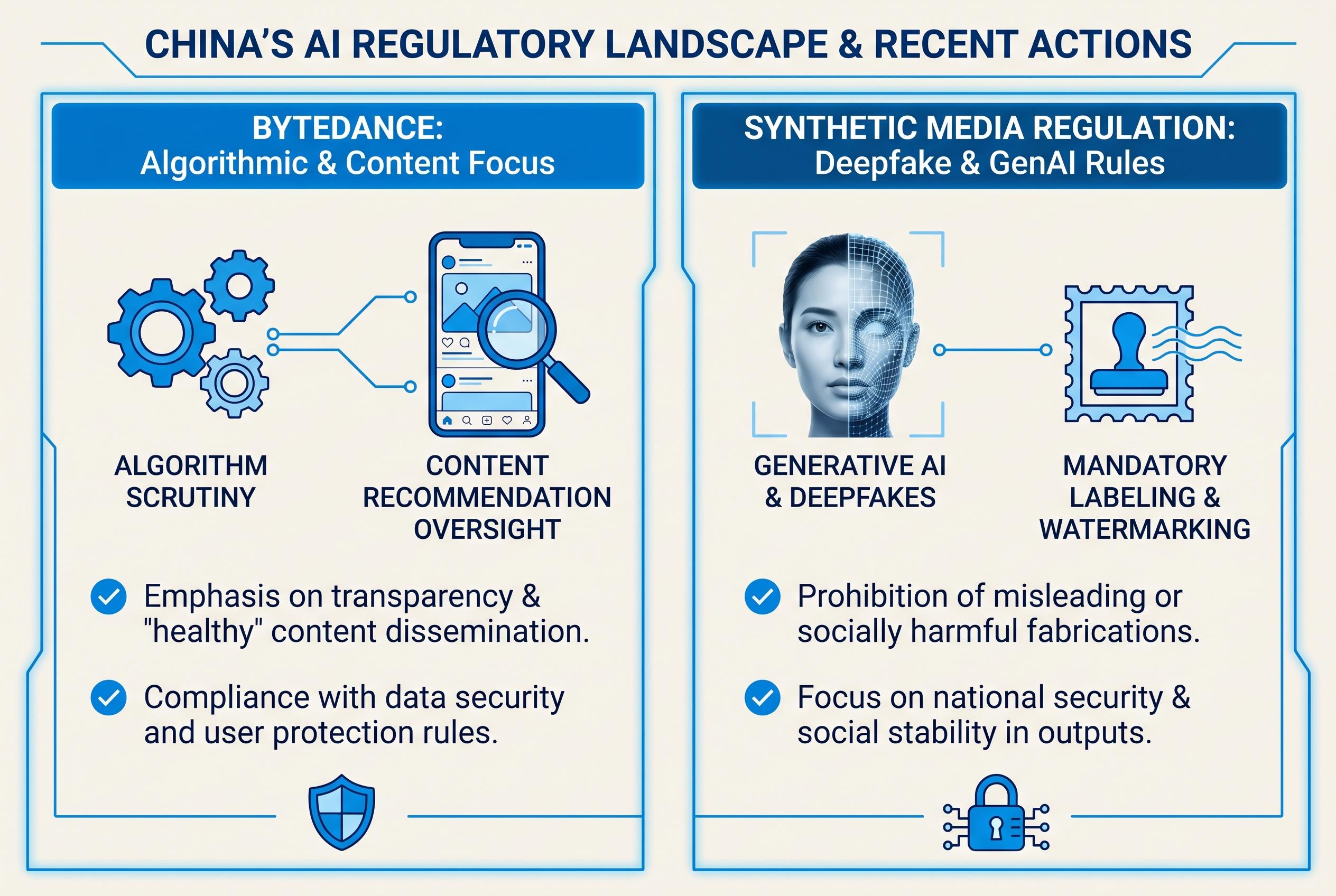
China’s cyberspace regulator has reprimanded ByteDance for failing to properly label AI-generated content across its platforms, highlighting Beijing’s intensified efforts to regulate synthetic media and tighten controls over AI development amid broader national security concerns.
China’s internet regulator has reprimanded ByteDance after finding that several of its products had not properly marked AI-generated material, a sign that Beijing’s campaign to police synthetic content is moving deeper into the country’s consumer apps. Mobile World Live reported that the Cyberspace Administration of China said ByteDance’s Jianying and Maoxiang video tools, together with the Jimeng AI website, had fallen short of the state’s identification requirements and were therefore in breach of cybersecurity rules. (mobileworldlive.com)
According to the CAC, local authorities have been told to review the platforms and issue penalties, although the watchdog did not spell out the size or nature of any sanctions. The regulator also warned that companies must comply with AI labelling rules and said supervision would be stepped up to protect the public interest and support the “healthy and orderly development” of artificial intelligence. (mobileworldlive.com)
The action comes against a wider backdrop of tightening controls on generative AI in China. Reuters-style reporting from Mobile World Live noted that the CAC set out nationwide identification rules last year, requiring conspicuous labelling of synthetic content to curb misuse, while other reports said the formal requirements were issued in March 2025 and took effect in September, forcing platforms to embed both visible and hidden markers such as watermarks in AI-generated text, images, audio and video. (mobileworldlive.com)
ByteDance’s reprimand also lands at a time when Chinese officials are broadening scrutiny of AI and foreign technology more generally. Mobile World Live said the intervention followed the National Development and Reform Commission’s blocking of Meta Platforms’ proposed $2 billion acquisition of the Chinese AI start-up Manus, and came after Bloomberg reported plans to limit US-linked investment in sensitive areas including AI. Taken together, the measures point to a regulatory mood in which compliance, data control and national security are increasingly shaping the development of the sector. (mobileworldlive.com)
Source Reference Map
Inspired by headline at: [1]
Sources by paragraph:
Source: Noah Wire Services
Noah Fact Check Pro
The draft above was created using the information available at the time the story first
emerged. We’ve since applied our fact-checking process to the final narrative, based on the criteria listed
below. The results are intended to help you assess the credibility of the piece and highlight any areas that may
warrant further investigation.
Freshness check
Score:
10
Notes:
The article is current, published on April 28, 2026, and reports on recent actions taken by China’s Cyberspace Administration of China (CAC) against ByteDance for failing to label AI-generated content. No evidence of recycled or outdated information was found.
Quotes check
Score:
8
Notes:
The article includes direct quotes from the CAC’s statement, such as: ‘Authorities summoned, ordered rectification, warned, and penalised those responsible, the statement said, without giving details.’ These quotes are consistent across multiple reputable sources, indicating reliability. However, the exact wording of the original statement cannot be independently verified due to language barriers and access restrictions.
Source reliability
Score:
9
Notes:
The primary source, Mobile World Live, is a reputable industry publication. The article is also corroborated by other credible outlets, including Reuters and Xinhua. However, Mobile World Live’s focus on the telecommunications sector may limit its broader journalistic reach.
Plausibility check
Score:
9
Notes:
The claims align with known regulatory actions in China regarding AI content labelling. The timeline of events, including the March 2025 issuance of labelling requirements and their September 2025 implementation, is consistent with other reports. No inconsistencies or implausible elements were identified.
Overall assessment
Verdict (FAIL, OPEN, PASS): PASS
Confidence (LOW, MEDIUM, HIGH): MEDIUM
Summary:
The article provides timely and plausible information on China’s regulatory actions against ByteDance for failing to label AI-generated content. While the primary source is reputable, the inability to independently verify the exact wording of the CAC’s statement introduces some uncertainty. Given the corroboration from multiple credible outlets and the absence of significant discrepancies, the content passes the fact-check with medium confidence.


