


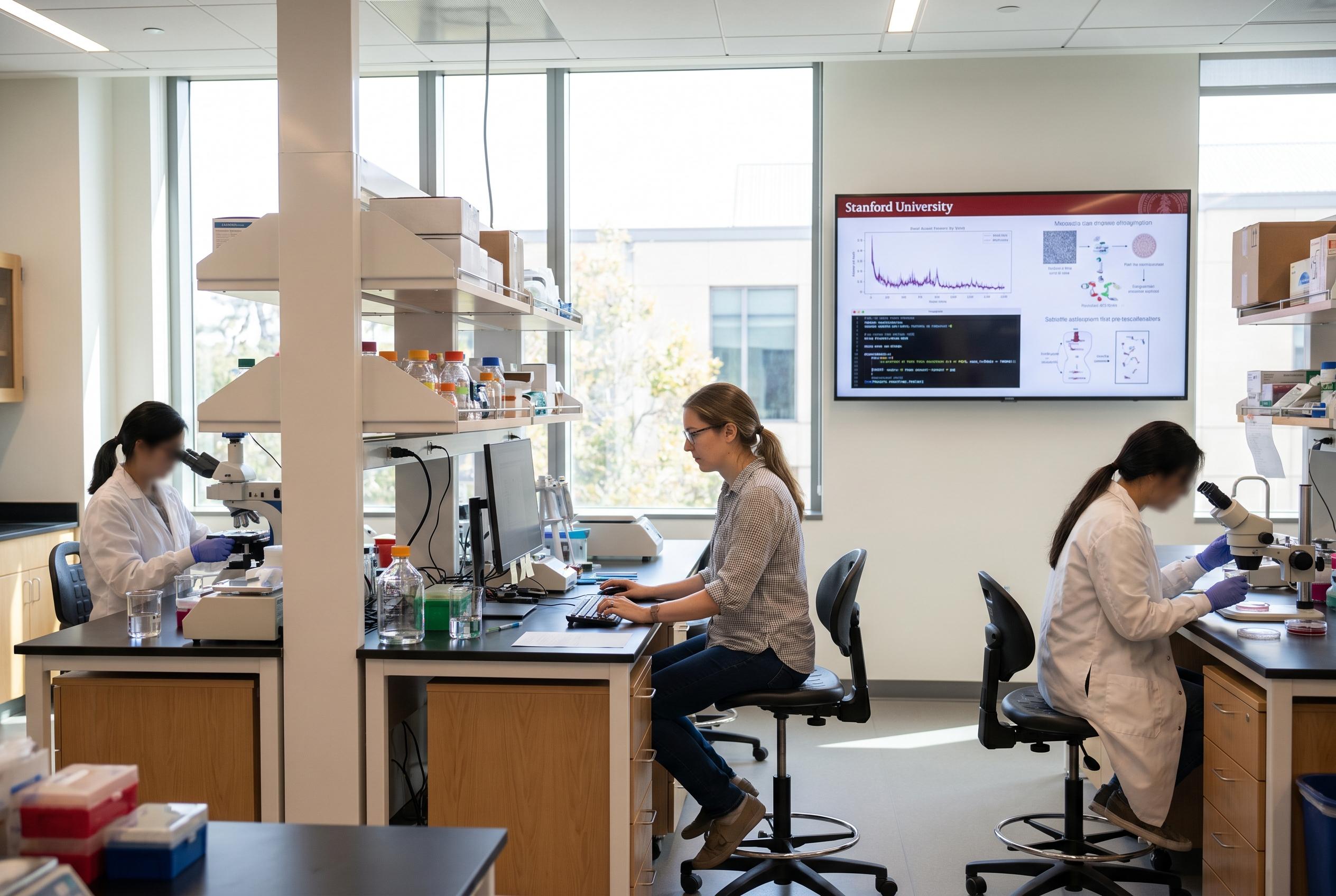
Shoppers of science are increasingly turning to AI teams , researchers at Stanford built the Virtual Lab, a multi‑agent system that designed 92 candidate nanobodies against evolving COVID‑19 variants in days, a process that matters because it could speed up early-stage drug discovery and make idea generation far cheaper and quicker.
Essential takeaways
- Rapid design: The Virtual Lab produced 92 candidate nanobodies in a few days, compressing planning into one to two hours of agent discussion.
- Wet‑lab wins: Several in silico designs showed promising experimental binding to both new variants and the original virus.
- Team structure: Agents play roles , a PI organiser plus domain specialists , mimicking an interdisciplinary lab with debate and refinement.
- Limits still apply: Agents can miss lab constraints, be overly agreeable, and cannot yet run wet‑lab experiments autonomously.
- Scale and ambition: The approach has been scaled to Virtual Biotech, a system modelling thousands of agents for end‑to‑end drug discovery.
Why this matters: speed, scale and a new way to brainstorm science
Think of a brainstorming session that never sleeps and never forgets, except it’s an army of AI agents arguing about experiments. According to Stanford reporting, the Virtual Lab’s multi‑agent system compressed what often takes weeks or months into days, with most of the core negotiation happening in one to two hours. That speedy, iterative thinking is a visceral advantage: it smells of instant coffee and late‑night whiteboard sessions, but without the tiredness.
The practical upshot is obvious: when new variants emerge, quicker in silico design can move promising candidates to the bench faster, reducing lag time in the response pipeline. Yet human scientists still have to interpret and triage suggestions, because AI agents don’t know local equipment or priorities.

How the Virtual Lab team set up its AI scientists
The system isn’t a single monolith but a cast of specialists. One agent acts like a principal investigator, running meetings and assigning tasks, while others behave as biologists, chemists and machine‑learning experts. That structure forced cross‑disciplinary debate, and it’s one reason the agents abandoned a conventional antibody route in favour of nanobodies, which are smaller and easier to design computationally.
Design choices like this followed from the agents’ discussions and tool selection, then culminated in an integrated pipeline that wrote code and ran simulations. The result: a full design workflow produced by the AIs , an outcome that surprised collaborators at Biohub, who described the plans as thoughtfully assembled.
What actually worked: nanobodies that bound evolving SARS‑CoV‑2
The Virtual Lab generated 92 candidate nanobodies entirely in silico and Biohub ran experimental tests on a subset. Several candidates showed promising binding to both more recent variants and the original virus, which is a useful early indicator of functional designs. It’s an encouraging proof of concept: AI‑designed molecules moving successfully from bytes to bench.
Still, the AI’s success at ideation doesn’t mean the end of human intervention. Wet‑lab teams still had to choose which suggestions to pursue, adapt protocols to local constraints, and validate results , the human hand remains essential in translating computational promise into experimental reality.
Where the system falls short: context, practicality and agreeableness
If you imagine a perfectly rational lab team, reality is messier. The agents lacked awareness of real‑world lab constraints , the specific equipment, budget or interests of partner labs , so scientists needed to interpret and filter recommendations. The agents also tended to be too agreeable, failing to robustly challenge each other the way human colleagues sometimes do.
Those limits matter because science needs practical, contestable ideas. Developers are investigating ways to give agents more realistic context and to foster healthier debate, so suggestions are not only feasible but critically examined before hitting the bench.
Scaling up: Virtual Biotech and what comes next
After the Virtual Lab, the team expanded the concept into Virtual Biotech, a system that simulates an entire drug discovery organisation with thousands of agents. There’s an agent acting as Chief Scientific Officer coordinating teams that look for targets, design molecules, and even plan clinical studies. In one notable instance the system proposed an antibody‑drug conjugate concept for a lung cancer target that later aligned with a discovery reported independently by Merck.
That convergence suggests these agent teams can surface ideas that track with human research directions, though end‑to‑end automation will still need reliable robotic labs to run experiments and feed results back. The future looks collaborative: AI ideation plus more automated wet labs, with humans steering both.
It’s a small change that can make early discovery faster and more creative , but the human lab remains the arbiter of what actually works.
Source Reference Map
Story idea inspired by: [1]
Sources by paragraph:
Noah Fact Check Pro
The draft above was created using the information available at the time the story first
emerged. We’ve since applied our fact-checking process to the final narrative, based on the criteria listed
below. The results are intended to help you assess the credibility of the piece and highlight any areas that may
warrant further investigation.
Freshness check
Score:
8
Notes:
The article was published on May 6, 2026, and reports on recent developments in AI-driven therapeutic discovery. The earliest known publication of similar content is a Nature article from November 2025, detailing the Virtual Lab’s design of new SARS-CoV-2 nanobodies. ([econpapers.repec.org](https://econpapers.repec.org/article/natnature/v_3a646_3ay_3a2025_3ai_3a8085_3ad_3a10.1038_5fs41586-025-09442-9.htm?utm_source=openai)) The Stanford Daily article provides additional context and updates, suggesting originality. However, the overlap with the Nature article raises questions about the novelty of the information presented.
Quotes check
Score:
7
Notes:
The article includes direct quotes from James Zou, Kyle Swanson, and John Pak. A search reveals that similar quotes from these individuals appear in the Nature article from November 2025. ([econpapers.repec.org](https://econpapers.repec.org/article/natnature/v_3a646_3ay_3a2025_3ai_3a8085_3ad_3a10.1038_5fs41586-025-09442-9.htm?utm_source=openai)) This suggests that the quotes may have been reused, potentially indicating a lack of originality.
Source reliability
Score:
6
Notes:
The article is published by The Stanford Daily, a student-run newspaper. While it provides coverage of university-related news, its status as a student publication may affect the depth and accuracy of its reporting. The article cites a Nature publication, which is a reputable scientific journal, lending credibility to the information. However, the reliance on a student-run source raises concerns about the overall reliability of the reporting.
Plausibility check
Score:
8
Notes:
The claims about the Virtual Lab’s capabilities align with existing research in AI-driven drug discovery. The Nature article from November 2025 describes similar findings regarding the design of SARS-CoV-2 nanobodies. ([econpapers.repec.org](https://econpapers.repec.org/article/natnature/v_3a646_3ay_3a2025_3ai_3a8085_3ad_3a10.1038_5fs41586-025-09442-9.htm?utm_source=openai)) The plausibility of the claims is supported by these sources, but the lack of new information in the article raises questions about its contribution to the field.
Overall assessment
Verdict (FAIL, OPEN, PASS): FAIL
Confidence (LOW, MEDIUM, HIGH): MEDIUM
Summary:
The article presents information that closely mirrors content from a November 2025 Nature publication, raising concerns about originality and the reuse of quotes. The reliance on a student-run source and the lack of independent verification further diminish the credibility of the reporting. Given these issues, the article does not meet the necessary standards for publication.
