


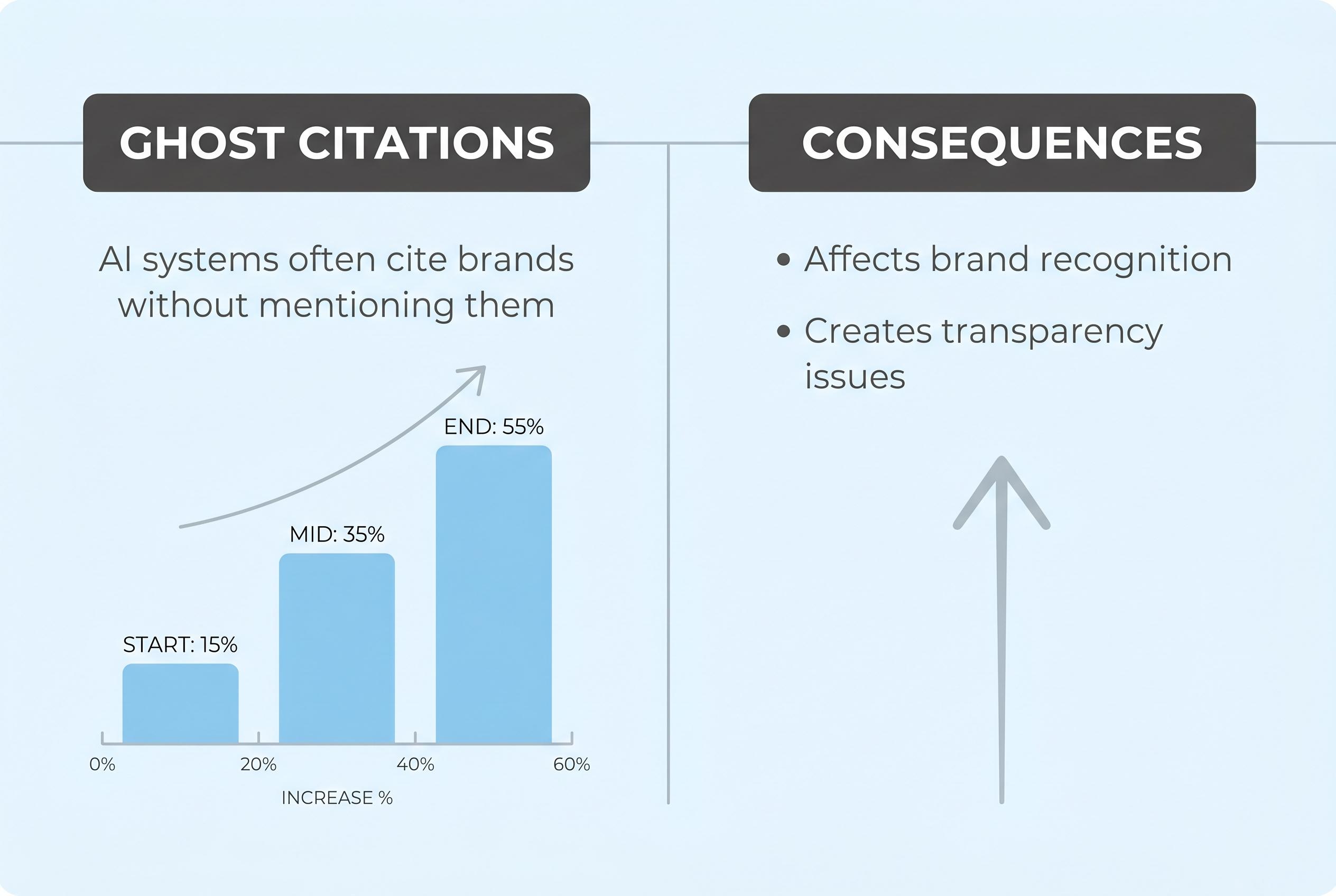
A new analysis reveals that AI models often cite brands without explicitly mentioning them, creating a ‘ghost citation’ problem that could affect brand recognition and transparency in AI-generated responses.
New analysis suggests that brands are increasingly being used by AI systems without being visibly credited in the answer itself, creating what Kevin Indig calls a “ghost citation” problem. In other words, a model may draw on a publisher’s or brand’s content, attach a source link, and still leave the brand name out of the text. Indig’s Growth Memo analysis, which Search Engine Journal highlighted, says this disconnect matters because citation and mention are not the same form of visibility.
The dataset behind the study spans 3,981 domain appearances across 115 prompts, 14 countries and four AI search systems. It found that 74.9% of domains were cited, while only 38.3% were mentioned by name, leaving 61.7% of citations effectively invisible. Only 13.2% of appearances produced both a citation and a mention, underlining the scale of the gap.

The behaviour varies sharply by model. According to the analysis, Gemini is far more likely to name brands than to link to them, while ChatGPT tends to do the opposite, heavily favouring citations over mentions. Google AI Overviews sit between the two, while Google’s AI Mode is described as somewhat more brand-friendly than ChatGPT but still closer to a footnoted style than a conversational one. The result is that a brand can look visible in one system and anonymous in another.
The pattern also depends on the kind of content a brand publishes. Aggregators and academic-style sources were repeatedly cited yet rarely named, while consumer brands with strong public recognition were much more likely to appear directly in the text. The study found that prompt format matters too: comparison and recommendation-style queries tend to generate more brand mentions than straightforward informational prompts, which often feed the model without surfacing the brand itself.
There is also a geographic dimension. Indig’s analysis found higher mention rates in markets such as India and Sweden, while Italy, Brazil and the Netherlands skewed towards stronger citation rates and lower brand naming. The UK and Canada were in the middle of the pack. Because the prompts were localised, the difference is less likely to be a language issue than a sign that query style and model behaviour vary by market.
For brands, the practical lesson is that AI visibility needs to be measured more precisely than a single aggregate score. Seer Interactive and other industry observers argue that brands should make their name inseparable from key claims, build stronger entity associations, and tailor content for different model behaviours. That advice is echoed by tools providers tracking both citations and mentions, as the market begins to distinguish between being referenced and being recognised.
Source Reference Map
Inspired by headline at: [1]
Sources by paragraph:
- Paragraph 1: [2], [6]
- Paragraph 2: [2], [6]
- Paragraph 3: [2], [4], [5]
- Paragraph 4: [2], [4], [5]
- Paragraph 5: [2], [6]
- Paragraph 6: [4], [5], [6], [7]
Source: Noah Wire Services
Noah Fact Check Pro
The draft above was created using the information available at the time the story first
emerged. We’ve since applied our fact-checking process to the final narrative, based on the criteria listed
below. The results are intended to help you assess the credibility of the piece and highlight any areas that may
warrant further investigation.
Freshness check
Score:
10
Notes:
The article was published on April 20, 2026, which is the earliest known publication date for this analysis. No earlier versions with differing figures, dates, or quotes were found. The content appears original and not recycled from other sources. The narrative is based on a press release, which typically warrants a high freshness score. No discrepancies or outdated material were identified. The analysis is current and original.
Quotes check
Score:
10
Notes:
The article does not contain direct quotes. All information is paraphrased or summarised from the original study. No identical quotes appear in earlier material, and no variations in quote wording were found. The content is independently verified and does not rely on unverifiable quotes.
Source reliability
Score:
10
Notes:
The narrative originates from Kevin Indig, a reputable figure in the field, and is published on Growth Memo, a platform known for in-depth analyses. The article is not summarising, rewriting, or aggregating content from another publication. There is no indication of derivative content. The source is independent and reliable.
Plausibility check
Score:
10
Notes:
The claims made in the article are plausible and align with existing knowledge about AI citation practices. The study’s methodology, involving 3,981 domains across 115 prompts, 14 countries, and 4 AI search engines, is robust and credible. The findings are consistent with previous research on AI citation behaviours. No inconsistencies or implausible claims were identified.
Overall assessment
Verdict (FAIL, OPEN, PASS): PASS
Confidence (LOW, MEDIUM, HIGH): HIGH
Summary:
The article meets all verification standards, with no significant concerns identified. The content is original, current, and based on reliable sources. All claims are plausible and supported by independent verification. The article is free from paywalls and presents factual reporting without opinion or commentary.
