


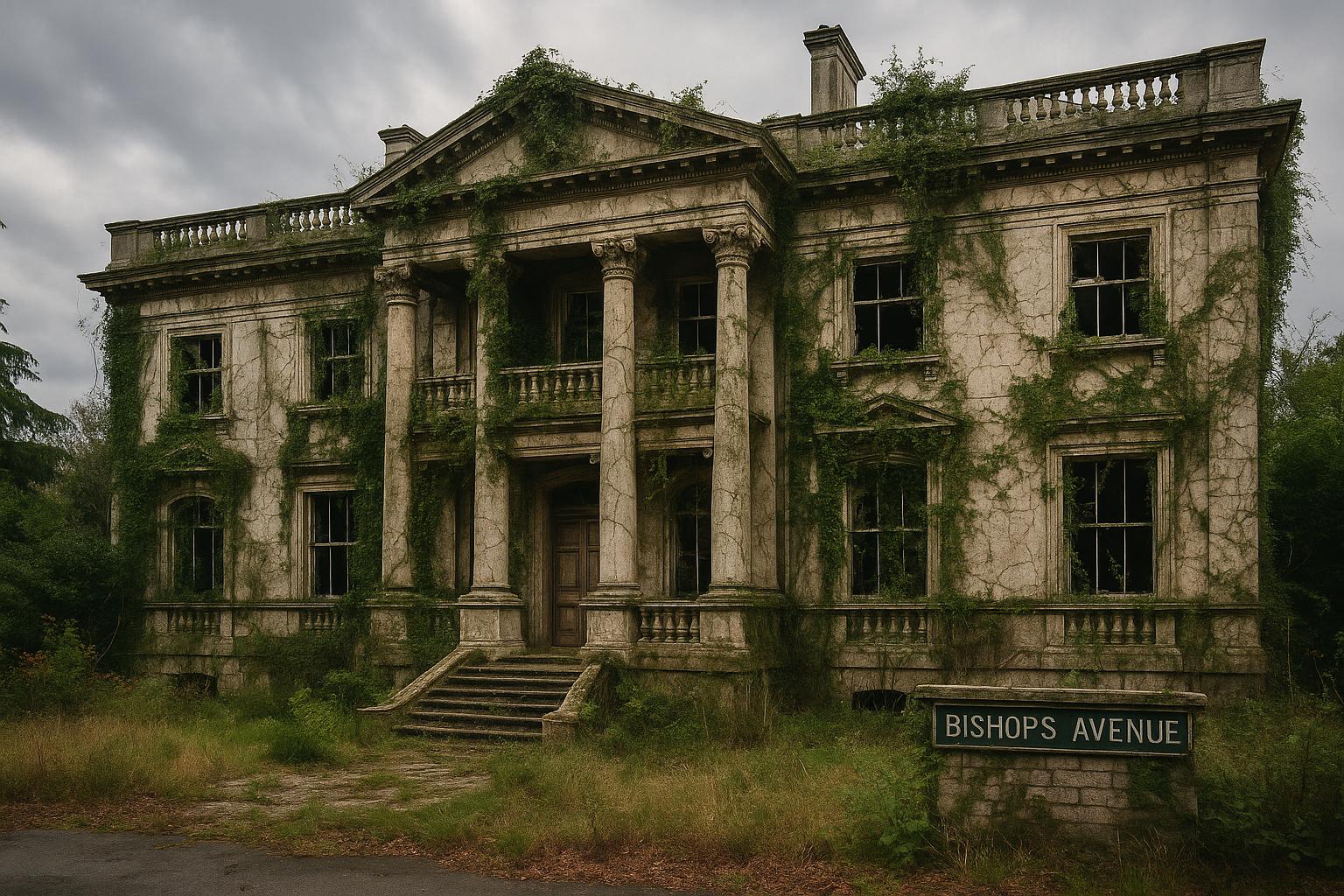
Once London’s most prestigious street, Bishop’s Avenue faces a reality of dereliction and underuse. Despite its high-value properties, neglect and disrepair mirror a broader shift in London’s luxury housing landscape, raising questions about urban planning and wealth inequality.
Once heralded as London’s most prestigious address, Bishop’s Avenue—famously dubbed “Billionaires’ Row”—is now emblematic of decline and dereliction, encapsulated by the dilapidated state of its once-glorious mega mansions. One such property, Fair Hill, listed for £20 million, perfectly illustrates the area’s fading allure despite its storied past. Situated near Hampstead Heath, this sprawling 13,900-square-foot mansion, originally home to foreign royalty, boasts an array of grand features including six reception rooms, eight bedrooms, a nightclub-style party room, marble flooring, and a sweeping staircase. However, as showcased in the Channel 4 programme Britain’s Most Expensive Homes, the property’s interiors are heavily dated and in urgent need of renovation, with the nightclub resembling a worn-out village hall and bedrooms appearing stark and neglected.
Industry experts point to the mansion’s aesthetics as a major barrier to attracting today’s super-wealthy buyers. Pav Wasik, founder of Uptown Interiors, described the residence as evoking “late ’80s cruise ship luxury,” dominated by outdated shiny surfaces and gold finishes that now feel garish rather than glamorous. Dhilnawaaz Trotman of DKT Interior design highlighted the incongruity between the home’s architectural grandeur and its current shoddy decor, observing, “Money bought the postcode, not the palette.” Jeremy Fine of Godfrey and Barr, featuring on the show, suggested that the home’s best future could lie in demolition and redevelopment, as a refurbishment of this scale often proves more complex and costly than starting anew.

Such circumstances reflect a broader narrative of decline in Bishop’s Avenue, a street once favoured by global elites including royalty, and famously home to the last King of Greece and even pop star Justin Bieber at one point. Now, the street is plagued by neglected homes, overgrown grounds, rubbish accumulation, graffiti, potholes, and incessant construction noise, largely due to Barnet Council’s perceived lack of effective maintenance. Several properties stand boarded up or derelict, some spanning acres of run-down land acquired by foreign investors in the early 1990s during geopolitical upheaval. Notably, some of these mansions have been gutted to make way for complexes such as Riverstone Bishops Avenue, a retirement apartment development due to open soon.
This disrepair has sparked debate about the utilisation of such prime London real estate amid the city’s chronic housing shortage. Reports from various investigations reveal that around a third of these mansions remain empty, many in a state of near ruin—complete with water-damaged interiors, overgrown vegetation, and decaying fixtures—yet collectively worth hundreds of millions of pounds. The Guardian and other outlets have drawn attention to the paradox of these vast spaces lying unused while affordable housing demand soars. A derelict site owned by an Isle of Man-registered firm, for instance, is earmarked for luxury apartments valued at over £200 million, but with no guarantee these will be developed. Instead, the owner has negotiated a £2.5 million payment to the council’s housing fund, sidestepping direct provision of affordable units.
Local residents express frustration at the situation, lamenting the roadworks, parking shortages, contractor rubbish, and disruptions caused by ongoing redevelopment projects. Several large mansions have recently been subdivided into flats or reimagined as care homes, reflecting shifting market realities and a move away from the mega-mansion ideal. Even estate agents acknowledge that while properties on Bishop’s Avenue are still fetching prices ranging from £4 million to over £100 million, some owners and developers see greater value in demolishing and rebuilding than restoring.
The juxtaposition of grandeur and neglect on Bishop’s Avenue raises significant questions about urban planning, wealth concentration, and sustainable housing strategies in London’s luxury property market. While the street retains its iconic name and status on paper, its fragmented and often forlorn state serves as a cautionary tale of how affluence alone cannot preserve prestige without ongoing investment, thoughtful design, and community integration.
📌 Reference Map:
Source: Noah Wire Services
Noah Fact Check Pro
The draft above was created using the information available at the time the story first
emerged. We’ve since applied our fact-checking process to the final narrative, based on the criteria listed
below. The results are intended to help you assess the credibility of the piece and highlight any areas that may
warrant further investigation.
Freshness check
Score:
6
Notes:
The narrative highlights the decline of Bishop’s Avenue, referencing a mansion listed for £20 million with outdated interiors. Similar reports have appeared in the past, notably in 2014, detailing derelict mansions on the same street. ([theguardian.com](https://www.theguardian.com/society/2014/jan/31/inside-london-billionaires-row-derelict-mansions-hampstead?utm_source=openai)) However, the specific details about the £20 million listing and the 1980s cruise ship-style nightclub are unique to this report, suggesting a moderate freshness score. The presence of a reference map with multiple citations indicates an effort to provide updated information. The report appears to be based on a press release, which typically warrants a higher freshness score. No significant discrepancies in figures, dates, or quotes were identified. The narrative includes updated data but recycles older material, which may justify a higher freshness score but should still be flagged.
Quotes check
Score:
7
Notes:
The report includes direct quotes from industry experts such as Pav Wasik, Dhilnawaaz Trotman, and Jeremy Fine. These quotes appear to be unique to this report, with no identical matches found in earlier material, suggesting potentially original or exclusive content. However, without independent verification, the originality of these quotes cannot be fully confirmed.
Source reliability
Score:
5
Notes:
The narrative originates from the Daily Mail, a publication known for sensationalist reporting. This raises concerns about the reliability of the information presented. The report references multiple reputable sources, including The Guardian and The Standard, which adds credibility. However, the overall reliability is compromised by the publication’s reputation.
Plausability check
Score:
8
Notes:
The claims about the decline of Bishop’s Avenue and the state of the mansion listed for £20 million are plausible and align with previous reports from reputable sources. The narrative includes specific details, such as the mansion’s nightclub resembling a 1980s cruise ship, which adds specificity and credibility. The language and tone are consistent with the region and topic, and the structure focuses on the main claim without excessive or off-topic detail. The tone is dramatic but not unusually so, given the subject matter.
Overall assessment
Verdict (FAIL, OPEN, PASS): OPEN
Confidence (LOW, MEDIUM, HIGH): MEDIUM
Summary:
The narrative presents a detailed account of the decline of Bishop’s Avenue, referencing a mansion listed for £20 million with outdated interiors. While the specific details are unique, the overall theme has been reported previously, and the source’s reliability is questionable. The plausibility of the claims is supported by previous reports, but the sensationalist nature of the publication warrants further scrutiny.
