


Listen to the article
Understanding Misinformation: Research Sheds Light on How Fake News Spreads and Affects Perception
In an era where misinformation can influence elections, fuel social unrest, and even impact public health decisions, researchers are intensifying their efforts to understand how false information spreads and why people believe it. Recent studies reveal concerning patterns about the vulnerability of different age groups to misinformation and highlight promising strategies to combat its influence.
The rise of what experts call the “post-truth era” has alarmed researchers across disciplines. Studies examining events like the January 6th Capitol riots, the 2018 Brazilian elections, and the COVID-19 pandemic have demonstrated how misinformation can drive real-world consequences with sometimes devastating effects.
“Understanding the psychological mechanisms behind why people believe fake news is crucial to developing effective interventions,” explains Stephan Lewandowsky, a cognitive scientist who has extensively studied misinformation. His research, published in the Journal of Applied Research in Memory and Cognition, underscores how the current information ecosystem creates unprecedented challenges.
Social media platforms have become primary vectors for misinformation. A 2017 study by Allcott and Gentzkow examining the 2016 U.S. presidential election found that false stories spread more rapidly and widely than accurate ones. Similarly, research by Grinberg and colleagues discovered that highly partisan and false content received disproportionate engagement on Twitter during the same election cycle.
The consequences extend beyond politics. During the COVID-19 pandemic, Loomba and colleagues demonstrated that exposure to vaccine misinformation significantly reduced people’s intention to get vaccinated in both the UK and USA. Climate change communication has faced similar challenges, with van der Linden’s research showing how misinformation can undermine public consensus on environmental issues.
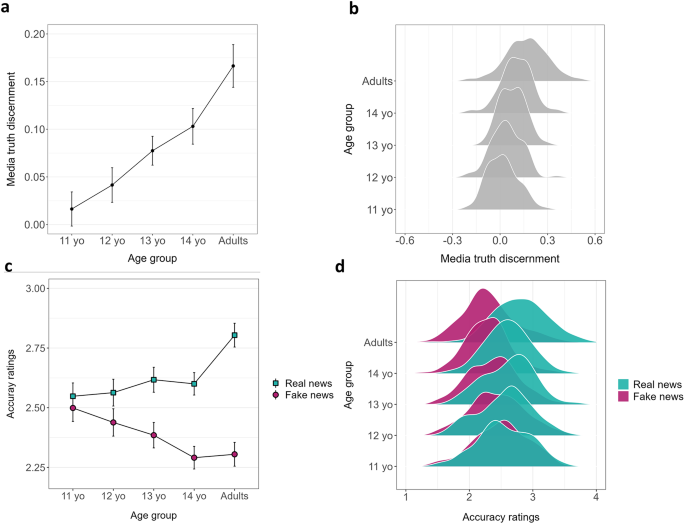
One particularly concerning finding comes from developmental psychology research. Lisa Fazio and Carrie Sherry’s 2020 study published in Psychological Science found that children and adolescents may be especially vulnerable to what’s known as the “illusory truth effect” – the tendency to believe information after repeated exposure, regardless of its accuracy.
“Young people are developing their critical thinking skills at the same time they’re becoming heavy consumers of online information,” says Fazio. “This creates a perfect storm where repeated exposure to misinformation can shape their beliefs before they’ve developed robust fact-checking habits.”
Cognitive reflection – the ability to override intuitive but potentially incorrect responses – appears to play a crucial role in misinformation resistance. Gordon Pennycook and David Rand’s research suggests that susceptibility to fake news correlates strongly with lower cognitive reflection abilities rather than partisan bias alone. Their studies, published in journals including Cognition and the Journal of Experimental Psychology, challenge the notion that people primarily believe fake news that aligns with their political views.
“It’s not just about political motivation,” Pennycook explains. “Many people fall for fake news because they fail to engage analytical thinking processes that could help them distinguish between accurate and inaccurate content.”
The research points to several promising interventions. Simply prompting people to consider accuracy before sharing information online can reduce misinformation spread, according to a 2021 Nature study. Media literacy programs that teach people to evaluate source credibility show similar potential.
Researchers are also examining how presentation format affects perception. A team led by Anthony Kim found that visual cues like source ratings significantly influenced whether users trusted news headlines, regardless of their actual accuracy. These findings suggest that social media platforms could implement design features to help users better evaluate information credibility.
As digital information continues to shape public discourse, these research insights become increasingly valuable. The studies collectively highlight that combating misinformation requires a multifaceted approach incorporating psychological understanding, educational interventions, and platform design improvements.
“What’s clear from the research is that there’s no single solution,” notes David Lazer, who co-authored a seminal Science paper on fake news. “We need coordinated efforts from researchers, educators, platform designers, and policymakers to create an information ecosystem that values and promotes accuracy.”
Verify This Yourself
Use these professional tools to fact-check and investigate claims independently
Reverse Image Search
Check if this image has been used elsewhere or in different contexts
Ask Our AI About This Claim
Get instant answers with web-powered AI analysis
Related Fact-Checks
See what other fact-checkers have said about similar claims
Want More Verification Tools?
Access our full suite of professional disinformation monitoring and investigation tools

8 Comments
Tackling the spread of misinformation is a complex challenge, but this study suggests that focusing on media literacy and critical thinking skills in adolescents could be an effective approach. Proactive strategies to combat fake news are much needed.
Interesting to see the link between adolescent cognitive development and the ability to discern truth from falsehood in media. Investing in programs that cultivate critical thinking skills seems like a wise long-term strategy.
The ‘post-truth’ era is indeed concerning, with misinformation having real-world consequences. This research underscores the importance of media literacy education, especially for younger generations who may be more susceptible to false narratives.
Agreed. Equipping people with the skills to navigate the modern information landscape is crucial. Fact-checking, source verification, and developing healthy skepticism should be prioritized.
Fascinating research on how adolescents’ media literacy skills impact their ability to discern truth from misinformation. Developing critical thinking and healthy skepticism at a young age seems crucial in this ‘post-truth’ era.
Agreed. Equipping young people with the tools to navigate the modern information landscape is vital. Media education should be a core part of the curriculum.
This study highlights an important challenge facing society. Combating the spread of misinformation, especially among impressionable youth, requires a multifaceted approach involving education, media literacy, and technological solutions.
Absolutely. Fact-checking, source verification, and developing healthy skepticism need to be prioritized to empower people to make informed decisions.