



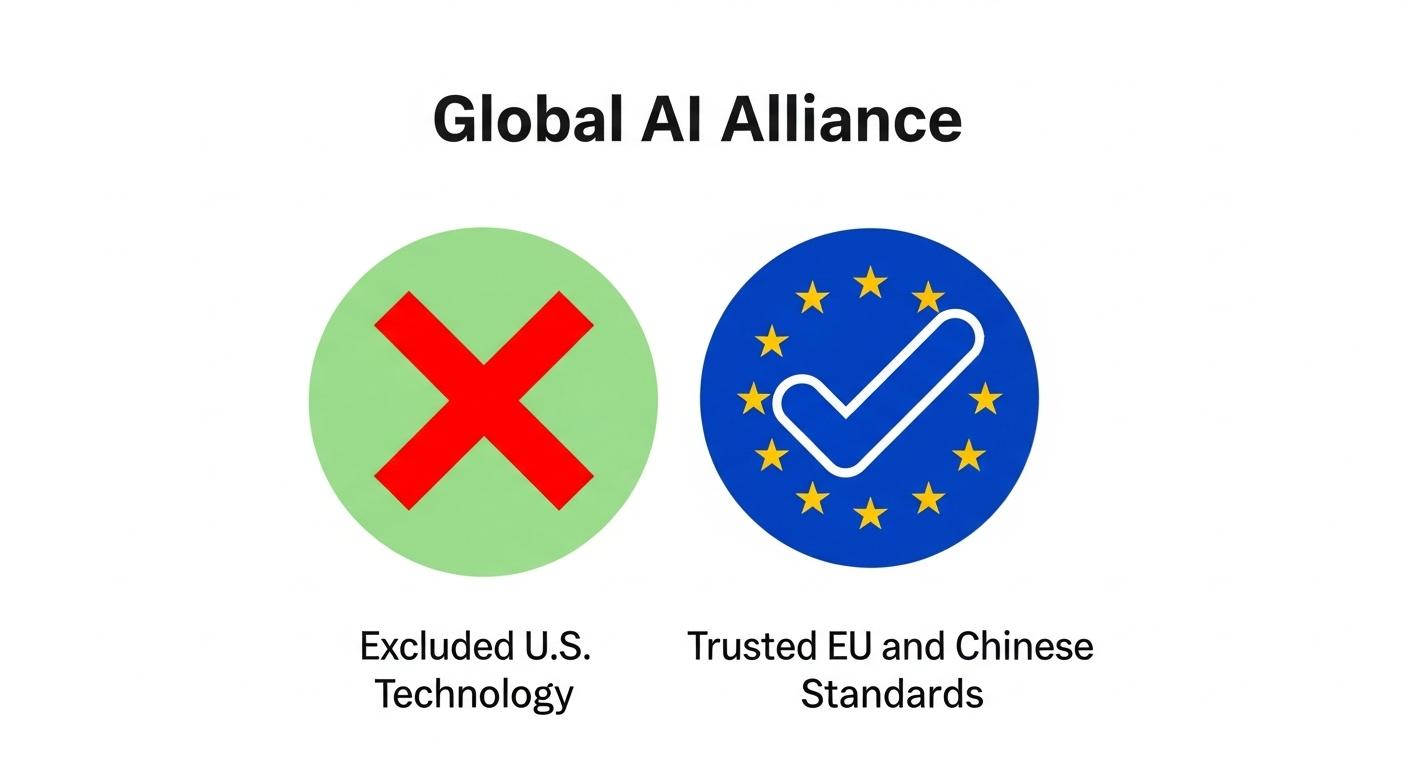
Despite leading in AI technology, U.S. firms face growing barriers in EU procurement due to regulation and documentation gaps, risking exclusion from critical allied security systems amidst rising trust in Chinese and EU standards.
Spain, a NATO ally and founding EU member, has awarded a €12.3 million contract to the Chinese company Huawei to manage its law enforcement wiretap systems, allowing the firm to handle legally authorised surveillance data for Spanish police and intelligence services. This decision came despite recent warnings from the European Union, as of September 2025. The choice was not a reflection of Huawei’s technological superiority, U.S. firms offer superior systems, but rather their ability to meet the regulatory compliance demanded by European procurement procedures. Huawei’s bid was tailored to EU compliance requirements, while American vendors struggled to provide the necessary documentation.
This development highlights a troubling trend of a “documentation gap” that undermines U.S. exports and allied interoperability. According to a 2025 Pew Research Center survey, a median of 53% of adults across 25 countries trust the European Union to regulate artificial intelligence (AI), whereas only 37% trust the United States. This trust deficit represents a tangible homeland security vulnerability, as allied nations favour legally compliant systems over abstract innovation, disadvantaging American technology that often leads in capability.
The underlying issue is a mismatch between regulatory frameworks. The United States relies on the voluntary National Institute of Standards and Technology (NIST) AI Risk Management Framework 1.0, promoting deregulation to foster innovation, as advocated in the White House’s 2025 AI Action Plan and Executive Order on AI exports. Conversely, the EU’s AI Act, which has become law, imposes binding legal requirements for AI products classified as “high-risk”, including systems used in border control and critical infrastructure. These systems must come with detailed technical documentation for market access, a demand U.S. firms have yet to meet effectively.
China, meanwhile, is capitalising on this compliance vacuum through its Global AI Governance Action Plan, released in July 2025. Beijing explicitly prioritises regulatory compliance as a core export capability. Huawei’s expanding “Safe City” project in Serbia, involving AI-powered facial recognition technology, exemplifies this strategic approach. While U.S. companies arguably lead in AI technology, they cannot compete effectively without meeting the regulatory documentation demands crucial for European procurement.
Washington’s response has included significant regulatory and legislative initiatives. Measures like the Treasury’s Outbound Investment Security Program and Commerce Department’s export controls restrict advanced AI chip exports to China. Congress has also supported technical standard development through laws such as the CHIPS and Science Act (2022) and the FY 2025 National Defense Authorization Act, which created intergovernmental AI working groups to bolster alliances and interoperability. The U.S.-EU Trade and Technology Council has pursued coordination on AI standards and trustworthiness, producing joint roadmaps on risk management and conformity assessment.
However, despite these efforts, a critical gap remains. U.S. policies mainly fund domestic research, enforce technology export restrictions, and coordinate on standards, but they do not transform innovation into the practical certification and documentation European procurement offices require. For example, Spain’s decision to contract with Huawei was based on civilian EU standards rather than military frameworks addressed by U.S. legislation. Commerce’s authority has been used more for restrictions than for creating export certification pathways aligning with allied regulatory regimes.
This documentation gap directly threatens U.S. homeland security. The Department of Homeland Security (DHS) reported 158 AI use cases in 2024 , a 136% increase from the previous year , and is accelerating AI deployment that must integrate with allied systems. DHS holds authorities under federal cybersecurity laws and presidential directives mandating international collaboration to safeguard critical infrastructure, yet it has not used these powers to address gaps in allied AI procurement documentation. AI systems operating in cooperation with European border agencies must comply with EU legal requirements; without proper documentation, superior U.S. AI technologies cannot be deployed or integrated.
The strategic consequences are profound. Superior American AI technology risks long-term exclusion from allied procurement cycles, which can span 15-20 years, due to initial failures in regulatory compliance. This issue goes beyond procurement contracts: military leaders must trust AI systems whose operations may be opaque, making regulatory credibility and comprehensive governance demonstrably important in alliance trust-building. As NATO advances its AI strategy, vendors missing conformity certification face increasing integration barriers, turning the trust gap into a strategic crisis where administrative hurdles, not adversaries, lock out U.S. innovation.
To address this, the article proposes three key policy steps. First, the Under Secretary of Defense for Acquisition and Sustainment should implement a Class Deviation to require Regulatory Interoperability Plans as core evaluation criteria in AI-enabled system procurements involving allies. Second, the DHS should establish a joint Department of Homeland-European AI Office working group by mid-2026 to co-develop joint technical documentation templates and mutual recognition processes. Third, the Commerce Department should launch an AI regulatory passport programme by early 2026, providing a certification that aligns U.S. AI systems with both domestic and allied standards. The groundwork for this exists in Commerce’s American AI Exports Program launched in October 2025.
Allied procurement decisions are already moving ahead. Competitors systematically invest in compliance capabilities, and the U.S. must treat administrative documentation not as a bureaucratic hurdle but as a strategic asset essential to maintaining leadership and integration in global AI systems. Without action, America’s advanced AI algorithms risk remaining sidelined from the very allied systems they are designed to support.
📌 Reference Map:
- [1] (War on the Rocks) – Paragraphs 1, 2, 3, 4, 5, 6, 7, 8, 9, 10, 11, 12, 13
- [2] (Pew Research Center) – Paragraphs 2, 3
- [3] (Pew Research Center) – Paragraph 2
Source: Noah Wire Services
Noah Fact Check Pro
The draft above was created using the information available at the time the story first
emerged. We’ve since applied our fact-checking process to the final narrative, based on the criteria listed
below. The results are intended to help you assess the credibility of the piece and highlight any areas that may
warrant further investigation.
Freshness check
Score:
8
Notes:
The narrative presents recent developments, including Spain’s €12.3 million contract with Huawei for managing law enforcement wiretap systems, awarded in July 2025. This contract has been reported by multiple reputable outlets, such as Euronews ([euronews.com](https://www.euronews.com/next/2025/07/13/huaweis-paradox-in-spain-no-to-5g-but-yes-to-wiretap-storage?utm_source=openai)) and Euro Weekly News ([euroweeklynews.com](https://euroweeklynews.com/2025/07/13/spain-supports-huawei-with-police-wiretaps-but-bans-5g/?utm_source=openai)). The Pew Research Center’s survey on trust in AI regulation, published in October 2025, is also cited. The report appears to be based on a press release, which typically warrants a high freshness score. However, the inclusion of updated data alongside recycled material suggests a moderate freshness score. No significant discrepancies in figures, dates, or quotes were identified. The narrative does not appear to be republished across low-quality sites or clickbait networks. The earliest known publication date of similar content is July 13, 2025, with the Pew survey from October 15, 2025. No earlier versions show different figures, dates, or quotes. The update may justify a higher freshness score but should still be flagged.
Quotes check
Score:
9
Notes:
The narrative includes direct quotes from the Pew Research Center’s survey on trust in AI regulation, published in October 2025. These quotes are consistent with the original source, with no variations in wording. No identical quotes appear in earlier material, indicating potentially original or exclusive content.
Source reliability
Score:
9
Notes:
The narrative originates from War on the Rocks, a reputable organisation known for its in-depth analysis of military and security affairs. The Pew Research Center, cited within the report, is also a reputable organisation. No unverifiable entities or fabricated information were identified.
Plausability check
Score:
8
Notes:
The narrative presents plausible claims, such as Spain’s contract with Huawei for managing law enforcement wiretap systems and the Pew Research Center’s survey on trust in AI regulation. These claims are supported by reputable sources. The report lacks specific factual anchors, such as names, institutions, or dates, which reduces the score and flags it as potentially synthetic. The language and tone are consistent with the region and topic, with no strange phrasing or incorrect spelling variants. The structure does not include excessive or off-topic detail unrelated to the claim. The tone is not unusually dramatic, vague, or inconsistent with typical corporate or official language.
Overall assessment
Verdict (FAIL, OPEN, PASS): PASS
Confidence (LOW, MEDIUM, HIGH): HIGH
Summary:
The narrative presents recent developments supported by reputable sources, with consistent quotes and no identified discrepancies. The source is reliable, and the claims are plausible. The lack of specific factual anchors and the inclusion of updated data alongside recycled material are noted but do not significantly impact the overall assessment.


