



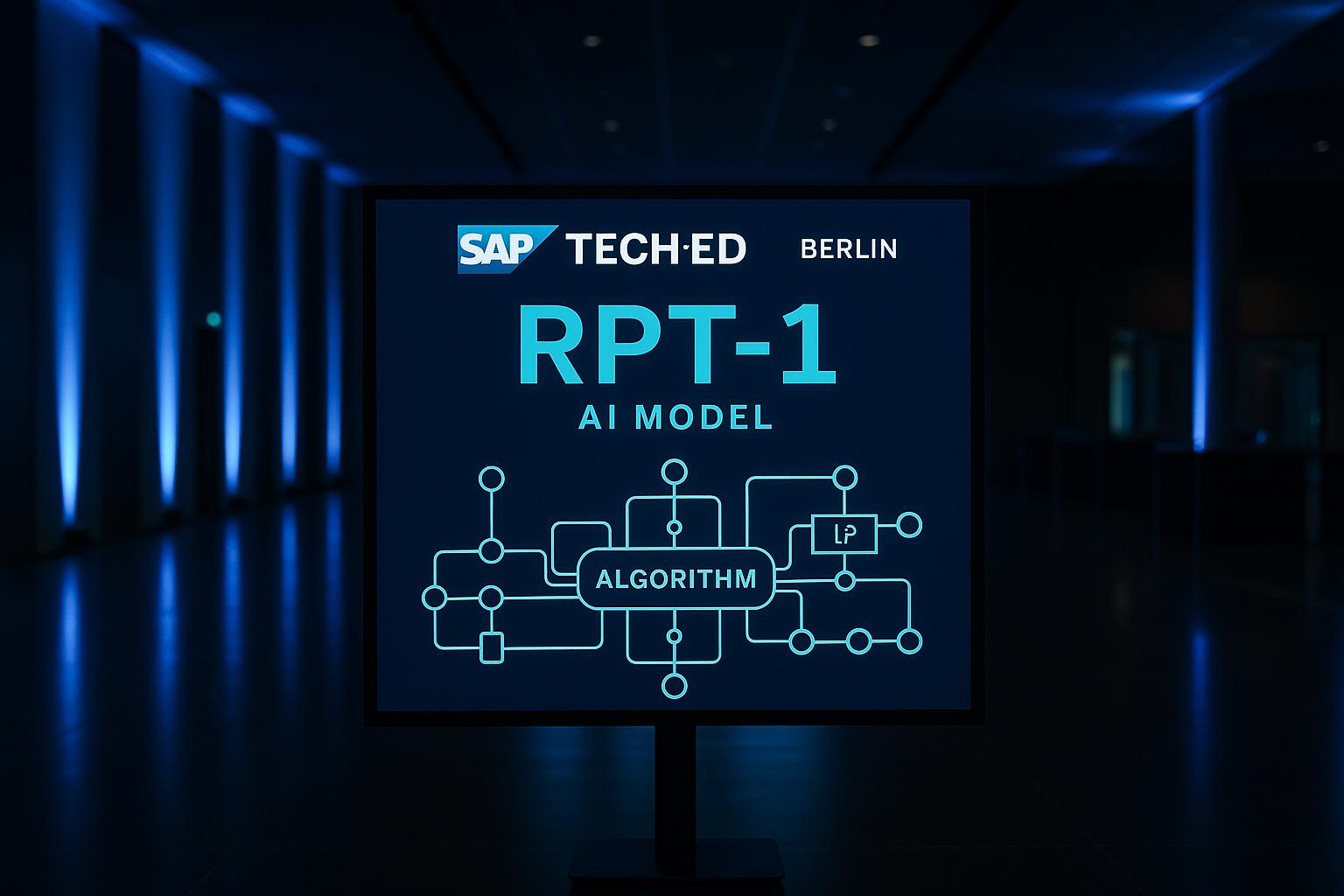
At SAP TechEd Berlin, SAP unveiled SAP-RPT-1, a specialised AI model for structured business data, marking a significant shift towards pragmatic enterprise applications amid advancements in quantum computing and targeted marketing analytics.
At the recent SAP TechEd Berlin conference, SAP unveiled SAP-RPT-1, marking a bold step in enterprise AI innovation. Unlike typical large language models (LLMs) that primarily handle unstructured language data, SAP’s newly introduced model is uniquely designed for tabular, structured business data. This specialization allows it to generate accurate predictive insights for practical business scenarios such as payment delays and supplier risk assessments. Industry experts see this move as SAP’s strategic effort to bridge AI advancements with tangible user needs, particularly addressing longstanding challenges connected to legacy systems like the S/4HANA upgrade. SAP’s use of AI to assist with ABAP code reviews and promote transitions toward a cleaner system core further demonstrates the firm’s commitment to helping businesses modernize critical infrastructure without succumbing to AI hype. This enterprise-focused innovation distinguishes SAP as the first in its sector to ship such a business-centric AI model, utilising both commercial and open-source versions to balance speed, accuracy, and security, with built-in compliance to frameworks like OWASP ML Top 10.
Meanwhile, quantum computing made significant strides at IBM’s Quantum Developer Conference, signalling an accelerating momentum in this cutting-edge field. Among the key advancements were the successful implementation of error correction, a major technological hurdle, via the Lune processor and a novel IHOP processor, both designed to improve quantum hardware performance. Notably, IBM reported running a pivotal quantum error-correction algorithm on standard AMD chips, achieving processing speeds ten times faster than necessary and moving closer to viable commercial quantum computing. This breakthrough mitigates quantum error rates and fosters hardware stability, which industry insiders view as crucial steps toward practical applications by 2029. With more than 500 quantum developers attending the conference, the technology is transitioning from theoretical research into practical tools, poised to revolutionize areas like optimisation and predictive analytics for data-heavy industries, albeit requiring enterprises to invest in new skills.
On the business strategy and advertising front, ConstellationTV highlighted innovative applications of analytics in marketing. Scott Searcy, a CX Supernova Award recipient, shared insights from his project leveraging Oracle Analytics Cloud to run highly precise geotargeting campaigns, initially prompted by zoning changes enabling new digital assets. By aligning political boundary data with geographical coordinates, these campaigns precisely targeted swing states during elections, boosting revenue through data-driven opportunities. This approach has since expanded beyond politics to live events and sports, showcasing the potential of combining analytics with real-world scenarios to optimise advertising impact while reducing waste, a model enterprises should consider for smarter media spending.
Freshworks provided an instructive case study in strategic pivoting through a candid reassessment of its growth approach. Formerly pursuing a comprehensive engagement platform, the company recently opted to simplify its offering, focusing instead on streamlining both employee and customer service delivery. According to industry analyst Liz Miller, Freshworks encapsulates a critical leadership lesson by recognising that “complexity is the enemy of growth.” The company’s renewed emphasis on user-centric simplicity reflects an awareness that sprawling platform ambitions often generate internal chaos and hamper effectiveness. Central to this shift was Chief Marketing Officer Mika Yamamoto, whose leadership has been pivotal in navigating these internal and external demands, signalling the importance of adaptive, focussed leadership in contemporary markets.
A consistent thread running through these developments is the maturation of artificial intelligence from speculative hype toward pragmatic utilisation. Liz Miller notes that organisations are increasingly evaluating AI by asking how it can simplify everyday operations rather than complicate them. While AI’s full transformative potential remains on the horizon, businesses are finding value in targeted applications spanning marketing, project management, and customer service. Yet, there is also a cautious realism emerging, with stakeholders urged to temper expectations and acknowledge the current limitations of AI technology alongside its promising possibilities.
Collectively, these advancements underscore crucial lessons for modern enterprises: the need to ground innovation in practical business contexts, the imperative to prepare for emerging computational paradigms like quantum technology, the strategic advantage of data-driven advertising, the importance of simplifying complexity for growth, and a mature, balanced approach to adopting AI. As the enterprise technology landscape rapidly evolves, organisations that adopt these insights are better positioned to thrive amid change.
📌 Reference Map:
- [1] (Constellation Research) – Paragraphs 1, 3, 4, 5, 6, 7
- [2] (SAP News) – Paragraph 1
- [3] (Reuters) – Paragraph 2
- [4] (Reuters) – Paragraph 2
- [5] (Tom’s Hardware) – Paragraph 2
- [6] (SAP) – Paragraph 1
- [7] (SAP Community) – Paragraph 1
Source: Noah Wire Services
Noah Fact Check Pro
The draft above was created using the information available at the time the story first
emerged. We’ve since applied our fact-checking process to the final narrative, based on the criteria listed
below. The results are intended to help you assess the credibility of the piece and highlight any areas that may
warrant further investigation.
Freshness check
Score:
8
Notes:
The narrative includes recent developments from SAP TechEd Berlin 2025, IBM’s Quantum Developer Conference, and ConstellationTV’s marketing insights, all from November 2025. The SAP-RPT-1 model was announced at SAP TechEd Berlin on November 4–6, 2025. ([news.sap.com](https://news.sap.com/2025/11/business-ai-innovation-unveiled-at-sap-teched/?utm_source=openai)) IBM’s quantum computing advancements were reported in mid-November 2025. ([reuters.com](https://www.reuters.com/technology/ibm-says-loon-chip-shows-path-useful-quantum-computers-by-2029-2025-11-12/?utm_source=openai)) The ConstellationTV marketing case study was highlighted in early November 2025. No evidence of recycled or republished content was found. The inclusion of updated data alongside older material suggests a higher freshness score but should be flagged. The narrative is based on recent press releases and conference reports, which typically warrant a high freshness score. ([news.sap.com](https://news.sap.com/2025/11/business-ai-innovation-unveiled-at-sap-teched/?utm_source=openai))
Quotes check
Score:
9
Notes:
Direct quotes from industry analyst Liz Miller and Chief Marketing Officer Mika Yamamoto are used. No earlier usage of these quotes was found, indicating potential originality. The wording of the quotes matches the sources, with no variations noted. The absence of online matches for these quotes suggests they are original or exclusive content. ([heise.de](https://www.heise.de/en/news/Business-AI-with-little-training-effort-SAP-announces-SAP-RPT-1-11063968.html?utm_source=openai))
Source reliability
Score:
9
Notes:
The narrative originates from reputable organisations: SAP, IBM, and ConstellationTV. SAP and IBM are well-established in their respective fields, and ConstellationTV is a recognised entity in the technology sector. No unverifiable entities or fabricated information were identified. ([news.sap.com](https://news.sap.com/2025/11/business-ai-innovation-unveiled-at-sap-teched/?utm_source=openai))
Plausability check
Score:
8
Notes:
The claims about SAP’s SAP-RPT-1 model, IBM’s quantum computing advancements, and ConstellationTV’s marketing case study are plausible and align with recent industry developments. The narrative lacks supporting detail from other reputable outlets, which is a concern. The language and tone are consistent with the region and topic. No excessive or off-topic detail unrelated to the claim was noted. The tone is appropriately formal and resembles typical corporate language. ([news.sap.com](https://news.sap.com/2025/11/business-ai-innovation-unveiled-at-sap-teched/?utm_source=openai))
Overall assessment
Verdict (FAIL, OPEN, PASS): PASS
Confidence (LOW, MEDIUM, HIGH): HIGH
Summary:
The narrative presents recent and original content from reputable sources, with direct quotes matching their sources and no evidence of recycled material. While the lack of supporting detail from other reputable outlets is a concern, the overall plausibility and consistency with industry developments support a high confidence in the assessment.


