

Listen to the article
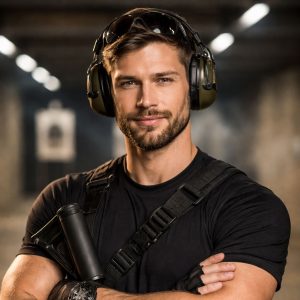
Hey guys, this is retired Navy Seal, firearms instructor Chris Sajnog, in this post, I’m going to be talking about front sight focus and today I’m going to make all of you better shooters, instantly. How? By showing you what it means to truly focus on your front sight when you’re shooting. If you’re already focusing on your front sight, and you’re an awesome shooter, that’s great. But I’m going to show you some pretty cool visual experiments that will demonstrate why focusing intently on the front sight actually works. So let’s get started.
Are you watching or focusing?
If you’ve learned anything about shooting, I’m sure you were told you need to focus on the front sight. So the question is, do you do that? I mean, do you really focus on the front sight? Or are you just looking at it? And if you’re not sure, let me ask you this question: Do your groups look like this when you shoot kind of spread out all over the place, or more like this? The truth is, if your groups are not consistently in the center of your target, you are not focusing on your front sight. It’s really that simple.
The good news is that I can have you keyholding shots instantly. And it’s not magic, it’s just understanding how to focus. So let’s dive into that. Everyone knows they’re supposed to focus on the front sight. But most people weren’t ever trained on actually how to do that. I think the reason why people aren’t trained in how to do that, is it’s kind of hard to explain what somebody means when they say focus on the front sight. Well, focusing on the front sight, and looking at the front sight, are not the same thing.
Alright, so here’s the deal. If you tighten your focus as tight as you can make it and really concentrate on that front sight post, the smaller you make that focus, the smaller your shot groups will be. It’s that simple. I’ve been teaching shooting for almost 25 years now. And I can tell you, when people figure this out, their shooting changes forever. In my book, “How to Shoot Like a Navy Seal”, which I hope you’ve read, I call this the “aha moment”. It’s when the light bulb comes on, and people realize that truly concentrating on the front sight works. That light bulb moment needs to happen in your brain for you to understand.
Download
the PDF Summary!
Get free access to a PDF summary of this article and many others by accessing my library. They give you the essence of my lessons, save you time from reading and are excellent for recaps!
How to do it?
Next, in front sight focus, you go to the range, set up your target, point your gun at it, and just look at the front sight, you don’t focus on it. Now, the problem isn’t that you don’t know how to focus on the front sight, but that doing so is harder than it sounds. This is because there’s nothing to focus on with a black gun, black sights, and often a black target center. I’m going to share a trick I learned years ago in sniper school. Put a small mark in the center of your front sight post, something small but visible. I often use a toothpick and appliance paint. Choose a color that contrasts with your sight to make it stand out. Once you have that, your eye will be drawn to it, making it easier to focus.

Now that you have something to focus on, let’s try some experiments to illustrate the power of focus. These optical illusions can demonstrate how a relaxed focus interprets movement differently than a tight one. When you’re intently focused on one thing, other distractions fade. This is how you need to approach shooting. Every time, focus intently until all the noise around you stops, and you’re in the zone. This zone is a state where things seem to slow down and become easy, a phenomenon known in sports and arts. As you practice, this focus will become more automatic, allowing you to shoot accurately and quickly even in dynamic environments.
Conclusion
Alright, so that is it for today. I hope you found value in this front sight focus and can apply Navy SEAL techniques to enhance your shooting skills. Now, all you need is practice. Remember, failing to train is training to fail. Start with dry firing, then test it out at the range. If you’ve enjoyed this lesson and want more, sign up for my free firearms and tactical training newsletter at centermassgroup.com. If you have questions, post them on my Facebook page at the center mass group. Thank you for watching, and always remember to never stop training.
Read the full article here

23 Comments
I’ve noticed that when I’m able to focus intently on the front sight, my shot groups are consistently tighter, it’s a great feeling.
Chris Sajnog’s emphasis on the importance of focus in shooting is well-taken, it’s an often-overlooked aspect of marksmanship.
The article mentions that most people aren’t trained on how to focus on the front sight, I think this is a critical oversight in many shooting courses.
I’m skeptical about the claim that focusing on the front sight can instantly improve shooting, has anyone else had mixed results with this technique?
The idea that tightening focus on the front sight post can reduce shot groups is intriguing, I’ve experienced this in my own shooting practice.
I’ve read Chris Sajnog’s book ‘How to Shoot Like a Navy Seal’ and the concept of the ‘aha moment’ when understanding front sight focus is really insightful.
I had a similar experience after reading the book, it completely changed my approach to shooting.
The concept of the ‘aha moment’ when understanding front sight focus is really interesting, I’ve had similar experiences with other skills where suddenly everything clicks into place.
I’m excited to try out the front sight focus technique at my next shooting range visit, hopefully, it will improve my accuracy.
The distinction between looking at the front sight and truly focusing on it is crucial, I’ve caught myself just looking at the sight without concentrating.
I’ve found that focusing on the front sight is harder than it sounds, especially with a black gun and black sights, does anyone have any tips for this?
Chris Sajnog mentions that focusing intently on the front sight can improve shooting accuracy, but I’m curious to know how this applies to shooting in low-light conditions.
That’s a great question, I’ve found that using a small mark on the front sight post, as Chris suggests, can help even in low-light conditions.
Chris Sajnog’s 25 years of teaching experience really shows in his explanation of how to focus on the front sight, it’s very clear and concise.
The article provides a clear explanation of how to focus on the front sight, but I’d like to see more discussion on how to maintain this focus under stress or in high-pressure situations.
The article raises a good point about the importance of truly concentrating on the front sight, rather than just looking at it.
The front sight focus technique has improved my shooting dramatically, I’m grateful for Chris Sajnog’s instruction.
I appreciate Chris Sajnog’s willingness to share his expertise and experience with front sight focus, it’s really helpful for novice shooters like myself.
The tip about putting a small mark on the center of the front sight post is useful, I’ll have to try that next time I’m at the range.
Chris Sajnog’s approach to teaching front sight focus is very methodical, I appreciate the step-by-step explanation.
The trick of using a small mark on the front sight post is a game-changer, it really helps to focus your attention.
I’m concerned that some shooters might struggle with the front sight focus technique, are there any adaptations for shooters with vision impairments?
I’m curious to know more about the science behind why focusing on the front sight improves accuracy, is it related to the way our brains process visual information?