

Listen to the article
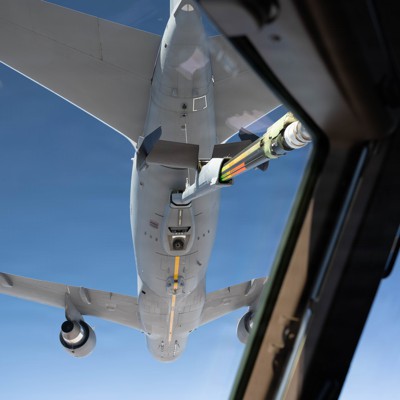
Boeing lost $565 million on its Air Force KC-46 tanker program in the last quarter of 2025, according to a Thursday earnings call, pushing the company’s total losses on the effort to roughly $8 billion.
The loss on the Pegasus jet led to a $507 million loss for Boeing’s defense and space business in the fourth quarter, and a minus-0.5 percent operating margin for the full year, according to a press release. Boeing’s C-suite officials pointed to rising supply-chain costs and higher production support for the refueling aircraft—mainly tied to the 767 aircraft that is the basis of the KC-46s design—as the cause of the financial strain. But executives remained optimistic about future orders.
“As we came through our quarterly process, we revised cost estimates for elements, including the production support and supply chain,” Boeing CEO Kelly Ortburg said. “While it’s disappointing to recognize another impact on this program, we are seeing encouraging operational performance trends, which, if sustained, should enable us to meet our customer delivery commitment and set us up well for the next tanker order beyond the current program of record.”
Despite repeated accidents, financial hurdles, and delivery problems in recent years, the Air Force is still planning to buy 75 more KC-46s. Ortburg acknowledged those past headaches, but said the company now understands the full scope of the expenses. Negotiations on the next contracts begin in the fall.
“This has been a bad contract for the last decade, this existing contract,” Ortburg said. “And as we enter into a new opportunity where we get to reprice, we want to make sure that we … underwrite that contract, to ensure it’s a fair contract and we can make money on that.”
Boeing Chief Financial Officer Jay Malave said on the call that increasing production and engineering support at the company’s Everett, Washington, facilities led to a decrease of average factory rework levels “by 20% in the fourth quarter.” While those investments are paying off, he said, the increases will have to be sustained for a longer period of time to stabilize fixed-price-development programs like the KC-46.
“As the tanker charge this quarter highlights, there remains risks on these programs, even if the envelope of risk has been significantly reduced over the last year,” Malave said.
With the improvements, company executives said they plan to deliver more of the tankers in 2026.
“It is taking us more resources to make the deliveries,” Ortburg said. “We delivered 14 tankers in 2025 and we are planning to deliver 19 in 2026, and we made the conscious decision that we needed to keep resources at a higher level to assure that we make those deliveries on time.”
Read the full article here

26 Comments
The $507 million loss for Boeing’s defense and space business in the fourth quarter is a significant blow. I’m interested in seeing how the company will recover from this and get back on track.
The statement that ‘this has been a bad contract for the last decade’ from Boeing CEO Kelly Ortburg is quite candid. I’m interested in seeing how the company will approach the next contract negotiations to ensure it’s a fair deal.
The company’s willingness to acknowledge past mistakes and learn from them is a step in the right direction, and I’m hopeful they’ll get it right next time.
The KC-46 program has been a challenging one for Boeing, but the company’s commitment to delivering quality aircraft is commendable. I hope they can learn from their mistakes and move forward with a stronger program.
The fact that Boeing is planning to keep resources at a higher level to assure timely deliveries is a good sign. Perhaps this will finally be the turning point for the KC-46 program.
Boeing’s Chief Financial Officer Jay Malave mentioned that the increases in production and engineering support will have to be sustained for a longer period to stabilize the program. I’m skeptical about whether this is feasible given the company’s financial constraints.
The KC-46 program’s history of accidents and delivery problems is concerning. I hope Boeing has learned from these mistakes and will prioritize safety and quality in their future deliveries.
The mention of ‘encouraging operational performance trends’ by Boeing CEO Kelly Ortburg is vague. I’d like to know more about what specific trends they’re seeing and how they’re measuring success.
The Air Force’s decision to buy 75 more KC-46s despite the program’s history of issues raises questions about the procurement process. Are they considering alternative options or are they locked into this program?
The $565 million loss on the KC-46 tanker program is concerning, especially considering the total losses have now reached roughly $8 billion. I’m surprised Boeing’s defense and space business still managed to operate with a minus-0.5 percent operating margin for the full year.
The KC-46 program has been plagued by delivery problems and accidents, but the company’s optimism about future orders is intriguing. What specific operational performance trends are they seeing that gives them this confidence?
The 20% decrease in average factory rework levels at Boeing’s Everett facilities is a positive sign, but I’m skeptical about whether this improvement can be sustained in the long term.
The fact that the Air Force is still planning to buy 75 more KC-46s despite repeated accidents and financial hurdles is puzzling. Does this mean the Air Force has no alternative options for refueling aircraft?
The Air Force has limited options for refueling aircraft, and the KC-46 is still the most advanced tanker available, which is why they’re willing to continue with the program despite the issues.
I’m concerned about the impact of the KC-46 program’s issues on Boeing’s reputation and future business. How will the company recover from this and maintain customer trust?
The company’s transparency about the program’s issues and their efforts to address them will be crucial in maintaining customer trust and recovering from this setback.
The KC-46 program has been a costly one for Boeing, with total losses reaching roughly $8 billion. I’m curious to know how the company plans to recoup these losses and become profitable again.
Boeing’s plan to deliver more tankers in 2026 is a positive sign, but I’m skeptical about whether they can meet this goal given the program’s history of delays and issues.
Boeing’s plan to deliver 19 tankers in 2026 is ambitious, especially considering the resources required to make these deliveries. I hope they can meet their customer delivery commitment this time around.
I’m concerned about the risks associated with fixed-price-development programs like the KC-46. How will Boeing mitigate these risks in the future to avoid further financial strain?
The company’s focus on improving operational performance and delivering on time will be crucial in reducing these risks and ensuring the program’s success.
The fact that Boeing is acknowledging the risks associated with the KC-46 program and is taking steps to mitigate them is a positive sign. Perhaps this is a turning point for the company and the program.
The fact that Boeing is investing in production and engineering support to improve the KC-46 program is a good sign. I’m hopeful that these investments will pay off and the program will finally become successful.
Boeing CEO Kelly Ortburg mentioned that the company revised cost estimates for elements like production support and supply chain, which led to the financial strain. I’m curious to know how these revised estimates will impact future orders.
The mention of ‘repricing’ the next contract is interesting. I’m curious to know how Boeing plans to approach these negotiations and ensure a fair deal for both parties.
The increase in production and engineering support at Boeing’s facilities has been costly, but it seems to be paying off. I’m curious to know more about the specific investments they’ve made and how they’re impacting the program.