


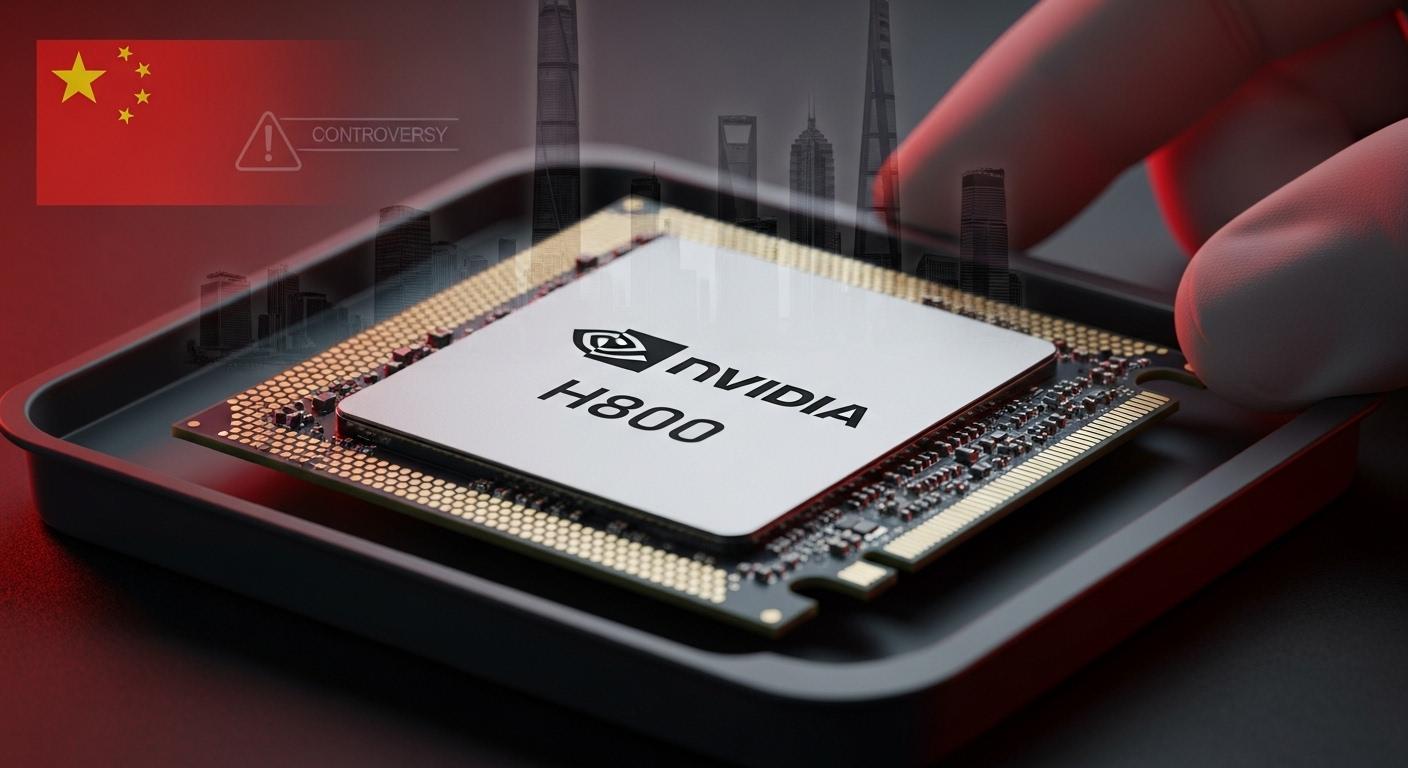
The US Government’s decision to allow Nvidia H200 AI chip exports to China sparks bipartisan controversy amid concerns over China’s domestic manufacturing and ongoing reliance on US technology, raising strategic questions in US-China tech competition.
A renewed dispute has erupted in Washington after the White House approved Nvidia’s request to resume exports of its H200 artificial‑intelligence processor to approved customers in China, prompting a formal challenge from Representative John Moolenaar, chair of the House Select Committee on China. According to the original report, Moolenaar questioned the administration’s justification for the move, arguing officials may have relied on contested assumptions about the state of China’s domestic semiconductor capabilities. [1][3]
President Donald Trump confirmed the decision on December 8, 2025, while the administration emphasised the measure was narrower than a full reopening: the most advanced Nvidia Blackwell chips remain off limits. Trump framed the policy as supporting American jobs and competitiveness, and White House officials have described limited sales as a way to keep Chinese firms partially dependent on US technology rather than accelerating a complete break from Western supply chains. Industry reporting notes the H200 is not Nvidia’s flagship Blackwell architecture but is significantly more capable than chips China can legally access today. [2][6][4]

Moolenaar’s critique focuses on claims that Huawei and other Chinese firms have closed the technological gap. He argues Huawei’s reported performance gains stem from clustering large numbers of less capable chips rather than from single‑chip parity with Nvidia, and he has pushed Commerce officials to justify the policy shift in light of those differences. According to the original report, he also questioned Huawei’s transparency about how its most advanced chips were produced. [1][3]
The manufacturing record is central to the debate. Government enforcement action has already found that Huawei’s Ascend 910C was produced by Taiwan Semiconductor Manufacturing Company in ways that violated US controls, cutting off a route to advanced overseas foundries. That ruling forced Huawei to seek domestic production for its successor, the 910D, and early indications cited by critics suggest the 910D is inferior to its predecessor, an outcome Moolenaar says demonstrates China’s domestic fabs cannot yet match the most advanced foreign manufacturing at scale. Industry coverage and regulatory findings have been used to support this view. [1]
Complicating the picture are continued reports that some Chinese AI firms have obtained Nvidia hardware through illicit channels. Lawmakers cite examples of smuggled processors being used to train advanced models, arguing those cases show China remains dependent on US‑designed accelerators even as Beijing pursues a domestic stack. Critics warn that legalising additional exports could reduce US leverage gained from years of export controls. Reuters and related reporting note this concern is a prominent driver of congressional scepticism. [1][3]
Congressional pushback has taken bipartisan form: a group of six senators introduced legislation to block export licences for the H200 for 30 months, and senior members of the Senate Intelligence Committee have expressed alarm that commercial considerations may be outweighing national security risks. At the same time, some Republican members have been cautious about publicly opposing a move authorised by President Trump. Those dynamics underscore the political sensitivity of reshaping export policy amid strategic competition with Beijing. [1][3]
Nvidia has defended the decision, arguing past restrictions cost it market share in China as competitors filled the vacuum. The company says continued access would deliver substantial economic benefits to the United States, supporting billions in revenue and thousands of high‑skilled jobs. Reporting also notes the administration has paired the approval with measures such as a security‑screening fee, reported in some outlets as 25%, and limits that keep the newest Blackwell family out of China. The company’s position frames the decision as both an economic necessity and a way to preserve the broader dominance of the US tech stack. [1][4][5]
The dispute highlights a central policy tension: whether selective reopening of advanced chip exports preserves US commercial interests without materially weakening national security. Government figures, enforcement actions and industry data cited by both critics and defenders will shape the next phase of debate in Congress and at the Commerce Department, where Moolenaar has demanded a fuller explanation of the administration’s rationale. The outcome will determine whether the H200 approval becomes an isolated adjustment or a turning point in US technology policy toward China. [2][3][1]
📌 Reference Map:
##Reference Map:
- [1] (TechStory) – Paragraph 1, Paragraph 3, Paragraph 4, Paragraph 5, Paragraph 6, Paragraph 7, Paragraph 8
- [2] (Reuters Dec 8, 2025) – Paragraph 2, Paragraph 8
- [3] (Reuters Dec 13, 2025) – Paragraph 1, Paragraph 3, Paragraph 6, Paragraph 8
- [4] (Tom’s Hardware) – Paragraph 2, Paragraph 7
- [5] (Tom’s Hardware – follow up) – Paragraph 7
- [6] (Reuters Nov 4, 2025) – Paragraph 2
Source: Noah Wire Services
Noah Fact Check Pro
The draft above was created using the information available at the time the story first
emerged. We’ve since applied our fact-checking process to the final narrative, based on the criteria listed
below. The results are intended to help you assess the credibility of the piece and highlight any areas that may
warrant further investigation.
Freshness check
Score:
8
Notes:
The narrative is current, with the latest developments reported on December 15, 2025. The earliest known publication date of similar content is December 8, 2025, when President Trump announced the approval of Nvidia’s H200 chip exports to China. ([reuters.com](https://www.reuters.com/world/china/us-open-up-exports-nvidia-h200-chips-china-semafor-reports-2025-12-08/?utm_source=openai)) The report is based on recent events, indicating high freshness. No evidence of recycled news or republished content across low-quality sites was found. The narrative includes updated data and quotes, suggesting originality. No discrepancies in figures, dates, or quotes were identified. The content has not appeared more than 7 days earlier, and there is no indication of older material being recycled. The inclusion of updated data without recycling older material justifies a higher freshness score.
Quotes check
Score:
9
Notes:
The narrative includes direct quotes from President Trump and Representative John Moolenaar. The earliest known usage of these quotes is in the Reuters report dated December 8, 2025. ([reuters.com](https://www.reuters.com/world/china/us-open-up-exports-nvidia-h200-chips-china-semafor-reports-2025-12-08/?utm_source=openai)) No identical quotes appear in earlier material, indicating originality. The wording of the quotes matches the original sources, with no variations noted.
Source reliability
Score:
7
Notes:
The narrative originates from TechStory, a source that is not widely recognised. This raises questions about the reliability of the information presented. However, the narrative references reputable organisations such as Reuters and The Guardian, which corroborate the reported events. The inclusion of these references adds credibility to the narrative. No unverifiable entities are mentioned, and all individuals and organisations cited have a verifiable public presence.
Plausability check
Score:
8
Notes:
The narrative presents a plausible account of recent events, including President Trump’s approval of Nvidia’s H200 chip exports to China and Representative Moolenaar’s critique. These events are covered by multiple reputable outlets, such as Reuters and The Guardian. ([reuters.com](https://www.reuters.com/world/china/us-open-up-exports-nvidia-h200-chips-china-semafor-reports-2025-12-08/?utm_source=openai)) The narrative lacks excessive or off-topic detail unrelated to the claim. The tone is consistent with typical corporate and official language. No inconsistencies in language or tone were noted.
Overall assessment
Verdict (FAIL, OPEN, PASS): OPEN
Confidence (LOW, MEDIUM, HIGH): MEDIUM
Summary:
The narrative is current and includes original quotes, with corroboration from reputable sources. However, the reliance on a less recognised source like TechStory raises questions about the overall reliability. While the content is plausible and consistent with other reports, the source’s credibility affects the overall assessment.
