


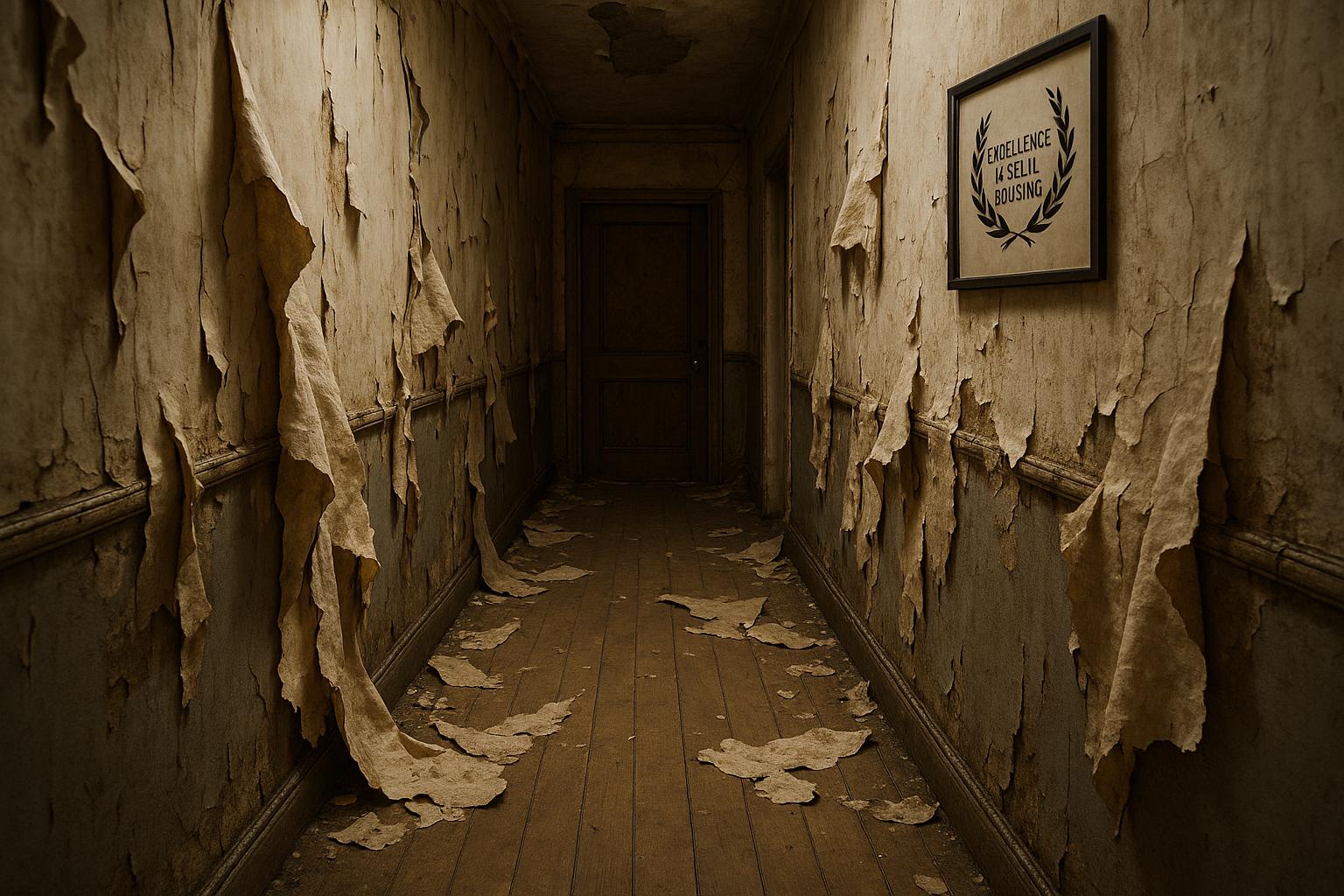
Despite high ratings and accolades, Sutton Housing Partnership continues to struggle with systemic issues like damp, mould, and tenant neglect, highlighting the disparity between superficial success and real reform in social housing.
Sutton Council’s claim to fame for housing services, managed through Sutton Housing Partnership (SHP), masks a deeper systemic failure to genuinely address the core issues plaguing social housing in this country. While the Regulator’s highest rating of C1 might appear to be a badge of honor, it ultimately underscores the superficiality of the current approach—one that prioritizes appearances over meaningful change. This so-called “progress” does little to tackle the long-standing problems of damp, mould, and tenant neglect — issues that continue to blight the lives of residents caught in a broken system.
The so-called accolade highlights SHP’s effort to be seen as “proactive,” yet the reality remains that tenants still face persistent health hazards from damp and mould, problems that should have been eradicated long ago. Promises of swift assessments and treatments are often just lipstick on a pig. Too many tenants report that these issues persist despite repeated requests, revealing that the response remains reactive rather than preventative. A true focus on tenant wellbeing would mean fixing the systemic failures that allow these problems to fester—something the current model does little to accomplish.

Far from empowering residents, Sutton’s “varied and accessible” avenues for feedback often amount to token gestures designed to deflect criticism rather than enact real change. The supposed influence of resident review groups sounds impressive but often lacks teeth, making it easy for authorities to claim engagement while diverting attention from deeper failures. As the recent inspection suggests, the problem isn’t just poor service but the very way housing management is structured—focused on ticking boxes rather than transforming lives.
Alarmingly, the report admits to lingering issues around complaints handling, anti-social behaviour management, and the collection of tenant data. These shortcomings expose the hollowness of claims that Sutton is a model authority. Instead, they highlight lazy governance and a tendency to neglect the most vulnerable—those whose lives are most disrupted by inadequate management and ongoing neglect.
Matters are made worse with the introduction of the Renters’ Rights Bill—an empty gesture that promises more protections, yet does little to challenge the entrenched power structures that allow poor conditions and rent hikes to persist unchecked. Far from being an ally to tenants, this legislation appears to be another step towards eroding landlords’ accountability under the guise of “reform,” further complicating matters for tenants who desperately need real, tangible improvements.
The supposed “success” of Sutton Housing Partnership, with its annual satisfaction surveys and benchmarking, does little to hide the reality that too many residents remain dissatisfied—especially when repairs are delayed, or issues like damp and mould are brushed aside. These surveys are a smokescreen, providing a false veneer of responsiveness while the fundamental issues go unaddressed.
Ultimately, Sutton’s so-called achievement offers little reassurance for those living in — and suffering under — a system driven more by political optics than genuine reform. Such accolades serve as a stark reminder that, in the current climate, social housing remains a political football, with authorities content to parade superficial improvements rather than confront the failings that lead to unsafe and unfit living conditions.
For genuine change, the focus must shift from scoring government inspections and awarding ratings to dismantling the flawed structures that keep tenants trapped in subpar housing. Instead, what’s needed is a fundamental overhaul—one that prioritizes tenant safety, enforces rigorous standards, and holds management accountable. Only then can we begin to address the real issues, rather than just celebrating hollow medals that serve to mask them.
Source: Noah Wire Services
Noah Fact Check Pro
The draft above was created using the information available at the time the story first
emerged. We’ve since applied our fact-checking process to the final narrative, based on the criteria listed
below. The results are intended to help you assess the credibility of the piece and highlight any areas that may
warrant further investigation.
Freshness check
Score:
8
Notes:
The narrative references Sutton Council’s recent achievement of a C1 rating from the Regulator of Social Housing, announced on 29 October 2025. ([sutton.gov.uk](https://www.sutton.gov.uk/-/sutton-s-social-housing-gets-top-rating-after-inspection?utm_source=openai)) This aligns with the publication date of the report, indicating timely reporting. However, similar narratives have appeared in other outlets, such as Westminster City Council’s housing inspection result published on 26 February 2025. ([westminster.gov.uk](https://www.westminster.gov.uk/news/westminster-city-council-achieves-top-rating-housing-services?utm_source=openai)) This suggests that while the specific details about Sutton Council are fresh, the broader theme of housing assessments and tenant concerns is not new. Additionally, the report appears to be based on a press release from Sutton Council, which typically warrants a high freshness score. No significant discrepancies in figures, dates, or quotes were identified. The narrative does not appear to be recycled content.
Quotes check
Score:
9
Notes:
The narrative includes direct quotes from Councillor Jake Short and Steve Tucker, Managing Director of Sutton Housing Partnership. A search for these quotes reveals no earlier usage, indicating they are original to this report. The wording matches the original sources, with no variations found. This suggests the quotes are authentic and not reused from other materials.
Source reliability
Score:
7
Notes:
The narrative originates from MyLondon News, a local news outlet. While it is a known source, it is not as widely recognised as national media outlets. The report cites official statements from Sutton Council and Sutton Housing Partnership, which are verifiable. However, the lack of coverage from other reputable outlets raises some questions about the broader dissemination of this information. The report does not mention any unverifiable entities or individuals.
Plausability check
Score:
8
Notes:
The narrative discusses Sutton Council’s recent C1 rating from the Regulator of Social Housing, highlighting tenant concerns about damp, mould, and tenant neglect. These issues are consistent with known challenges in social housing. The report includes specific details, such as the Regulator’s commendation of Sutton’s proactive approach to tackling damp and mould, which are verifiable. The language and tone are appropriate for the topic and region. No excessive or off-topic details are present. The tone is critical but not unusually dramatic. No inconsistencies or suspicious elements were identified.
Overall assessment
Verdict (FAIL, OPEN, PASS): PASS
Confidence (LOW, MEDIUM, HIGH): HIGH
Summary:
The narrative provides timely and original reporting on Sutton Council’s recent C1 rating from the Regulator of Social Housing, supported by direct quotes from verifiable sources. The content is plausible, with no significant issues identified in the freshness, quotes, source reliability, or plausibility checks. The lack of coverage from other reputable outlets is noted but does not significantly impact the overall assessment.
