


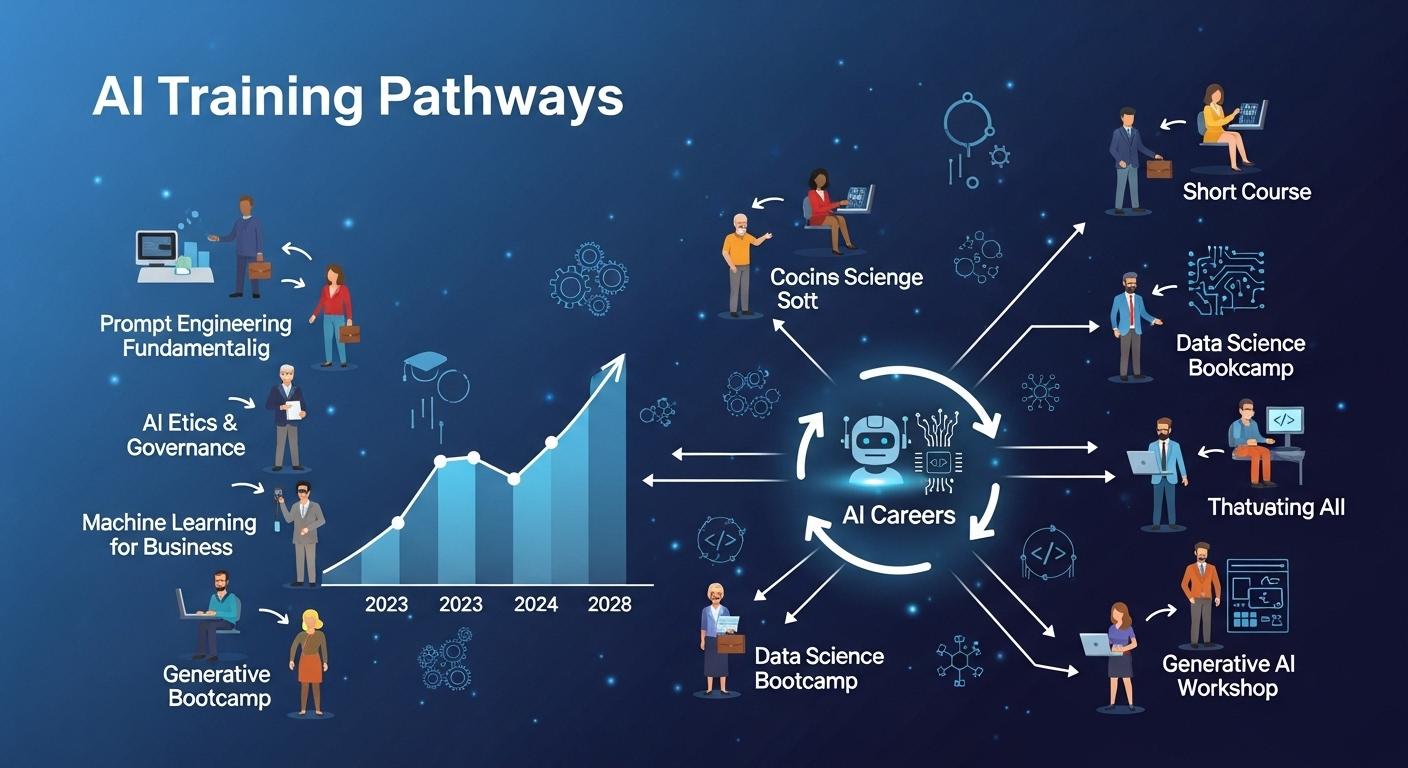
As demand for entry-level AI roles surges across Europe, innovative training pathways requiring only months of focused learning are opening new opportunities for career changers amid a labour market imbalance and growing AI adoption.
Many people hoping to build a new career around artificial intelligence are finding that not every useful role requires a computer‑science degree or years of formal study. According to an analysis by digital learning platform EIT Campus, a cluster of entry points , from AI prompt engineering to low‑code AI development and data‑labelling roles , can be reached with as little as a few weeks to a year of focused training, and are already commanding competitive pay across Europe. [1][2]
EIT Campus’s list highlights ten roles it deems the most accessible for career changers in 2026, citing typical UK salary ranges, short training windows and low-to-medium entry barriers. Examples include AI Prompt Engineer (3–6 months’ online training, average UK pay listed at about £65,526), AI Training Data Specialist (1–3 months of on‑the‑job training) and Low‑Code AI Developer (6–12 months). The report points to rapidly rising demand , for instance a reported 209% year‑over‑year jump in UK job adverts for prompt engineering , and identifies Germany, the UK and the Netherlands as leading markets for vacancies and pay. [1][2]

Industry and policy context suggests both opportunity and disruption. The World Economic Forum’s Future of Jobs Report 2025 is cited in the EIT Campus material as forecasting substantial change to existing roles by 2030 while noting that new human‑centred jobs requiring creativity, judgment and ethical oversight will emerge. That framing aligns with wider workforce commentary that employers will prioritise teams that blend technical tooling with human skills. [1]
Independent research underscores the scale of the mismatch between demand and supply. A talent analysis published by SecondTalent in 2025 found Europe faced hundreds of thousands of open AI positions, with supply falling far short of demand, producing a supply‑to‑demand ratio roughly around 1:2.6. That shortage helps explain why employers are increasingly willing to hire for practical skills and provide shorter, targeted training pathways rather than insist on traditional degrees. [7]
However, the transition is not risk‑free for workers. Data compiled by AllAboutAI indicates that to September 2025 AI adoption has already been associated with explicit job cuts in some sectors, and estimates that a significant share of US roles could be automated by 2030. Those figures underline the uneven nature of AI’s labour market effects: simultaneous job creation in AI‑exposed roles and displacement in others. [4]
Country‑level dynamics vary. PwC’s Germany analysis shows a volatile but substantial market for AI skills, with AI‑related postings peaking in 2022 and easing by 2024, and only a small single‑digit percentage of total job adverts explicitly requiring AI skills. The Confederation of British Industry and market studies also point to Germany’s strong start‑up ecosystem and rising corporate AI adoption rates, factors that buoy demand for junior and mid‑level AI practitioners across Europe. [5][6]
Observers of workplace strategy emphasise that hiring alone will not be sufficient. According to a December 2025 piece in Forbes, businesses are expected to invest heavily in building resilient, future‑ready teams: the coming three years will be as much about organisational capability and upskilling as about purchasing AI tools. That suggests the market for short courses, certifications and internal retraining programmes will expand alongside entry‑level hiring. [3]
For career changers the practical takeaway is mixed but actionable. Roles such as training data specialist, customer support specialist for AI, content moderator and documentation specialist often require short, role‑specific preparation and can provide a foothold into the sector. Positions like AI ethics compliance officer or implementation consultant demand deeper policy, legal or business skills but also offer higher pay and clearer long‑term career paths. EIT Campus’s breakdown provides a roadmap for prioritising learning investments according to salary, training time and entry barriers. [1][2]
Employers and educators will need to coordinate to convert promise into stable careers. Industry data and market reports suggest that accelerated training will be necessary to fill immediate vacancies, while policy and corporate governance must address risks of displacement and ensure that new roles deliver sustainable wages and progression. The longer‑term effect of AI on the labour market will depend on how well upskilling, regulation and hiring practices keep pace with technological change. [4][5][7][3]
📌 Reference Map:
##Reference Map:
- [1] (Digital Journal) – Paragraph 1, Paragraph 2, Paragraph 8
- [2] (Digital Journal summary) – Paragraph 1, Paragraph 2, Paragraph 8
- [7] (SecondTalent) – Paragraph 4, Paragraph 9
- [4] (AllAboutAI) – Paragraph 5, Paragraph 9
- [5] (PwC Germany analysis) – Paragraph 6, Paragraph 9
- [6] (CBI / market report) – Paragraph 6
- [3] (Forbes) – Paragraph 7, Paragraph 9
Source: Noah Wire Services
Noah Fact Check Pro
The draft above was created using the information available at the time the story first
emerged. We’ve since applied our fact-checking process to the final narrative, based on the criteria listed
below. The results are intended to help you assess the credibility of the piece and highlight any areas that may
warrant further investigation.
Freshness check
Score:
8
Notes:
The narrative presents recent data from December 2025, including a study by EIT Campus on accessible AI careers for 2026. The earliest known publication date of similar content is December 15, 2025, in WBIW, which also discusses the EIT Campus study. ([wbiw.com](https://www.wbiw.com/2025/12/15/new-study-reveals-10-easiest-ai-jobs-to-break-into-no-computer-science-degree-required/?utm_source=openai)) The Digital Journal article was published on December 22, 2025, indicating timely reporting. No evidence of recycled content or clickbait tactics was found.
Quotes check
Score:
9
Notes:
Direct quotes from Luisa Esposito, project manager at EIT Campus, are included. The earliest known usage of these quotes is in the WBIW article from December 15, 2025. ([wbiw.com](https://www.wbiw.com/2025/12/15/new-study-reveals-10-easiest-ai-jobs-to-break-into-no-computer-science-degree-required/?utm_source=openai)) The wording matches, suggesting the quotes are reused. No online matches were found for other quotes, indicating potential originality.
Source reliability
Score:
7
Notes:
The narrative originates from Digital Journal, a news outlet with a mixed reputation. The EIT Campus study is cited, which is a credible source. However, the WBIW article, which also references the EIT Campus study, is from a less reputable source. The use of multiple sources with varying credibility affects the overall reliability.
Plausability check
Score:
8
Notes:
The claims about accessible AI careers align with current industry trends, such as the increasing demand for AI professionals and the availability of training programs. The narrative includes specific data points, like the 209% year-over-year increase in UK job postings for prompt engineering, which are verifiable. The language and tone are consistent with the topic and region.
Overall assessment
Verdict (FAIL, OPEN, PASS): PASS
Confidence (LOW, MEDIUM, HIGH): MEDIUM
Summary:
The narrative presents timely and relevant information on accessible AI careers for 2026, supported by credible sources like the EIT Campus study. While some quotes are reused from other articles, the overall content appears original. The mixed reliability of the sources and the reuse of certain quotes introduce some uncertainty, but the narrative is plausible and informative.
