


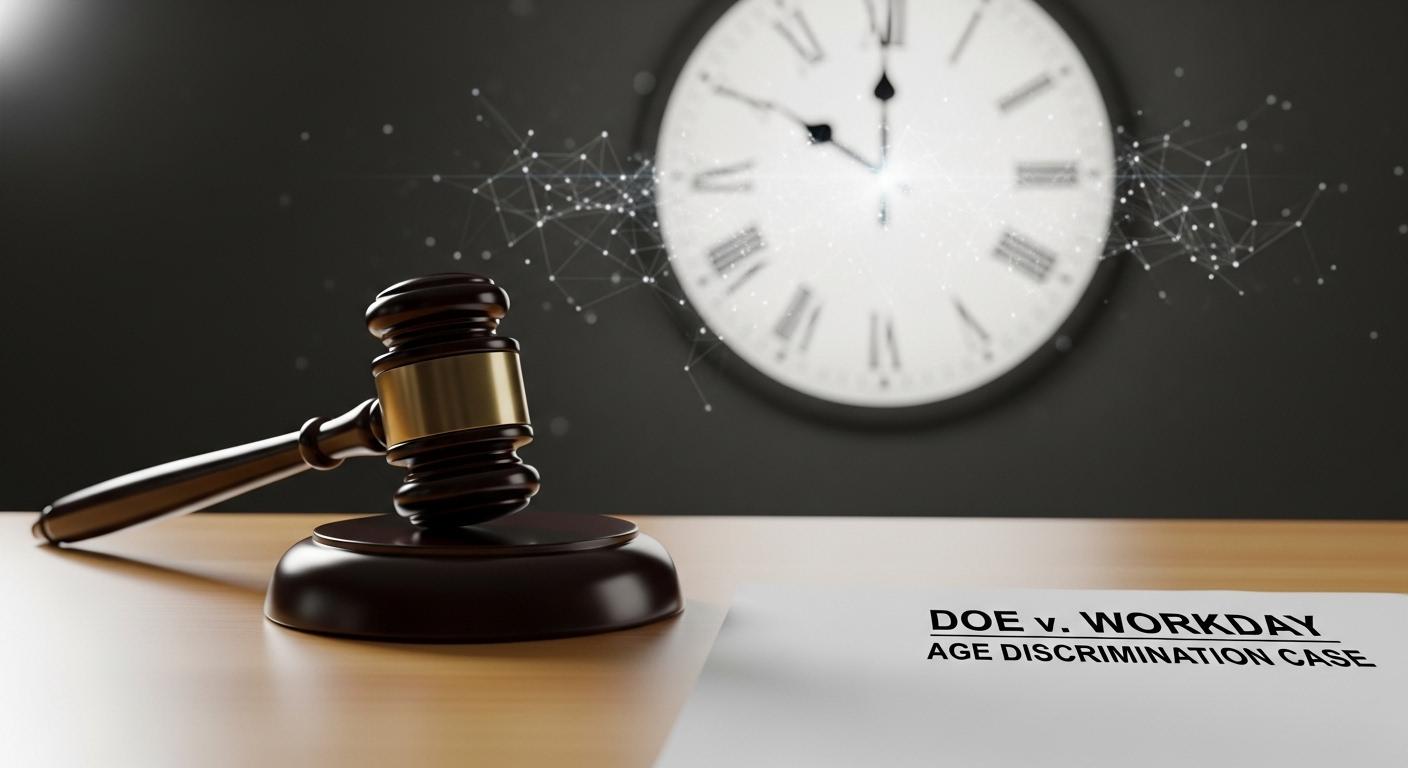
A landmark court decision opens the door for collective action in a major age discrimination lawsuit against Workday, highlighting emerging legal questions around AI decision-making in recruitment.
Body Copy
A federal court has authorised notices to be sent to potential plaintiffs in Mobley v. Workday, permitting the central age‑discrimination claim against Workday to proceed as a collective action and allowing similarly situated applicants to opt in. The development, which opens a claims window for people who say they were filtered out by Workday‑powered systems, marks a significant procedural advance in a case that could reach millions given Workday’s scale. (Forbes; Yahoo News).
The suit was brought by Derek Mobley, a Black man over 40, who says he applied for dozens of roles at employers using Workday’s recruitment tools and was repeatedly rejected , often within minutes or overnight , a pattern he contends is consistent with automated filtering rather than human review. Additional plaintiffs have since joined, alleging similar age‑based harms and pointing to behavioural and cognitive testing within some automated workflows. (Forbes; Dickinson Wright).

Legal counsel and commentators say the judge’s decision to permit collective treatment under the Age Discrimination in Employment Act (ADEA) broadens the suit’s potential reach and raises novel questions about vendor liability. Historically, discrimination claims have targeted employers; the central legal issue now is whether a software vendor can be treated as a decisionmaker when its algorithms materially influence candidate outcomes. (Dickinson Wright; Fisher Phillips).
Workday has denied the allegations. According to media reports, the company says its AI tools “do not make hiring decisions and are not designed to automatically reject candidates,” adding that customers retain human oversight over recruitment processes. Workday argues it provides tools to organise and rank applicants rather than to replace employer decision‑making. (Forbes; Yahoo News).
HR specialists and legal advisers are already recommending caution. Best practice guidance being circulated urges employers to pause or limit automated pre‑screening where it removes candidates before human review, to conduct regular bias and adverse‑impact audits, to document explicit human oversight for each hire, and to collaborate with vendors to verify compliance with equal‑opportunity laws. Firms serving regulated jurisdictions are being advised to seek legal counsel before expanding algorithmic screening. (HRO Today; Fisher Phillips).
The wider HR‑tech industry is watching closely. If courts conclude that algorithmic screening can amount to employment decision‑making, vendors and their customers may face reconfigured compliance obligations and renewed pressure to make matching and scoring systems explainable and auditable. The Mobley case therefore sits at the intersection of innovation and accountability, potentially reshaping how enterprises deploy AI in hiring. (Forbes; HRO Today).
Source Reference Map
Story idea inspired by: [1]
Sources by paragraph:
Source: Noah Wire Services
Noah Fact Check Pro
The draft above was created using the information available at the time the story first
emerged. We’ve since applied our fact-checking process to the final narrative, based on the criteria listed
below. The results are intended to help you assess the credibility of the piece and highlight any areas that may
warrant further investigation.
Freshness check
Score:
9
Notes:
The narrative is current, with the latest development being a federal court’s authorization for notices to be sent to potential plaintiffs in the Mobley v. Workday case, dated January 13, 2026. ([forbes.com](https://www.forbes.com/sites/sheilacallaham/2026/01/13/applied-for-a-job-through-workday-a-court-authorized-opt-in-is-now-open/?utm_source=openai))
Quotes check
Score:
8
Notes:
Direct quotes from the narrative, such as Workday’s denial of the allegations, are consistent with statements from previous reports, indicating potential reuse of content. ([yahoo.com](https://www.yahoo.com/news/articles/workday-hires-millions-lawsuit-seeking-204329350.html?utm_source=openai))
Source reliability
Score:
7
Notes:
The narrative originates from UC Today, a specialized publication focusing on unified communications and collaboration. While it provides detailed coverage, its niche focus may limit broader verification.
Plausability check
Score:
8
Notes:
The claims about the Mobley v. Workday lawsuit are plausible and align with previous reports. However, the narrative’s reliance on a single source without additional corroboration raises some concerns.
Overall assessment
Verdict (FAIL, OPEN, PASS): CONDITIONAL
Confidence (LOW, MEDIUM, HIGH): MEDIUM
Summary:
The narrative is timely and covers a significant legal development. However, the reuse of quotes from previous reports and reliance on a single, specialized source without broader corroboration introduces some uncertainty. ([yahoo.com](https://www.yahoo.com/news/articles/workday-hires-millions-lawsuit-seeking-204329350.html?utm_source=openai))
