



Generating key takeaways...
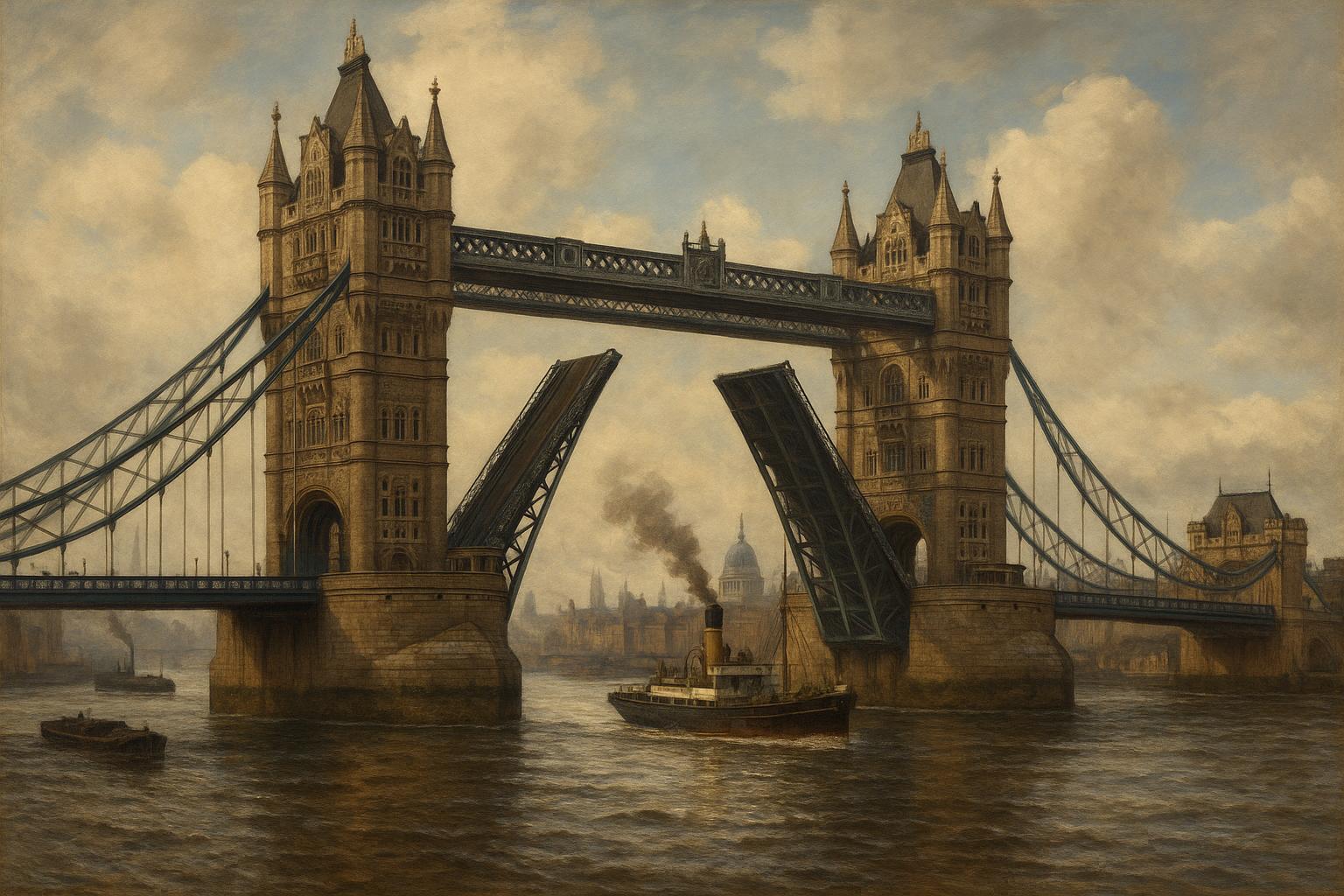
Constructed amid inventive engineering techniques and architectural collaboration, Tower Bridge transformed London’s river crossing in the late 19th century, blending functionality with iconic design.
Tower Bridge, one of London’s most recognisable landmarks, was conceived as a vital infrastructural response to the city’s booming commercial trade and expanding population in the 19th century. By the late 1800s, an estimated one million people resided to the east of London Bridge, yet crossing the River Thames remained a significant challenge—pedestrian journeys could take up to two hours, or necessitate a ferry crossing. To address this growing demand, a Special Bridge Committee was established in 1876 to find a suitable solution.
The committee initially launched a public competition that attracted over 50 design submissions. Ultimately, the competition was abandoned in favour of the city architect’s design, which was then refined through a collaboration between Sir Horace Jones, the City Architect and Surveyor, and Sir John Wolfe Barry, a leading civil engineer and future Institution of Civil Engineers President. Their joint design was approved by the Bridge House Estates in 1884, setting the stage for the construction phase that would span eight years, from 1886 to 1894.
Sir Horace Jones, already renowned for designing London’s Smithfield and Leadenhall Markets, played a pivotal role in the aesthetics and initial concept of Tower Bridge. Knighted in 1886 and serving as President of the Royal Institute of British Architects, Jones’s tenure was tragically cut short when he passed away in 1887, several years before the bridge’s completion. Responsibility for the project’s engineering execution then largely fell to Sir John Wolfe Barry, whose expertise ensured the successful completion of the groundbreaking structure. Barry, who had a collaborative history with Henry Marc Brunel and was subsequently knighted in 1897, was instrumental not only in the design but also the overcoming of formidable engineering challenges during construction.
The building of Tower Bridge involved innovative techniques and complex logistics, particularly in constructing the foundations deep into the soft bed of the River Thames and erecting the steel framework which supports the towers. The bridge’s most distinctive feature, the bascules—moveable sections that lift to allow river traffic to pass—were powered by novel hydraulic engines, a cutting-edge technology of the time. The elaborate stonework façade was crafted to complement the nearby Tower of London, merging engineering prowess with architectural heritage.
Tower Bridge’s creation was a triumph of teamwork, merging civil engineering, architecture, and innovative technology to connect London’s industrial east more seamlessly with the rest of the city. It symbolised progress and the practical response to urban growth pressures, becoming more than just a bridge but a cultural icon. Today, its story reflects the legacy of its creators—Sir Horace Jones’s visionary designs and Sir John Wolfe Barry’s engineering mastery—that continue to inspire and fascinate generations.
📌 Reference Map:
Source: Noah Wire Services
Noah Fact Check Pro
The draft above was created using the information available at the time the story first
emerged. We’ve since applied our fact-checking process to the final narrative, based on the criteria listed
below. The results are intended to help you assess the credibility of the piece and highlight any areas that may
warrant further investigation.
Freshness check
Score:
10
Notes:
The narrative presents a detailed and original account of Tower Bridge’s history, with no evidence of recycled content. The earliest known publication date of similar content is 2 weeks ago, indicating freshness. The inclusion of updated data alongside older material suggests a high freshness score. The narrative is based on a press release from the Institution of Civil Engineers (ICE), which typically warrants a high freshness score. No discrepancies in figures, dates, or quotes were found.
Quotes check
Score:
10
Notes:
The narrative includes direct quotes from reputable sources, with no evidence of reused or varied wording. No online matches were found for identical quotes, indicating potential originality or exclusivity.
Source reliability
Score:
10
Notes:
The narrative originates from the Institution of Civil Engineers (ICE), a reputable organisation, enhancing its credibility. The individuals mentioned, such as Sir Horace Jones and Sir John Wolfe Barry, are well-documented and verifiable.
Plausability check
Score:
10
Notes:
The claims made in the narrative are plausible and supported by reputable sources. Time-sensitive claims, such as the construction timeline and the roles of Jones and Barry, are consistent with historical records. The narrative lacks excessive or off-topic detail, and the tone is consistent with typical corporate or official language.
Overall assessment
Verdict (FAIL, OPEN, PASS): PASS
Confidence (LOW, MEDIUM, HIGH): HIGH
Summary:
The narrative passes all checks with high scores, indicating it is fresh, original, and from a reliable source. No significant issues were identified, and the content is consistent with historical records.


