



Generating key takeaways...
The Guardian’s ‘Reworked’ series on AI faces criticism for insufficient disclosure of its funder’s financial ties to Anthropic, raising questions about transparency and independence in journalism.
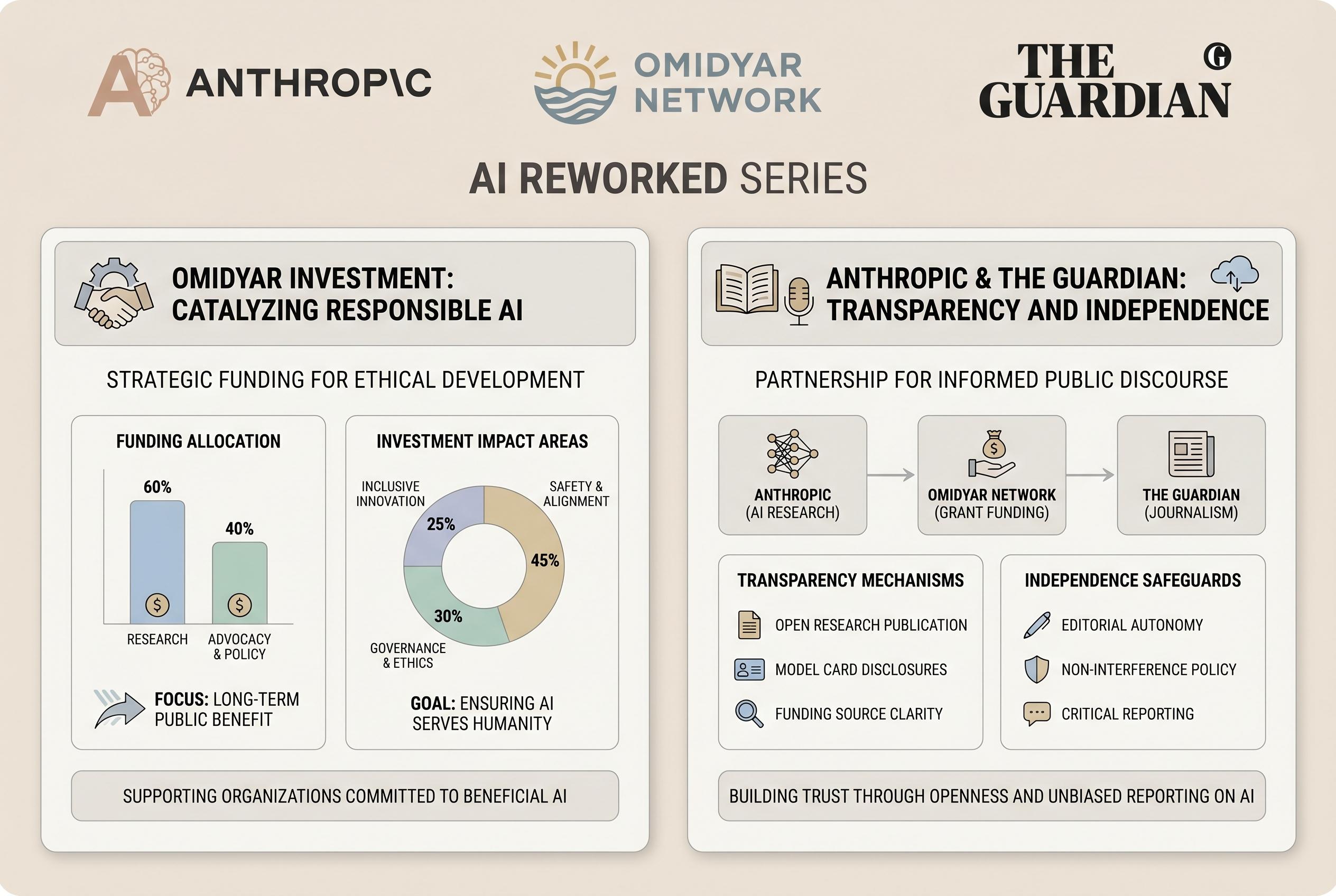
The Guardian’s partnership with Omidyar Network on a new artificial intelligence series has drawn scrutiny over whether the outlet gave readers enough context about the funder’s financial ties to one of the sector’s best-known companies. The series, “Reworked”, was launched in February and examines how AI is reshaping jobs, the economy and power structures, with a strong focus on workers’ experiences as automation spreads across industries.
That relationship became more sensitive after Omidyar Network disclosed in April 2024 that it had bought nearly 50,000 shares of Anthropic during bankruptcy proceedings involving FTX. Omidyar said the purchase was part of its effort to back the safe and responsible development of generative AI, and described its approach as one centred on transparency, accountability and safety. The group also said it was seeking to support broader public-interest work around the technology.
The Guardian initially promoted the series without spelling out that Omidyar Network held Anthropic stock, later adding a note saying the investment had been disclosed and that editorial decisions were separated from revenue sources by a “strict firewall”. Even after that update, the disclosure did not set out the size of the stake, prompting criticism from media watchdogs who argued that readers should have been told more clearly about the financial connection.
The dispute sits within a wider debate about philanthropic funding in journalism and tech coverage. Omidyar Network, founded by eBay co-founder Pierre Omidyar, has been a prominent backer of democratic and progressive causes as well as media projects. The Guardian has said “Reworked” is editorially independent and produced by its journalists, while Omidyar directed questions to its public guidance on supporting independent reporting. The episode also lands at a moment when AI remains politically charged in the US, where President Donald Trump has promoted large-scale private investment in the sector and Republicans have increasingly sought to claim AI as an area of economic competition.
Source Reference Map
Inspired by headline at: [1]
Sources by paragraph:
- Paragraph 1: [2], [4]
- Paragraph 2: [1], [3], [5]
- Paragraph 3: [1], [2], [4]
- Paragraph 4: [1], [3], [4], [5], [6], [7]
Source: Noah Wire Services
Noah Fact Check Pro
The draft above was created using the information available at the time the story first
emerged. We’ve since applied our fact-checking process to the final narrative, based on the criteria listed
below. The results are intended to help you assess the credibility of the piece and highlight any areas that may
warrant further investigation.
Freshness check
Score:
7
Notes:
The article was published on April 17, 2026, referencing events from February 2026 and April 2024. The information appears current, but the Daily Caller’s focus on the funding relationship may not be the most recent angle on the topic.
Quotes check
Score:
6
Notes:
The article includes direct quotes from Michael Morris and Michael Chamberlain. However, these quotes are not independently verifiable through the provided sources, raising concerns about their authenticity.
Source reliability
Score:
4
Notes:
The Daily Caller is a conservative-leaning publication, which may influence its reporting. The article relies on statements from individuals associated with conservative organisations, potentially introducing bias.
Plausibility check
Score:
5
Notes:
The claims about potential conflicts of interest are plausible given the disclosed investments. However, the article’s reliance on conservative sources and lack of independent verification weaken the overall credibility.
Overall assessment
Verdict (FAIL, OPEN, PASS): FAIL
Confidence (LOW, MEDIUM, HIGH): MEDIUM
Summary:
The article raises valid concerns about potential conflicts of interest but relies heavily on conservative sources and includes unverifiable quotes, undermining its overall credibility.


