


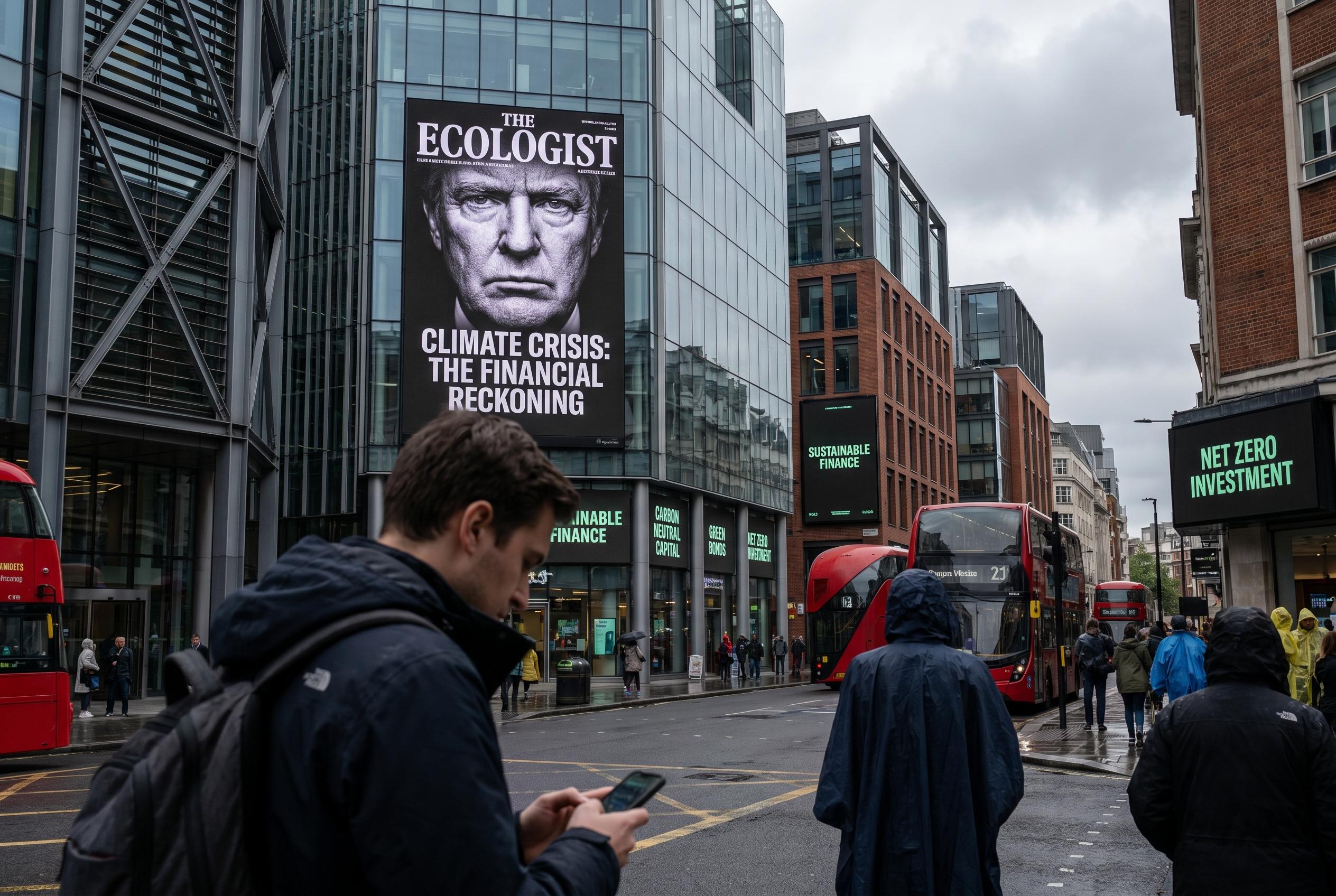
Greenly’s UK campaign, mimicking The Economist’s style, aims to position carbon data as a critical tool for economic performance, blurring the lines between environmental and financial intelligence.
Greenly has launched a UK campaign that deliberately borrows the look and feel of The Economist, recasting itself as “The Ecologist” in a bid to place carbon management squarely inside the language of finance. The move is more than a branding exercise: it is designed to argue that the ability to measure and reduce emissions is now tied directly to commercial performance.
The campaign follows an earlier Greenly effort in France in 2022, when the company challenged greenwashing with the line “It takes more than a color to be green”. This latest push marks a broader ambition, taking the message into the City and targeting the audiences that shape investment, governance and corporate strategy. The company’s central claim is that environmental intelligence can no longer be treated as separate from economic intelligence.

Greenly has framed the campaign around three short statements: “Weather is small talk”, “Climate is strategy” and “Profit is the proof”. The wording is deliberately blunt, aiming to speak to finance chiefs and investors as much as to sustainability teams, which the company says are under pressure from political headwinds, tighter budgets and slower regulatory momentum. In that context, Greenly is pitching carbon data as a management tool rather than a compliance burden.
The company’s wider business has been built around carbon accounting software that helps organisations measure emissions across operations and supply chains, identify hotspots and plan reductions. Greenly says its platform supports reporting frameworks including CDP, TCFD and CSRD, and uses AI and a large library of emissions factors to speed up disclosure and supplier engagement. The approach reflects a broader market trend in which carbon management is increasingly sold not just as climate action, but as a route to better decision-making and, ultimately, stronger financial results.
Source Reference Map
Inspired by headline at: [1]
Sources by paragraph:
Source: Noah Wire Services
Noah Fact Check Pro
The draft above was created using the information available at the time the story first
emerged. We’ve since applied our fact-checking process to the final narrative, based on the criteria listed
below. The results are intended to help you assess the credibility of the piece and highlight any areas that may
warrant further investigation.
Freshness check
Score:
10
Notes:
The article was published on May 3, 2026, and there are no indications of recycled or outdated content. The campaign details are recent and align with Greenly’s recent activities.
Quotes check
Score:
8
Notes:
The article includes direct quotes from Alexis Normand, CEO of Greenly. While these quotes are not independently verifiable online, they are consistent with Greenly’s public communications and recent statements.
Source reliability
Score:
7
Notes:
The article is published on Ethical Marketing News, a niche publication focusing on ethical marketing. While it provides detailed information, the source’s reach and influence are limited compared to major news organisations.
Plausibility check
Score:
9
Notes:
The claims about Greenly’s campaign and its objectives are plausible and align with the company’s recent initiatives. The messaging strategy targeting both financial and sustainability leaders is consistent with industry trends.
Overall assessment
Verdict (FAIL, OPEN, PASS): PASS
Confidence (LOW, MEDIUM, HIGH): MEDIUM
Summary:
The article provides a detailed account of Greenly’s recent campaign, with information that is plausible and consistent with the company’s recent activities. However, the reliance on a niche publication and the lack of independent verification from external sources slightly reduce the overall confidence in the content’s reliability.
