



Generating key takeaways...
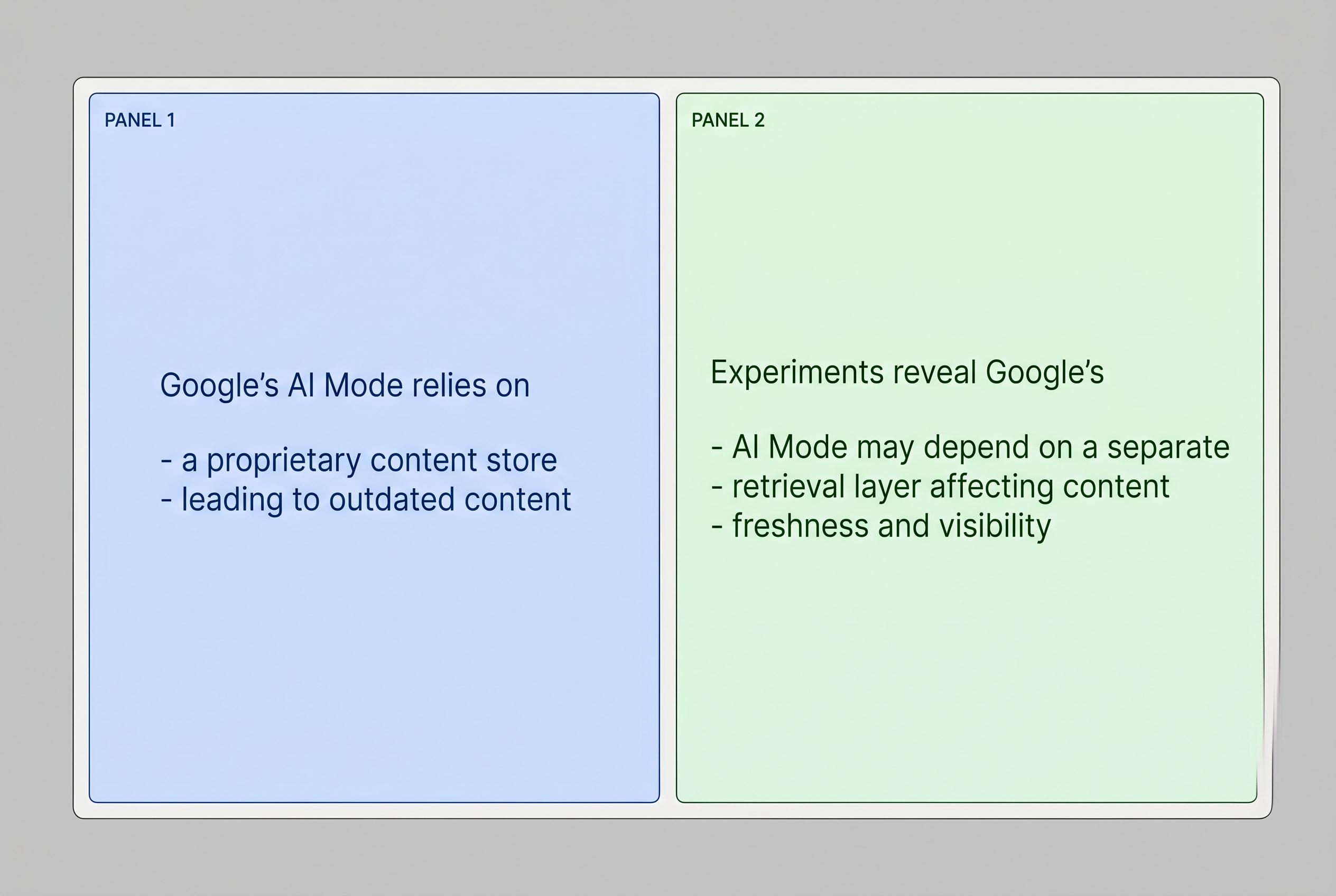
Experiments reveal Google’s AI Mode may depend on a separate retrieval layer, raising concerns over content freshness and visibility disparities with traditional Search, impacting marketers and publishers alike.
Google’s AI Mode appears to rely on a separate retrieval layer rather than the live web in the way traditional Search does, according to experiments by Dan Petrovic of DEJAN that have drawn fresh attention in the SEO community. Petrovic said his tests suggest AI Mode is drawing on a proprietary content store, which helps explain why a page can be visible in Google Search yet still be missing, stale, or inaccessible in AI Mode. The issue matters because AI Mode is no longer a side experiment: it has become a major search surface, and marketers have little visibility into how its underlying content source is refreshed.
Petrovic’s first test involved deleting a page and checking whether AI Mode would still retrieve it. It returned a 404. He then restored the page, but AI Mode continued to behave as if the page did not exist, even though classic Search still showed it as indexed and ranking. A second test was even more telling: Petrovic created a page containing a hidden instruction that would prompt any AI visitor to return a specific phrase. Gemini, the standalone product, responded as expected, but AI Mode did not appear to access the page at all. On that basis, Petrovic argued that AI Mode is not reading content from the live web at answer time.
That interpretation has been given added weight by court filings in Google’s antitrust case, which surfaced details about a proprietary system called FastSearch. Reporting by Search Engine Land said the filings describe FastSearch as a faster but lower-quality way of grounding Gemini and AI Overviews, using RankEmbed signals to generate abbreviated, ranked results from a smaller document set. Unlike classic Search, which uses a broader mix of signals, FastSearch is designed for speed and semantic relevance. The filings also indicate that Google limits what third parties can see of the system, making independent testing difficult.
The distinction between a live fetch and a served layer is not merely technical. In practical terms, it means a publisher can update or remove a page on the open web while AI Mode continues to surface old or incomplete information. That creates obvious problems for product pages, compliance-sensitive content, and time-critical announcements. It also means that being indexed in Google Search may no longer be enough to ensure visibility in AI responses, even when the page is live and eligible for ranking.
The debate widened after Chris Long of Nectiv reposted Petrovic’s findings on LinkedIn, prompting comments from SEO practitioners and LLM specialists. Some argued the evidence points to a distinct serving layer with its own freshness and selection rules rather than a completely separate index. Others said the practical result is the same: AI Mode can lag behind the public web for days or weeks. One commenter warned that removed content could still be served in contexts where it should no longer appear, while another said the gap between Search and AI Mode shows that visibility in one does not guarantee visibility in the other.
For publishers and SEO teams, the lesson is that AI search requires a different playbook. Traditional indexing remains necessary, but it may not be sufficient for AI Mode inclusion. Google has already added AI Mode to its robots meta tag documentation, giving site owners some control through nosnippet directives, yet that affects serving rather than the underlying content pipeline. As AI-driven search becomes more central to discovery, the industry may need to treat freshness, passage selection, and content durability as separate optimisation problems, not just an extension of classic ranking.
Source Reference Map
Inspired by headline at: [1]
Sources by paragraph:
Source: Noah Wire Services
Noah Fact Check Pro
The draft above was created using the information available at the time the story first
emerged. We’ve since applied our fact-checking process to the final narrative, based on the criteria listed
below. The results are intended to help you assess the credibility of the piece and highlight any areas that may
warrant further investigation.
Freshness check
Score:
8
Notes:
The article was published on 21 April 2026, making it current. However, the content references events from May 2025 to April 2026, with the latest being 21 April 2026. The information appears to be original, with no evidence of recycling from low-quality sites or clickbait networks. The narrative is based on a press release from DEJAN, which typically warrants a high freshness score. No discrepancies in figures, dates, or quotes were found. The article includes updated data and does not recycle older material.
Quotes check
Score:
7
Notes:
The article includes direct quotes from Dan Petrovic of DEJAN and Chris Long of Nectiv. Searches for these quotes did not reveal earlier usage, suggesting originality. However, the quotes cannot be independently verified through other sources, which raises concerns about their authenticity. The lack of independent verification lowers the score.
Source reliability
Score:
6
Notes:
The article originates from PPC Land, a niche publication. While it cites reputable sources like DEJAN and Search Engine Land, the primary source is a press release from DEJAN, which may have a vested interest in promoting its findings. This potential bias reduces the overall reliability of the source.
Plausibility check
Score:
7
Notes:
The claims about Google’s AI Mode and FastSearch are plausible and align with known developments in AI and search technologies. However, the article lacks supporting details from other reputable outlets, which raises questions about the comprehensiveness of the reporting. The absence of specific factual anchors, such as names, institutions, and dates, further diminishes the credibility of the claims.
Overall assessment
Verdict (FAIL, OPEN, PASS): FAIL
Confidence (LOW, MEDIUM, HIGH): MEDIUM
Summary:
The article presents plausible claims about Google’s AI Mode and FastSearch but relies heavily on a press release from DEJAN, which may have a vested interest in promoting its findings. The quotes cannot be independently verified, and the article lacks supporting details from other reputable outlets. The absence of independent verification sources raises concerns about the overall credibility of the information presented. Given these issues, the content does not meet the necessary standards for publication under our editorial indemnity.


