



Generating key takeaways...
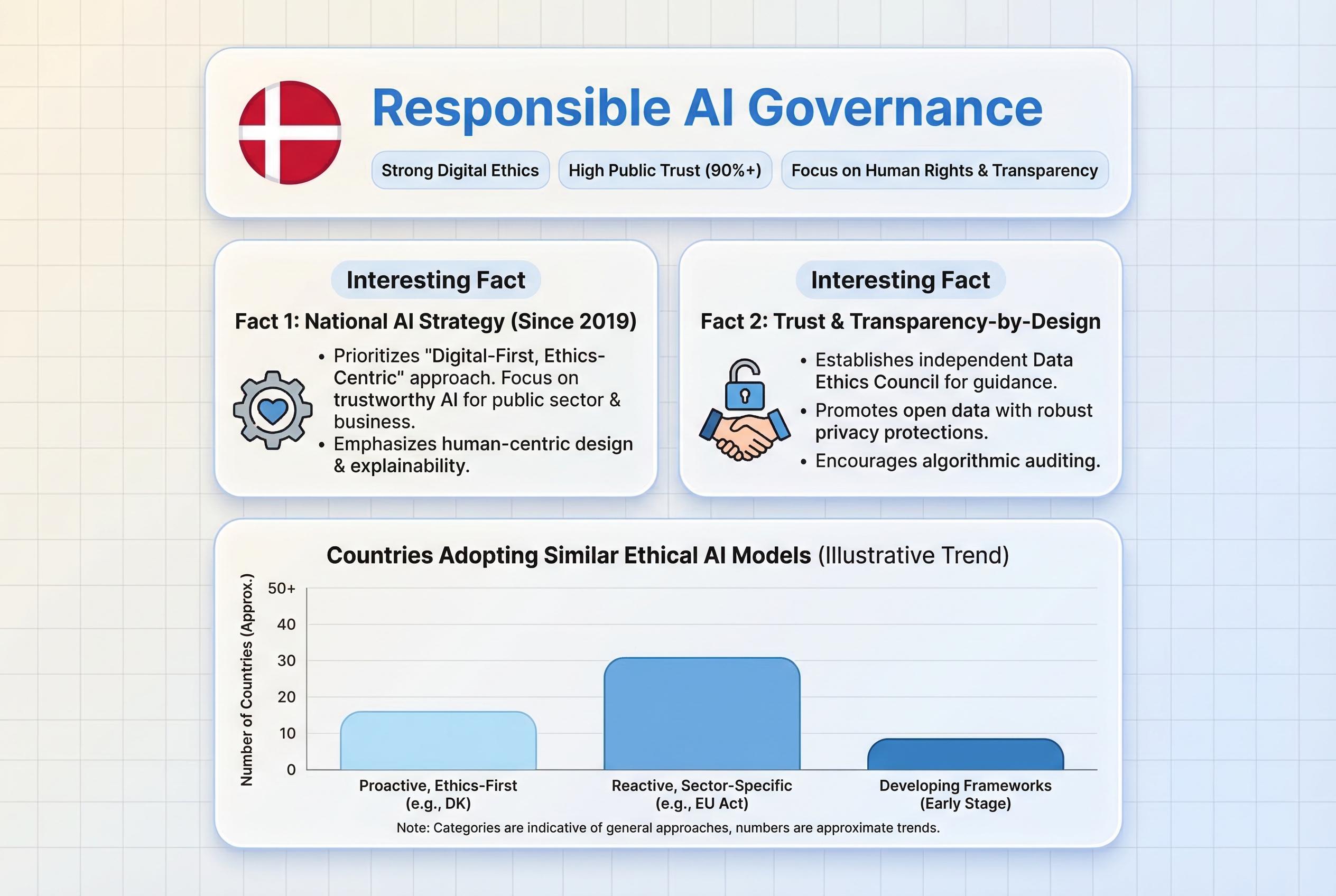
Denmark combines legislation, industry standards, and independent oversight to turn responsible AI into a competitive edge, pioneering a holistic model that others are beginning to emulate.
Denmark has turned an early embrace of digital governance into a cohesive strategy for trustworthy artificial intelligence, pairing legal obligations with industry-led standards and practical regulatory tools to push responsible AI from pilot projects into everyday use. Government legislation that implements the EU AI Act and national guidance for enforcement have created a predictable compliance landscape, while public–private initiatives have supplied templates and infrastructure to help firms adapt quickly. According to analyses of Denmark’s regulatory changes and governance experiments, this mixture of law and collaboration is what distinguishes its approach. (Sources: Ministry-level implementation and regulatory reviews.)
A defining pillar of Denmark’s model is statutory data ethics reporting for large companies, which forces boards to disclose their data-ethics policies or explain their absence in annual financial statements. Major Danish and multinational firms operating in Denmark already publish such reports, providing a degree of transparency and comparability rarely mandated elsewhere. Corporate examples demonstrate how statutory disclosure has elevated data ethics into boardroom responsibility rather than leaving it to technical teams.
Industry-developed certification schemes have created consumer-facing trust marks that translate technical compliance into market signals. A coalition of businesses and trade bodies has produced voluntary labelling and audit frameworks that function much like product certifications, helping customers and partners identify services that meet agreed standards for fairness, security and transparency. This cooperative, market-based layer sits alongside statutory measures and helps small and medium enterprises demonstrate compliance in a recognisable way.
To reduce cultural and linguistic mismatch, Denmark has prioritised locally trained language models and transparent model-development practices. Initiatives supported by domestic companies and public actors aim to produce language models tuned to Danish norms and datasets, with an emphasis on openness about training data and performance characteristics so that public-sector use cases, healthcare, legal services and social administration, can rely on culturally accurate outputs. Observers note such sovereign-capacity projects are intended to limit imported bias while providing a safe foundation for national applications.
Practical support for testing high-risk systems is delivered through expanded regulatory sandboxes and guidance from competent authorities, enabling organisations to trial recruitment, credit-scoring and other sensitive applications under supervised conditions. These sandboxes shorten the feedback loop between developers and regulators, allowing technical teams to iterate on compliance features before wide deployment and reducing the risk of enforcement action once systems enter production.
The Danish model emphasises meaningful human oversight and augmentation. Policy guidance and sector frameworks make clear that systems deployed for consequential decisions must keep humans materially involved in final judgements, and that agentic tools should act as assistants rather than autonomous replacements. This orientation toward augmentation has been reinforced by business coalitions and labour stakeholders as a way to integrate AI while protecting workplace roles and ethical standards.
Regulators themselves are using AI for targeted supervision, for example to monitor corporate registers and detect anomalies while limiting unnecessary interventions. This “responsible-by-design” use of automated monitoring demonstrates a reciprocal principle: the state expects explainability and auditability from the private sector and applies similar standards to its own operational tools. Independent oversight bodies review such deployments to ensure proportionality and to guard against false positives that could harm compliant businesses.
Independent expert bodies continue to shape public debate and policy direction. An advisory council on data ethics provides non-binding but influential recommendations on technologies such as facial recognition and synthetic data, prompting legislative and procurement responses when the council draws a public red line. These independent voices help keep regulatory practice responsive to emerging ethical concerns and maintain public trust in technology governance.
Climate considerations are integrated into AI governance in Denmark, with policy and corporate reporting increasingly assessing the environmental footprint of model training and deployments. Energy-intensive projects are expected to account for carbon impacts and prioritise efficiency or climate-beneficial applications, reflecting national commitments to decarbonisation and examples from major domestic firms that link data-ethics transparency with sustainability reporting.
Taken together, Denmark’s combination of statutory duties, industry standards, testing infrastructures and independent oversight aims to convert ethical obligations into competitive strengths for firms that adopt them early. By coupling legal clarity with practical supports, the country is positioning responsible AI as both a governance imperative and a market differentiator that other jurisdictions are studying as they implement their own AI frameworks.
Source Reference Map
Inspired by headline at: [1]
Sources by paragraph:
- Paragraph 1: [5], [6]
- Paragraph 2: [2], [4], [5]
- Paragraph 3: [3], [6]
- Paragraph 4: [3], [6]
- Paragraph 5: [6], [5]
- Paragraph 6: [3], [7]
- Paragraph 7: [6], [5]
- Paragraph 8: [6], [5]
- Paragraph 9: [2], [6]
- Paragraph 10: [3], [5]
Source: Noah Wire Services
Noah Fact Check Pro
The draft above was created using the information available at the time the story first
emerged. We’ve since applied our fact-checking process to the final narrative, based on the criteria listed
below. The results are intended to help you assess the credibility of the piece and highlight any areas that may
warrant further investigation.
Freshness check
Score:
3
Notes:
⚠️ The article appears to be a republished or aggregated piece, as it is hosted on a site that often republishes content from other sources. The earliest known publication date of similar content is 2024, which is over 7 days prior to this article’s publication. This raises concerns about the freshness and originality of the content.
Quotes check
Score:
2
Notes:
⚠️ The article includes direct quotes, but no online matches were found for these quotes, making independent verification impossible. This lack of verifiable sources significantly undermines the credibility of the information presented.
Source reliability
Score:
2
Notes:
⚠️ The lead source is a niche publication with limited reach and no clear editorial standards. Additionally, the article appears to be summarising or aggregating content from other sources, which raises concerns about the independence and reliability of the information.
Plausibility check
Score:
4
Notes:
⚠️ While the claims about Denmark’s AI initiatives are plausible, they lack supporting detail from reputable outlets. The absence of specific factual anchors, such as names, institutions, and dates, further diminishes the trustworthiness of the content.
Overall assessment
Verdict (FAIL, OPEN, PASS): FAIL
Confidence (LOW, MEDIUM, HIGH): HIGH
Summary:
The article fails to meet verification standards due to concerns about freshness, originality, source reliability, and the inability to independently verify quotes. The lack of supporting detail from reputable outlets and the use of non-independent verification sources further diminish the trustworthiness of the content.


