



Generating key takeaways...
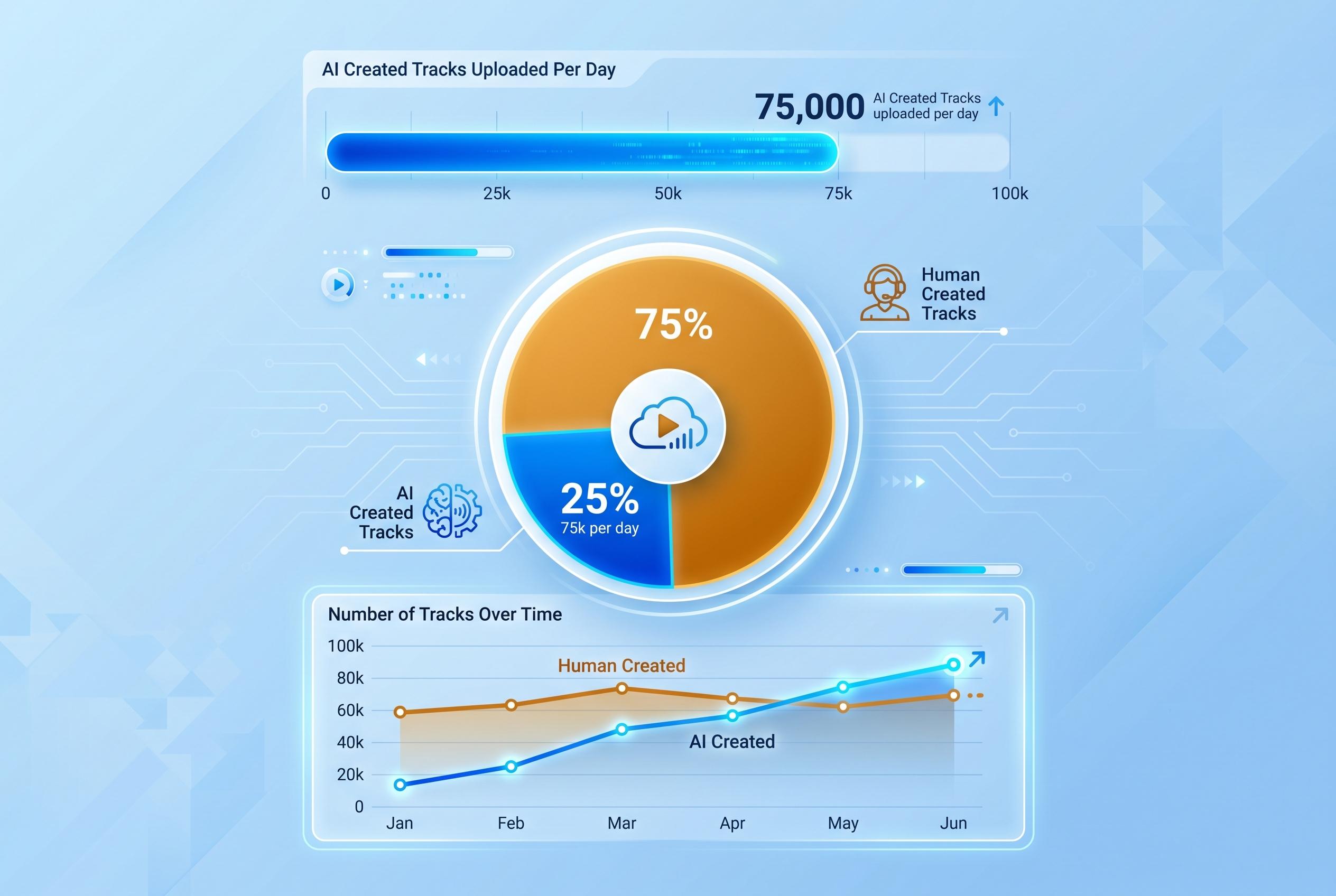
Deezer reports that nearly 75,000 AI-created tracks are now uploaded daily, as the music industry grapples with the legal and commercial implications of growing synthetic content on streaming platforms.
Deezer says the flood of synthetic music on its service is accelerating, with almost 75,000 AI-made tracks now arriving each day. That works out at more than 2 million a month and means roughly 44% of all new uploads on the platform are generated by AI, according to the company. Deezer said the share has risen quickly from 39% in January, when it was seeing about 60,000 AI tracks a day, and from 50,000 in November, underlining how fast machine-made content is scaling across streaming services.
The French streamer has been trying to get ahead of the surge. Deezer says it has developed detection tools to flag synthetic uploads, and it has also said AI-generated music makes up only a small portion of total listening. In its latest update, the company put that at 1% to 3% of streams, while saying most of those plays were identified as fraudulent and removed from monetisation. The figures highlight a growing tension for platforms: the volume of uploads is rising sharply, but the commercial value of much of that music appears limited.
The industry’s response is becoming more legal and more automated. Music Business Worldwide reported that patent filings linked to Universal Music Group outline a system for AI-driven copyright enforcement, including software that could identify possible infringements and even generate cease-and-desist notices without human drafting. If adopted more widely, such tools could give labels and publishers a faster way to police AI misuse as generative systems produce more songs, more quickly, and often with little transparency about training data or ownership.
Elsewhere, the wider music-rights market continues to move at pace. Kroll Bond Rating Agency said a vehicle connected to Chord Music Partners is preparing a $500 million securitisation backed by royalties from more than 3,750 works, including catalogues associated with Suicideboys, Morgan Wallen, Ryan Tedder, Diplo and Twenty One Pilots. In a separate development, Universal Music Group and Concord Music Group have sued fashion retailer Quince over alleged copyright infringement in TikTok promotional posts, while Bella Figura Music has acquired the publishing catalogue and related income of producer Paul Epworth, whose credits include work with Adele and Florence + The Machine. Together, the deals and disputes show a sector that is simultaneously attracting capital, defending legacy rights and confronting the legal fallout from AI and social-media driven distribution.
Source Reference Map
Inspired by headline at: [1]
Sources by paragraph:
Source: Noah Wire Services
Noah Fact Check Pro
The draft above was created using the information available at the time the story first
emerged. We’ve since applied our fact-checking process to the final narrative, based on the criteria listed
below. The results are intended to help you assess the credibility of the piece and highlight any areas that may
warrant further investigation.
Freshness check
Score:
10
Notes:
The article presents recent data from Deezer, dated April 20, 2026, regarding the surge in AI-generated music uploads. No evidence of recycled or outdated content was found. ([newsroom-deezer.com](https://newsroom-deezer.com/2026/04/ai-generated-tracks-represent-44-of-new-uploaded-music/?utm_source=openai))
Quotes check
Score:
8
Notes:
The article includes direct quotes from Deezer’s CEO, Alexis Lanternier. While these quotes are consistent across multiple sources, they originate from Deezer’s official press release, which may limit their originality. ([newsroom-deezer.com](https://newsroom-deezer.com/2026/04/ai-generated-tracks-represent-44-of-new-uploaded-music/?utm_source=openai))
Source reliability
Score:
7
Notes:
The primary source is Deezer’s official press release, which is reliable but may present a biased perspective. Secondary sources include reputable outlets like Ars Technica and TechRadar, which corroborate the information. ([arstechnica.com](https://arstechnica.com/ai/2026/04/deezer-says-44-of-new-music-uploads-are-ai-generated-most-streams-are-fraudulent/?utm_source=openai))
Plausibility check
Score:
9
Notes:
The reported surge in AI-generated music uploads aligns with industry trends and Deezer’s previous statements. The figures are consistent with other reports from reputable sources. ([arstechnica.com](https://arstechnica.com/ai/2026/04/deezer-says-44-of-new-music-uploads-are-ai-generated-most-streams-are-fraudulent/?utm_source=openai))
Overall assessment
Verdict (FAIL, OPEN, PASS): PASS
Confidence (LOW, MEDIUM, HIGH): MEDIUM
Summary:
The article provides recent and plausible information about the increase in AI-generated music uploads on Deezer, supported by multiple sources. However, the reliance on Deezer’s press release for primary data and the limited independence of verification sources warrant a medium confidence level. Further independent verification is recommended to enhance credibility.


