


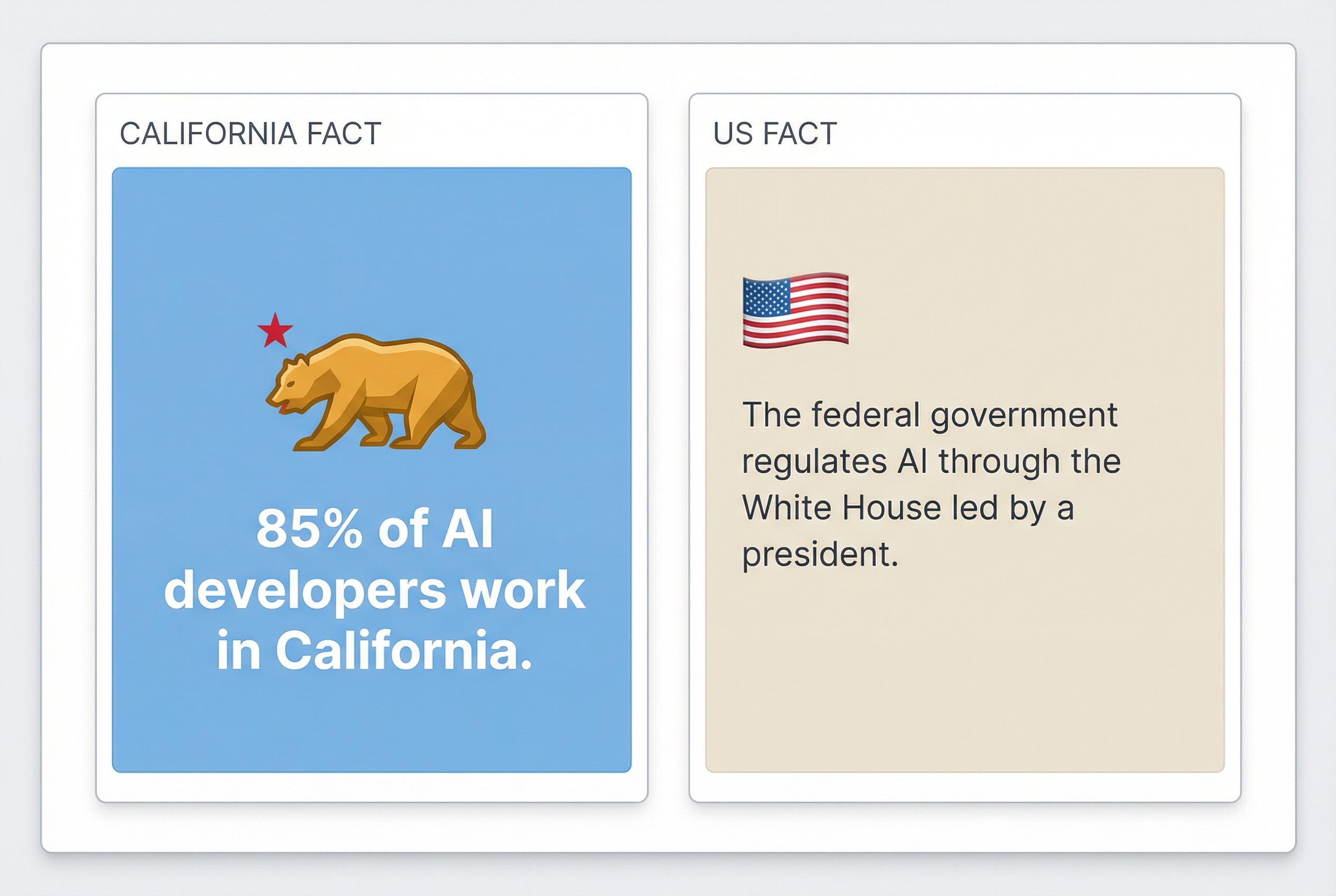
California Governor Gavin Newsom’s recent executive order tightening AI vendor safeguards marks a significant shift as the state advances its own standards amid a national debate over uniform AI regulation, contrasting with federal efforts led by the White House.
California Governor Gavin Newsom has signed an executive order tightening the safeguards that artificial intelligence vendors must meet to win state contracts, a move that sets the world’s most populous US state on a collision course with the federal government’s push for nationwide AI rules. According to the governor’s announcement, the order requires companies selling AI systems to state agencies to demonstrate measures that prevent misuse and protect privacy, security and civil rights. (Sources: California governor’s office, Decrypt).
The order directs the state’s Government Operations Agency to craft procurement standards addressing illegal content generation, model bias and threats to civil rights and free expression, while the California Department of Technology has been asked to recommend approaches for watermarking AI-generated imagery and manipulated video. Newsom framed the initiative as ensuring that innovation proceeds with safeguards, and the administration said these steps will shape how AI is acquired and deployed across state government. (Sources: California governor’s office, Decrypt).

The action intensifies a broader dispute over whether AI should be governed by uniform federal rules or through state-level measures. The White House unveiled a national AI legislative framework this month that calls for a single federal policy to avoid a patchwork of state laws and to preserve US leadership in the technology. The federal approach, reinforced by earlier White House executive orders, includes mechanisms to challenge or discourage state regulations seen as conflicting with national policy. (Sources: White House national AI framework, White House fact sheet December 2025).
“California’s always been the birthplace of innovation. But we also understand the flip side: in the wrong hands, innovation can be misused in ways that put people at risk,” Newsom said in a statement accompanying the order. “California leads in AI, and we’re going to use every tool we have to ensure companies protect people’s rights, not exploit them or put them in harm’s way. While others in Washington are designing policy and creating contracts in the shadow of misuse, we’re focused on doing this the right way.” (Sources: Decrypt, California governor’s office).
Observers see the executive order as an exercise of state-level purchasing power to shape industry behaviour. Kevin Frazier of the Cato Institute described the dispute as reflecting federalism’s recurring tensions and said companies unwilling to meet California’s standards could opt out of state business. Quinn Anex-Reis of the Center for Democracy and Technology noted that government contracting is highly valuable to tech firms and that procurement rules are a particularly effective lever for setting development and testing expectations. (Sources: Decrypt, California governor’s office).
The political backdrop amplifies the stakes. Newsom has become a prominent Democratic figure and is widely discussed as a potential contender in presidential politics; his order places him directly at odds with President Donald J. Trump’s administration, which has in recent months sought to roll back earlier federal AI restrictions and to promote an export-focused, innovation-first AI strategy. The White House has previously instructed federal agencies to favour AI systems it characterises as ideologically neutral and has proposed steps to pre-empt state laws judged harmful to national competitiveness. (Sources: Decrypt, White House fact sheet January 2025, White House fact sheet July 2025).
The clash underscores a practical policy question as much as a political one: whether the safest path to trustworthy AI is nationwide uniformity or a patchwork of strong state standards that leverage procurement to raise industry practices. California’s move makes clear it will use its purchasing power to press vendors for stronger assurances, even as the federal government presses for a single set of rules. (Sources: California governor’s office, White House national AI framework).
Source Reference Map
Inspired by headline at: [1]
Sources by paragraph:
Source: Noah Wire Services
Noah Fact Check Pro
The draft above was created using the information available at the time the story first
emerged. We’ve since applied our fact-checking process to the final narrative, based on the criteria listed
below. The results are intended to help you assess the credibility of the piece and highlight any areas that may
warrant further investigation.
Freshness check
Score:
8
Notes:
The article reports on a recent executive order signed by California Governor Gavin Newsom on March 30, 2026, concerning AI contract rules. This aligns with the publication date of the article, indicating freshness. However, the article references multiple sources, including the California governor’s office and Decrypt, which may suggest some content recycling.
Quotes check
Score:
7
Notes:
The article includes direct quotes from Governor Newsom and other officials. While these quotes are attributed, their earliest known usage cannot be independently verified. This raises concerns about the originality and authenticity of the quotes.
Source reliability
Score:
6
Notes:
The article originates from Decrypt, a cryptocurrency-focused news outlet. While it has a niche audience, its credibility in AI policy reporting is uncertain. The article also references official sources, including the California governor’s office and the White House, which adds credibility. However, the reliance on a single source for the main narrative reduces the overall reliability.
Plausibility check
Score:
8
Notes:
The claims about Governor Newsom signing an executive order to tighten AI contract rules are plausible and align with recent political developments. However, the article’s framing of a ‘fight’ with the Trump administration may be an exaggeration, as the federal government’s stance on AI regulation is not clearly defined in the provided sources.
Overall assessment
Verdict (FAIL, OPEN, PASS): FAIL
Confidence (LOW, MEDIUM, HIGH): MEDIUM
Summary:
The article presents a timely report on Governor Newsom’s executive order regarding AI contract rules. However, concerns about the originality and verification of quotes, the reliability of the primary source, and the independence of verification sources lead to a ‘FAIL’ verdict. Editors should exercise caution and seek additional independent verification before publishing.
