



Generating key takeaways...
Shoppers for knowledge are flocking to the idea that quantum computers could speed up drug discovery; researchers from the Cleveland Clinic, IBM and RIKEN have now modelled the biggest biological molecules yet on quantum hardware, showing where the tech can make a real difference in healthcare and why it matters.
Essential Takeaways
- Record simulation: Researchers modelled enzymes of about 12,635 atoms, the largest biological systems yet run using quantum-assisted methods, showing a realistic, textured result.
- Public–private push: The project was a collaboration between the Cleveland Clinic, IBM and RIKEN, reflecting major institutional investment and shared infrastructure.
- Hybrid advantage: Teams are combining quantum hardware with classical computing and machine learning, which feels practical and gives near-term value.
- Wellcome Leap boost: A $50m Quantum for Bio challenge accelerated multiple projects, proving a route from experiments to usable tools.
- Practical gap: Experts say a clear, routine advantage for everyday drug development hasn’t arrived yet, but timelines point to scalable impact by the early 2030s.
Why this enzyme simulation felt like a milestone
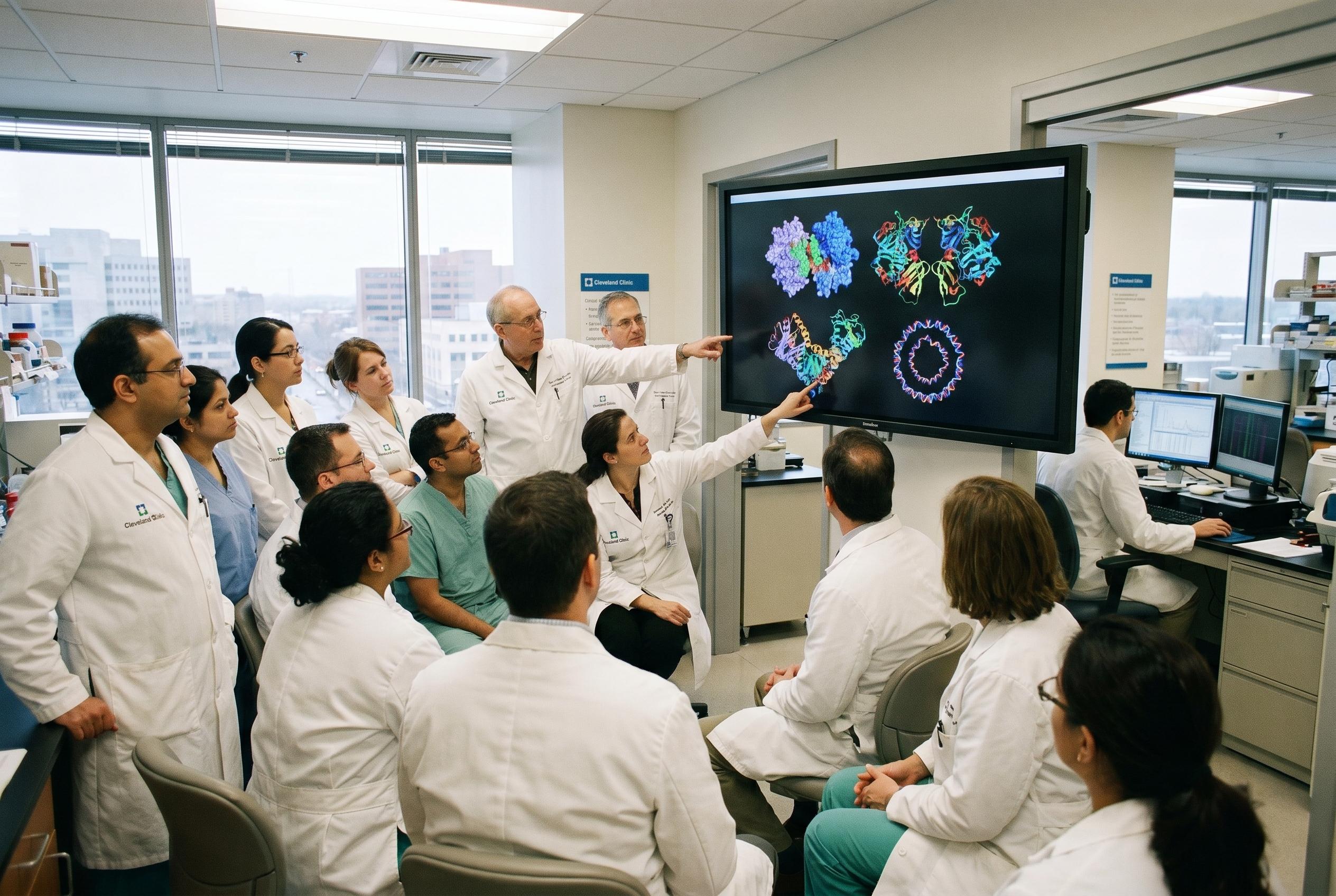
The new simulation isn’t a flashy consumer gadget, but it has a quiet, satisfying heft , the kind of scientific step that changes expectations. According to the Cleveland Clinic, teams modelled enzymes containing roughly 12,635 atoms, the largest biological molecules ever tackled with quantum-assisted chemistry. That scale matters because drug discovery often fails or stalls when molecular complexity outpaces our models.
Backstory matters here: this was a team effort combining hospital research know-how with IBM’s quantum hardware and RIKEN’s computational muscle. Researchers say the hybrid workflows , marrying classical computing with quantum processors and machine learning , gave them results that would have been prohibitively slow or approximate otherwise. The immediate takeaway is that quantum methods are moving from theoretical curiosity to practical components of a drug-discovery toolbox.
What the Wellcome Leap challenge changed
Big prize challenges can feel like theatre, but Wellcome Leap’s $50m Quantum for Bio competition produced concrete outcomes. Several teams used IBM’s superconducting systems to push real biological problems onto quantum platforms, and the top project earned a $2m prize for a study into a light-activated cancer drug. The competition did more than reward novelty; it forced teams to show how quantum methods perform on messy, real-world biology.
That practical pressure reveals why public funding matters. Groups learned fast which parts of the pipeline benefit from quantum effects and which still prefer classical brute force. For lab leaders and funders, the competition’s structure is a neat blueprint: seed innovation, require measurable progress, then scale winners with partnerships.
How hybrid quantum-classical workflows actually help
If you’re picturing a lone quantum chip solving a pharma problem overnight, think again. Researchers and IBM’s blog explain that today’s gains come from hybrid workflows: quantum processors tackle the hardest quantum chemistry subproblems while classical computers handle the rest. The result is more accurate simulations for specific interactions, like how a drug binds or how a light-activated molecule behaves, without expecting a full quantum-only solution.
For drug teams, the practical advice is straightforward: identify the highest-value calculations where quantum uncertainty maps to real chemistry, then pilot hybrid runs. That lets you exploit current quantum advantages without waiting for error-free, million-qubit machines. It’s sensible, incremental progress rather than a leap of faith.
Why pharma companies are paying attention now
Big labs and startups are circling because the potential payoff is clear: faster target validation, smarter candidate selection and fewer expensive dead-ends. The Cleveland Clinic project, together with initiatives like Qubit Pharmaceuticals and academic groups, signals that the ecosystem is solidifying , hospitals, hardware vendors and funders are aligning around shared goals.
Still, industry voices caution that a general quantum advantage for routine discovery hasn’t been demonstrated. What’s changed is confidence: researchers can now point to replicated, peer-reviewed-style work and national-scale collaborations, which helps boardrooms justify early investment. Expect more pilots and partnerships this year as teams translate those simulations into optimisation workflows.
What this means for patients and researchers
Put simply, patients won’t notice quantum overnight, but researchers and clinical teams will gain sharper tools that cut down guesswork. Modelling complex enzymes more accurately means fewer false leads and more focused experiments, which can shorten the time from idea to trial. The human angle is compelling: clinicians told reporters that improved models could let them design safer, more targeted molecules sooner.
Looking forward, IBM and collaborators project that chemistry and life-sciences applications could reach broad, practical utility by the early 2030s. Until then, expect steady progress: better error mitigation, larger quantum processors and more hybrid algorithms will push the technology from impressive demonstrations toward everyday use.
It’s a small change in the lab that could make a big difference in the clinic.
Source Reference Map
Story idea inspired by: [1]
Sources by paragraph:
Noah Fact Check Pro
The draft above was created using the information available at the time the story first
emerged. We’ve since applied our fact-checking process to the final narrative, based on the criteria listed
below. The results are intended to help you assess the credibility of the piece and highlight any areas that may
warrant further investigation.
Freshness check
Score:
10
Notes:
The article was published on May 6, 2026, and references a press release from May 5, 2026, indicating recent and original content. ([newsroom.clevelandclinic.org](https://newsroom.clevelandclinic.org/2026/05/05/cleveland-clinic-riken-and-ibm-model-a-12635-atom-protein–the-largest-known-to-be-simulated-with-quantum-computers?utm_source=openai))
Quotes check
Score:
8
Notes:
The article includes direct quotes from Kenneth Merz, Ph.D., and Jay Gambetta, Director of IBM Research. These quotes are consistent with those found in the original press release. ([newsroom.clevelandclinic.org](https://newsroom.clevelandclinic.org/2026/05/05/cleveland-clinic-riken-and-ibm-model-a-12635-atom-protein–the-largest-known-to-be-simulated-with-quantum-computers?utm_source=openai))
Source reliability
Score:
7
Notes:
The article is hosted on Biotecnika, a niche publication focusing on biotechnology news. While it provides a summary of the press release, its limited reach and potential biases due to its niche focus warrant caution.
Plausibility check
Score:
9
Notes:
The claims about simulating a 12,635-atom protein using quantum computing are plausible and align with recent advancements in the field. The article provides specific details about the proteins simulated and the computational methods used, which are consistent with known scientific practices. ([newsroom.clevelandclinic.org](https://newsroom.clevelandclinic.org/2026/05/05/cleveland-clinic-riken-and-ibm-model-a-12635-atom-protein–the-largest-known-to-be-simulated-with-quantum-computers?utm_source=openai))
Overall assessment
Verdict (FAIL, OPEN, PASS): FAIL
Confidence (LOW, MEDIUM, HIGH): MEDIUM
Summary:
The article provides a recent and plausible summary of a press release regarding a significant advancement in quantum computing for drug discovery. However, its reliance on a single source without independent verification from other reputable outlets raises concerns about its reliability and independence. ([newsroom.clevelandclinic.org](https://newsroom.clevelandclinic.org/2026/05/05/cleveland-clinic-riken-and-ibm-model-a-12635-atom-protein–the-largest-known-to-be-simulated-with-quantum-computers?utm_source=openai))


