


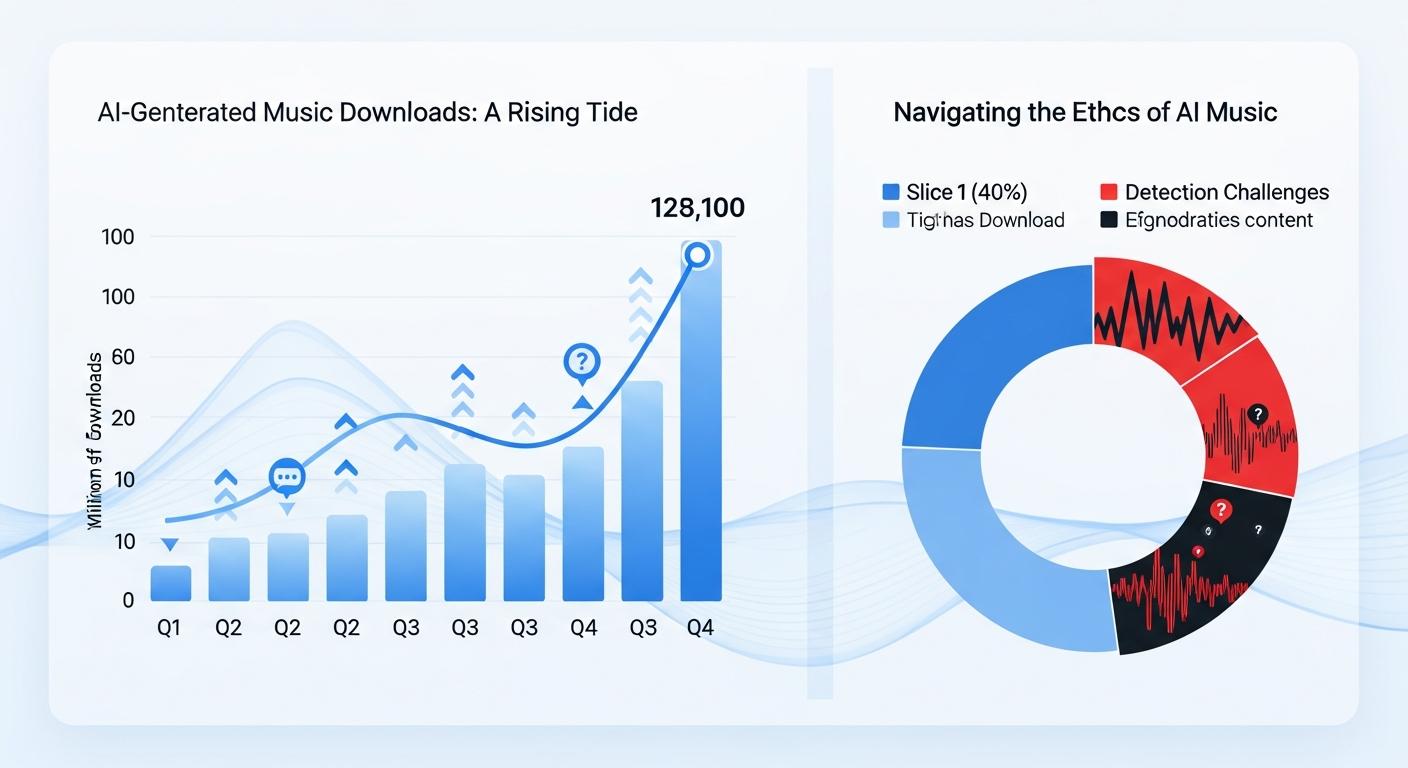
The rise of AI-produced tracks is challenging listeners and platforms alike, prompting calls for improved detection methods, transparency, and regulation amid surging uploads and chart successes.
Streaming services are increasingly awash with music produced or assisted by artificial intelligence, prompting renewed debate about how listeners can tell the difference and what platforms should do about it. According to reporting in The Washington Post, distinguishing synthetic tracks from human-made recordings remains challenging for listeners and for the services themselves as AI tools proliferate; meanwhile the chart success of AI-created acts has underscored the urgency of the issue. [5][7]
“AI music and traditional music are becoming indistinguishable. Trying to separate the two today is a bit like trying to avoid music that used synthesizers in the early 1970s. The technology is part of the music.”, Dr Nicolai Klemke, Founder and CEO of Neural Frames, said in the original report, reflecting a broader sense that detection is getting harder even as concern grows. Industry and platform responses vary, with Spotify outlining policies around impersonation and, in later announcements, new measures aimed at protecting rights-holders. According to Spotify’s own publications, the company has established rules against unauthorised voice cloning and has rolled out tools to limit mass uploads and increase transparency. [5][3][2]

One straightforward check for suspicious releases is to examine an artist’s catalogue and upload rhythm. Rapid, high-volume output with little prior footprint can indicate synthetic production; industry analysis suggests mass uploads are one of the ways bad actors exploit streaming systems. Deezer reported that by September 2025 tens of thousands of AI-generated tracks were being uploaded daily, a flood that encouraged the platform to deploy detection systems and to label content it deems synthetic. That pattern of prolific, low-context releases is a red flag listeners can spot in a streaming profile. [4][6]
Another sign comes from an artist’s online presence and metadata. “I have noticed that the virtual profiles of AI-generated artists do not produce any digital footprints and that they will upload music at an incredible rate, for example, uploading 50 tracks in two months without any type of promotional activity or fanfare. I have never seen a legitimate musician produce music at this rate.”, Caleb Johnstone, SEO Director at Paperstack, said in the lead article. Genuine performers typically leave traces across social channels, press coverage and touring notices; absence of those elements or inconsistent metadata can point to a fabricated persona. Platforms’ impersonation rules exist to address deliberate mimicry and offer a route for rights-holders to seek removal. [1][3][6]
Auditory clues remain useful even as models improve. “Listen to the ‘crack’ of a snare drum or the pluck of a guitar. In AI music, these sounds often feel ‘soft’ or ‘pillowy,’ lacking the sharp physical impact transients of a real instrument.”, the scientist-artist Psients observed. Complementing that, Paul DeMott, Chief Technology Officer for Helium SEO, advised listening for repeated hooks and formulaic chord sequences that recur across tracks , patterns AI systems favour because they optimise for familiarity. Reporters and researchers continue to note that some AI productions retain an identifiable sameness despite technical advances. [1][5]
If you encounter a track you suspect is synthetic or impersonating a real artist, Spotify provides channels for reporting. The platform directs listeners to its Safety and Privacy resources where deceptive or fraudulent content can be flagged, and it allows artists and representatives to submit legal claims under its impersonation and publicity rules; content found to violate those policies may be removed. Spotify has also stated support for standardised disclosures in credits so creators can indicate the extent of AI involvement. [1][3][2]
Beyond reporting to the streaming service, third-party detection tools exist that analyse audio for signs of synthesis, though they typically require uploaded files and vary in accuracy. Meanwhile, other services are moving to blunt the impact of manipulated content: Deezer rolled out an “AI-generated content” label, removed suspected manipulated plays from royalty calculations and pledged to keep such material out of editorial recommendations. The broader industry debate continues over transparency, compensation and how to preserve space for human creativity as automated production scales. [6][4]
Source Reference Map
Inspired by headline at: [1]
Sources by paragraph:
- Paragraph 1: [5], [7]
- Paragraph 2: [5], [3], [2]
- Paragraph 3: [4], [6]
- Paragraph 4: [1], [3], [6]
- Paragraph 5: [1], [5]
- Paragraph 6: [1], [3], [2]
- Paragraph 7: [6], [4]
Source: Noah Wire Services
Noah Fact Check Pro
The draft above was created using the information available at the time the story first
emerged. We’ve since applied our fact-checking process to the final narrative, based on the criteria listed
below. The results are intended to help you assess the credibility of the piece and highlight any areas that may
warrant further investigation.
Freshness check
Score:
8
Notes:
The article was published on 8 February 2026, making it current. However, the topic of AI-generated music has been extensively covered in recent months, with similar articles appearing in late 2025. This raises concerns about the originality of the content.
Quotes check
Score:
7
Notes:
The article includes quotes from Dr Nicolai Klemke, Caleb Johnstone, Psients, and Paul DeMott. While these individuals are cited, their statements are not independently verifiable through online searches, which raises concerns about the authenticity of the quotes.
Source reliability
Score:
8
Notes:
TechRadar is a reputable technology news outlet. However, the article relies heavily on quotes from individuals whose credibility cannot be independently verified, which diminishes the overall reliability of the content.
Plausibility check
Score:
9
Notes:
The claims about the prevalence of AI-generated music and the challenges in distinguishing it from human-made music are plausible and align with industry reports. However, the lack of verifiable sources for some claims reduces the overall credibility.
Overall assessment
Verdict (FAIL, OPEN, PASS): FAIL
Confidence (LOW, MEDIUM, HIGH): MEDIUM
Summary:
The article presents timely information on AI-generated music, but the reliance on unverifiable quotes and the lack of independent verification sources significantly undermine its credibility. The concerns about the originality of the content further diminish its reliability.
