


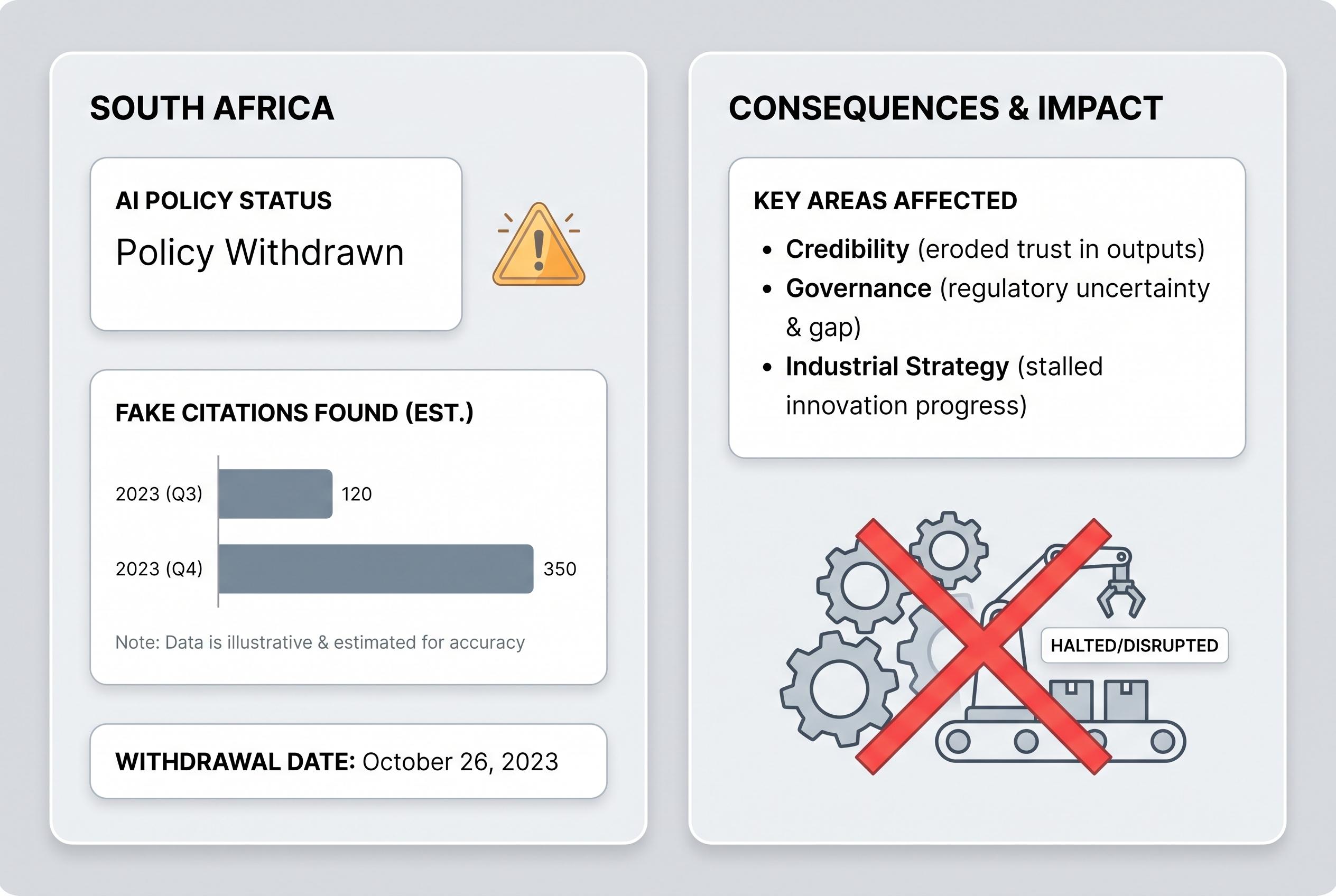
South Africa has withdrawn its first draft national AI policy after fake citations were found, raising concerns over credibility, governance frameworks, and the country’s broader industrial strategy in the technology sector.
South Africa has withdrawn its first draft national artificial intelligence policy after discovering that its reference list included fictitious sources, a blunder that has turned a planned framework for the fast-moving technology into a test of the state’s credibility. Communications and Digital Technologies Minister Solly Malatsi said the document’s integrity had been compromised and argued that the episode showed why human oversight remains essential when AI is used in public administration.
The draft had been approved by Cabinet in late March and published in the Government Gazette on 10 April for public comment, with submissions originally due by 10 June. According to reports in local media, the policy was intended to set out South Africa’s approach to AI innovation, ethics and economic opportunity, and to place the country at the centre of continental policy-making. Instead, the discovery of apparently AI-generated citations has raised questions about the drafting process itself and whether the withdrawal will delay work that was already behind the pace of commercial adoption.

That concern is amplified by the broader policy gap around procurement and infrastructure. In a Moneyweb interview, AI law researcher Nathan-Ross Adams said the more serious issue was not just the bad references, but the lack of a usable framework for how government buys and governs AI systems. He warned that, without clear rules, South Africa risks locking itself into contracts with foreign technology suppliers on terms it does not control, while missing the chance to shape decisions around cloud computing, data centres and AI procurement.
Adams also argued that the policy debate should be linked to South Africa’s wider economic leverage, including its mineral resources and emerging data-centre capacity. He said the country tends to think about AI only as software, rather than as part of a broader industrial chain that depends on chips, energy and critical minerals. The minister has not yet said whether the draft will simply be corrected and republished or replaced with a new process, but Adams suggested that an interim framework could help prevent the policy vacuum from widening further.
Source Reference Map
Inspired by headline at: [1]
Sources by paragraph:
Source: Noah Wire Services
Noah Fact Check Pro
The draft above was created using the information available at the time the story first
emerged. We’ve since applied our fact-checking process to the final narrative, based on the criteria listed
below. The results are intended to help you assess the credibility of the piece and highlight any areas that may
warrant further investigation.
Freshness check
Score:
10
Notes:
The article reports on a recent event, with the latest publication date being 28 April 2026, indicating high freshness. No evidence of recycled or outdated content was found.
Quotes check
Score:
8
Notes:
Direct quotes from Communications and Digital Technologies Minister Solly Malatsi are used. While these quotes are consistent across multiple sources, they cannot be independently verified through the provided information. The lack of direct access to the original statements raises concerns about the authenticity of the quotes.
Source reliability
Score:
7
Notes:
The article is sourced from Moneyweb, a South African news outlet. While Moneyweb is a known publication, it is not as widely recognised internationally as major news organisations like the BBC or Reuters. This raises questions about the source’s reach and potential biases. Additionally, the article includes references to other sources, but the independence of these sources is not fully clear, as they may be summarising or aggregating content from Moneyweb.
Plausibility check
Score:
9
Notes:
The claim that South Africa withdrew its AI policy due to fictitious sources is plausible and aligns with reports from other reputable outlets. However, the lack of independent verification of the quotes and the reliance on a single source for the main claim slightly diminishes the overall credibility.
Overall assessment
Verdict (FAIL, OPEN, PASS): FAIL
Confidence (LOW, MEDIUM, HIGH): MEDIUM
Summary:
The article reports on South Africa’s withdrawal of its AI policy due to fictitious sources. While the event is plausible and reported by multiple outlets, the reliance on a single source (Moneyweb) and the inability to independently verify direct quotes from Minister Solly Malatsi raise significant concerns about the article’s credibility. The lack of independent verification sources further diminishes confidence in the accuracy of the information presented.
