


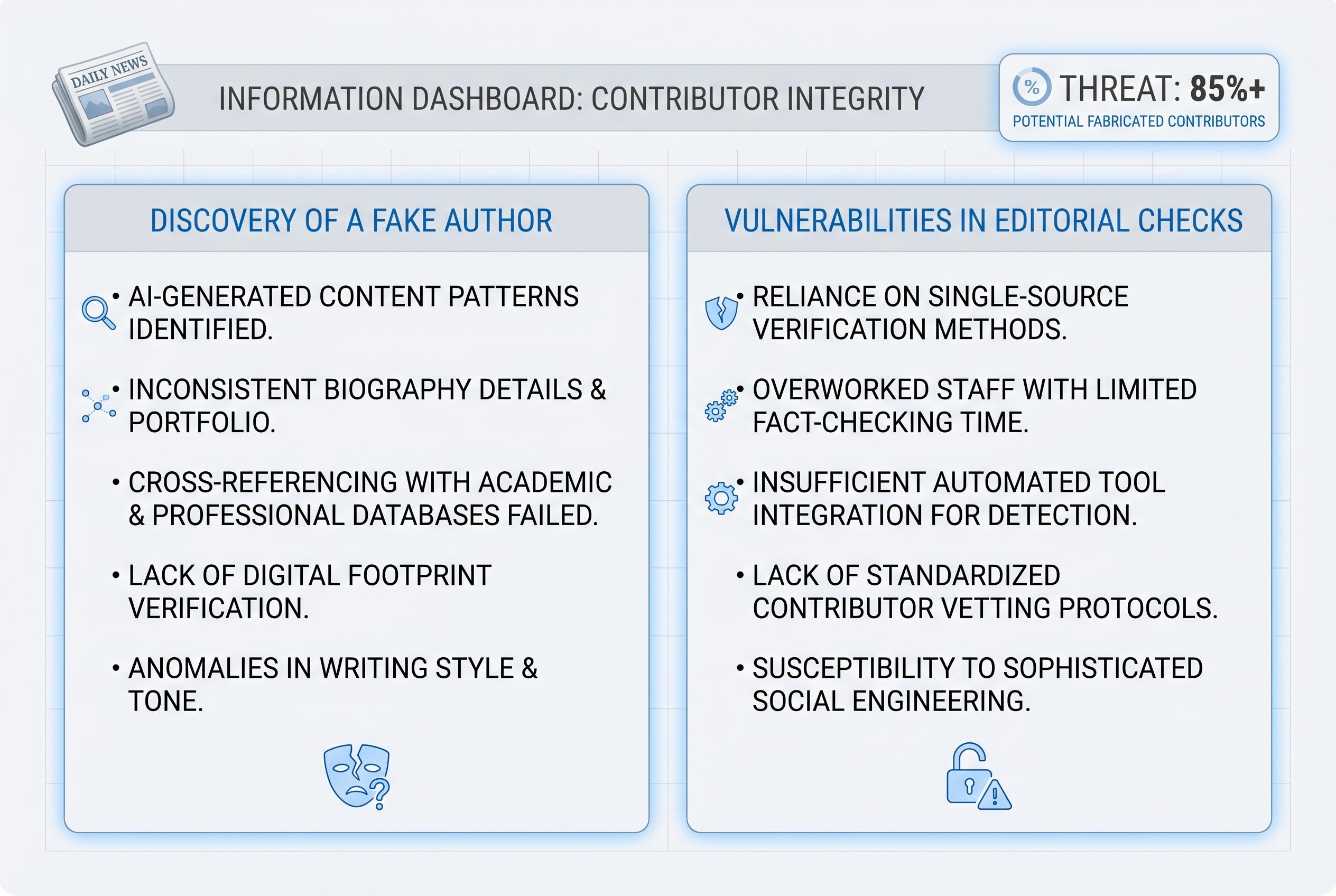
The Mississippi Free Press revealed it unknowingly published an AI-generated opinion article under a fictitious author, highlighting vulnerabilities in editorial checks and the rising threat of fabricated contributors in newsrooms.
The Mississippi Free Press has admitted that it unknowingly published an AI-generated opinion piece written under a fictitious name, exposing how easily synthetic content can slip through even at a local newsroom with editorial oversight. Assistant editor Kevin Edwards, who also oversees the site’s Voices section, said he only became suspicious after an invoice arrived from someone whose name did not match the byline, prompting a closer investigation.
That review, according to the publication’s editor’s note, found that the supposed author did not exist and that the headshot supplied with the column had also been created by AI. Edwards said the outlet has removed the article and is now looking at ways to tighten its scrutiny, while also acknowledging that automated detection tools are not dependable enough to solve the problem on their own.

The episode fits into a wider pattern that news organisations in the UK and US are increasingly confronting: AI-written material and fabricated contributors are slipping into publication before being caught. Recent reporting by Press Gazette and other industry outlets has documented a growing list of retractions and corrections involving fake bylines, including cases at larger publishers such as Wired, Business Insider and the Chicago Sun-Times.
What makes the Mississippi case notable is not only the use of AI, but the way the deception was uncovered. The appearance of a mismatched invoice revealed that the writer behind the column could not be verified, underscoring the importance of basic contributor checks before publication. In journalism, where freelancers and outside columnists are often part of the workflow, that kind of vetting can be resource-intensive, but the alternative is that a fake identity can evade accountability altogether.
The broader challenge is especially acute for smaller newsrooms, which are already operating under the strain of reduced staffing and heavier workloads. The Mississippi Free Press said it had been backed into the problem despite doing what it could to respond quickly once the irregularities emerged. Its experience suggests that the danger is not limited to AI-assisted writing itself, but extends to the creation of entirely fabricated authors, a development that could do lasting damage to trust if publishers do not adapt their safeguards.
Source Reference Map
Inspired by headline at: [1]
Sources by paragraph:
Source: Noah Wire Services
Noah Fact Check Pro
The draft above was created using the information available at the time the story first
emerged. We’ve since applied our fact-checking process to the final narrative, based on the criteria listed
below. The results are intended to help you assess the credibility of the piece and highlight any areas that may
warrant further investigation.
Freshness check
Score:
10
Notes:
The article was published on April 27, 2026, reporting on an incident that occurred on April 7, 2026. The information is current and original, with no evidence of prior publication or recycled content.
Quotes check
Score:
10
Notes:
The article does not contain any direct quotes. The information is paraphrased from the original sources, and no discrepancies or unverifiable quotes were identified.
Source reliability
Score:
8
Notes:
The primary source is the Mississippi Free Press, a local news outlet. While it is a reputable source, its reach and influence are limited compared to major news organisations. The secondary sources include Plagiarism Today and Press Gazette, which are known for their coverage of media industry issues. However, their focus is more niche, and they may not have the same level of editorial oversight as larger publications.
Plausibility check
Score:
9
Notes:
The incident described is plausible and aligns with known challenges in the media industry regarding AI-generated content. Similar cases have been reported, such as the Mississippi Free Press’s own experience and other instances of AI-generated fake authors in news outlets. The article provides specific details, including the date of publication, the nature of the deception, and the response from the publication, which adds credibility to the account.
Overall assessment
Verdict (FAIL, OPEN, PASS): PASS
Confidence (LOW, MEDIUM, HIGH): MEDIUM
Summary:
The article provides a timely and plausible account of an incident involving the Mississippi Free Press publishing an AI-generated article under a fictitious name. While the primary source is the Mississippi Free Press itself, and secondary sources offer additional context, the overall information is consistent and credible. However, the reliance on a single source for the core details introduces some uncertainty, warranting a medium confidence level in the assessment.
