


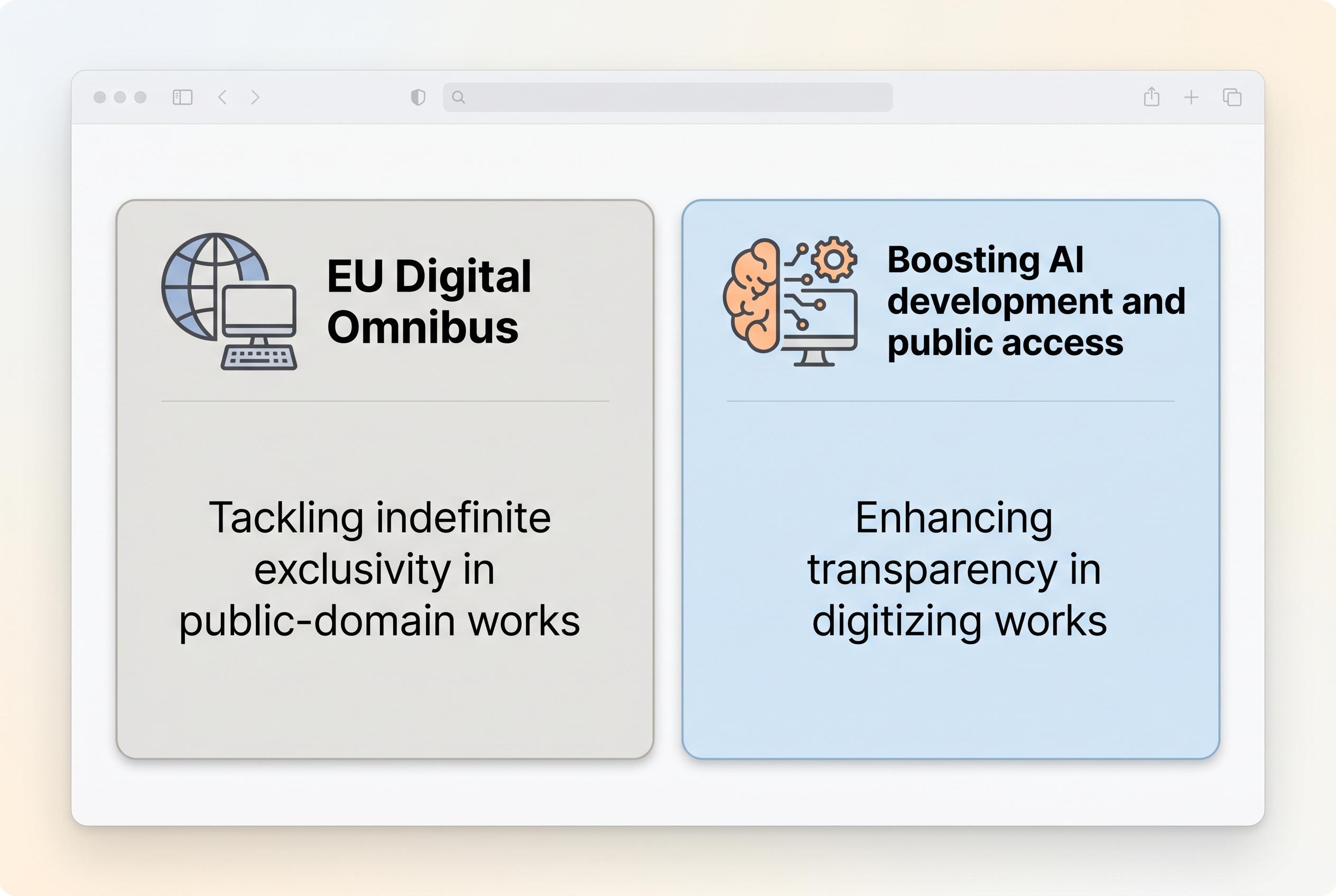
The European Commission’s upcoming Digital Omnibus seeks to end long-standing loopholes in copyright rules, tackling indefinite exclusivity in digitising public-domain works and boosting transparency to support AI development and public access.
The European Commission’s planned Digital Omnibus is opening a fresh debate over a corner of EU law that campaigners say has never worked as intended: the rules meant to stop cultural heritage digitisation deals from locking up public-domain books for years on end. The proposal would fold the Open Data Directive into an expanded Data Act and, in doing so, revisit Article 12(3), the clause governing exclusive arrangements in public-private digitisation partnerships. According to the Commission’s own proposal, the change is presented as largely technical, but critics see a chance to fix a long-standing enforcement gap.
Communia, a digital rights group, says the problem is no longer theoretical. In a blog post published on 27 April 2026, it argues that the rule stating exclusivity should “in general” last no more than 10 years has not been observed in practice. The group says digitisation agreements involving major commercial partners and European libraries remain opaque, often covered by non-disclosure agreements, and in some cases appear to grant exclusive access indefinitely. It estimates that at least 2 million public-domain books are currently caught by arrangements that would fall outside a genuine 10-year ceiling.

The issue matters well beyond copyright housekeeping. The European Commission has already warned that member states need to move faster on digitising cultural heritage, and it has stressed the value of collaboration with private partners to improve online access to Europe’s collections. At the same time, EU policy on AI increasingly depends on access to large volumes of lawful training material. Communia argues that the current system leaves libraries unable to make digitised public-domain works broadly available for AI development, while giving incumbents an advantage over smaller European developers. Academic work on the interaction between AI, copyright and cultural heritage also shows how sensitive the legal landscape has become as institutions try to balance access, rights and innovation.
Its proposed fix is straightforward: turn the 10-year language into a hard maximum, remove the review mechanism that has rarely, if ever, constrained long-running deals, and consider making the agreements public on the websites of the institutions that sign them. The group says this would give libraries a clearer legal basis to challenge old arrangements and would not impose new retroactive penalties on private partners. Instead, it would make clear that existing and future agreements need to come into line with EU law. Supporters of stricter rules on re-use have long argued that transparency and periodic review are essential if digitised public-domain material is to remain genuinely accessible, rather than becoming monopolised through contractual workarounds.
Source Reference Map
Inspired by headline at: [1]
Sources by paragraph:
Source: Noah Wire Services
Noah Fact Check Pro
The draft above was created using the information available at the time the story first
emerged. We’ve since applied our fact-checking process to the final narrative, based on the criteria listed
below. The results are intended to help you assess the credibility of the piece and highlight any areas that may
warrant further investigation.
Freshness check
Score:
8
Notes:
The article was published on 27 April 2026, which is recent. However, the content references a blog post from 3 February 2026, indicating that some information may be recycled. ([communia-association.org](https://communia-association.org/2026/02/03/consultation-submission-digital-omnibus/?utm_source=openai))
Quotes check
Score:
7
Notes:
The article includes direct quotes from the European Commission’s proposal and other sources. However, without access to the original documents, it’s challenging to verify the accuracy and context of these quotes.
Source reliability
Score:
6
Notes:
The article originates from the Communia Association, a digital rights group. While they are a known entity, their perspective may be biased, and their reach is limited compared to major news organisations.
Plausibility check
Score:
7
Notes:
The claims about the ineffectiveness of Article 12(3) of the Open Data Directive and the estimated 2 million books under exclusive restrictions are plausible. However, without independent verification, these figures remain unconfirmed.
Overall assessment
Verdict (FAIL, OPEN, PASS): OPEN
Confidence (LOW, MEDIUM, HIGH): MEDIUM
Summary:
The article presents recent information on the Digital Omnibus and its potential impact on public domain books. However, concerns about the recycling of content, unverifiable quotes, and reliance on a single source without independent verification reduce the overall confidence in its accuracy and reliability. ([communia-association.org](https://communia-association.org/2026/02/03/consultation-submission-digital-omnibus/?utm_source=openai))
