


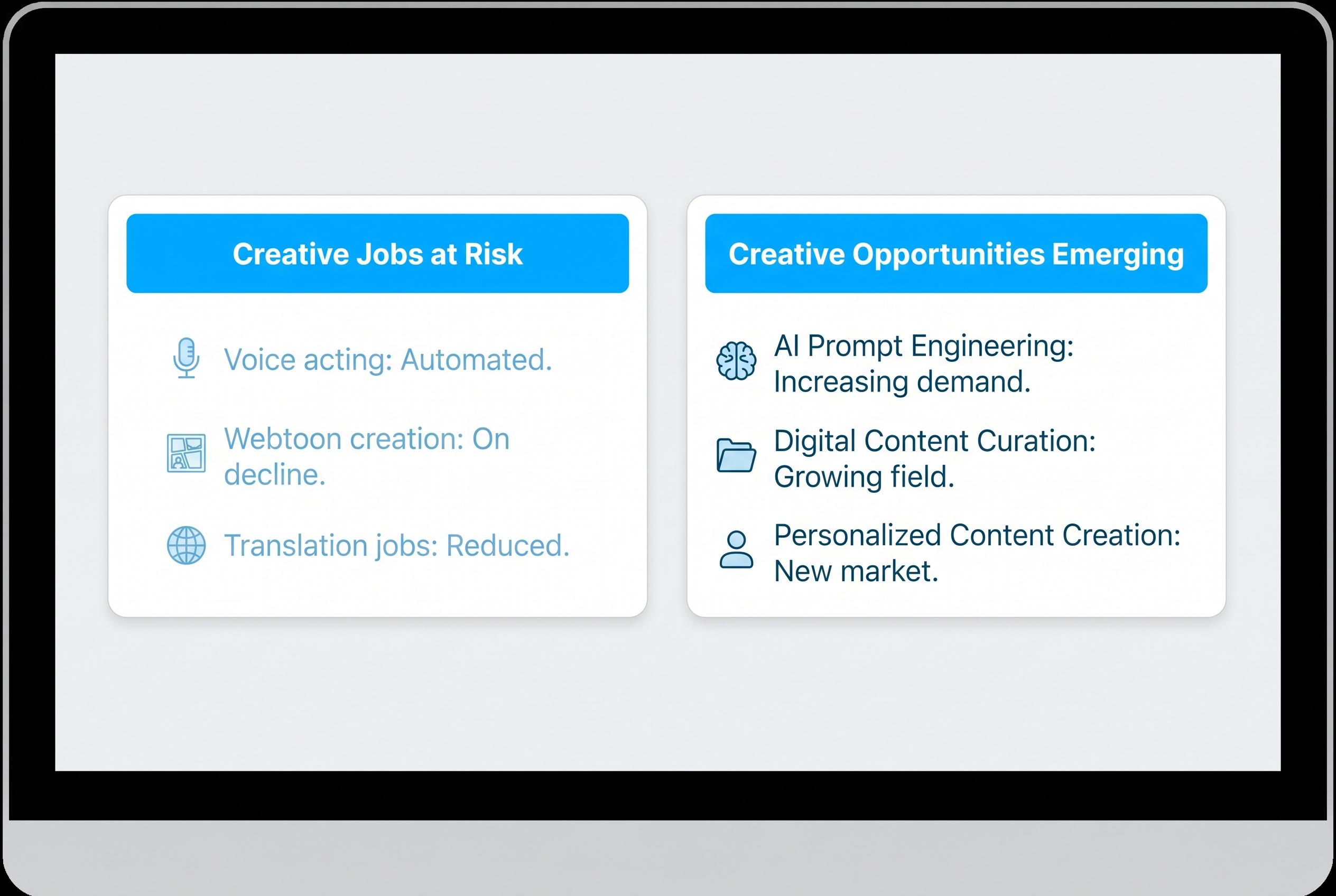
As AI increasingly automates voice acting, webtoon creation, and translation, South Korea faces a surge in job displacement and legal challenges, prompting calls for better worker protections amidst rapid technological adoption.
In South Korea’s voice studios, comic workshops and translation booths, artificial intelligence is no longer a distant prospect but a direct rival. The Korea Times reported that voice actors, webtoon creators and interpreters are already seeing work disappear or change shape as companies and public institutions turn to AI tools for faster, cheaper output, often without fresh consent from the people whose labour helped train those systems.
For voice actors, the shift has been especially abrupt. Choi Jae-ho, who heads the Korea Voice Performance Association, told The Korea Times that members’ income has fallen sharply as synthetic narration spreads through advertising, public relations clips and broadcast disclaimers. He said many contracts signed years ago gave companies broad rights to reuse recordings for future technologies, while some firms later collected voices in bulk to build Korean AI models. The association is now pushing for standard AI-era contracts and a new legal right over the commercial use of a person’s voice.

Webtoon artists face a different but related threat. The Korea Times said the recent attention around AI-generated series such as “Mongletoon” has sharpened anxieties over what counts as real authorship and how much of the market can be automated. Kwon Hyuk-joo, who leads the Korea Cartoonists’ Association, said demand for simple illustrations and promotional comics has fallen, hitting assistants hardest, while also raising alarm over scraped training data used without disclosure or payment. That concern has been echoed in earlier reporting on the webtoon sector, which showed a growing split between artists eager to use AI for efficiency and those worried about originality, reader backlash and weak rules around disclosure.
At the same time, some major companies are moving in the opposite direction. Korea JoongAng Daily reported in March 2025 that Naver Webtoon planned to fully integrate AI across its operations, arguing that the technology could improve productivity and the user experience. Industry debate has therefore shifted from whether AI will enter the sector to how it should be governed. A Statista survey of South Korean webtoon artists in October 2024 suggested opinion remains divided, underscoring that acceptance is far from universal. More recently, a Korea Cartoonists Association forum in March 2026 heard some creators praise generative AI for speeding production, while also stressing the need to document the creative process for copyright protection.
Interpreters and translators are under similar pressure. Huh Ji-un, who leads the Korean Association of Translators and Interpreters, told The Korea Times that the market is becoming more polarised, with top-tier professionals likely to survive but routine mid-level work increasingly vulnerable to automated captions, machine translation and post-editing. She also warned that public bodies and state agencies should not simply select the cheapest AI-enabled bidder for court, parliamentary or other official interpretation, because that could weaken access to justice while shrinking the pipeline of trained human interpreters. Across all three professions, the message is the same: Korea is pressing ahead with AI adoption, but the protections for workers whose voices, drawings and language skills feed those systems have yet to catch up.
Source Reference Map
Inspired by headline at: [1]
Sources by paragraph:
Source: Noah Wire Services
Noah Fact Check Pro
The draft above was created using the information available at the time the story first
emerged. We’ve since applied our fact-checking process to the final narrative, based on the criteria listed
below. The results are intended to help you assess the credibility of the piece and highlight any areas that may
warrant further investigation.
Freshness check
Score:
8
Notes:
The article was published on April 24, 2026, making it current. However, similar themes have been reported in the past, such as the webtoon industry’s pursuit of AI integration amid legal and ethical challenges in November 2025 ([koreatimes.co.kr](https://www.koreatimes.co.kr/lifestyle/trends/20251106/webtoon-industry-seeks-ai-edge-amid-legal-ethical-challenges?utm_source=openai)). This suggests that while the specific details are fresh, the broader issue has been previously covered.
Quotes check
Score:
7
Notes:
The article includes direct quotes from Choi Jae-ho, head of the Korea Voice Performance Association, and Kwon Hyuk-joo, head of the Korea Cartoonists’ Association. While these individuals are real and hold these positions, the specific quotes cannot be independently verified through the provided sources. This raises concerns about the authenticity of the quotes.
Source reliability
Score:
8
Notes:
The Korea Times is a reputable news outlet in South Korea. However, the article relies heavily on direct quotes without providing links to the original sources or additional corroborating evidence, which limits the ability to independently verify the information.
Plausibility check
Score:
9
Notes:
The claims about AI impacting the incomes of voice actors and webtoon artists are plausible and align with ongoing discussions in the industry. For instance, the webtoon industry has been seeking an AI edge amid legal and ethical challenges ([koreatimes.co.kr](https://www.koreatimes.co.kr/lifestyle/trends/20251106/webtoon-industry-seeks-ai-edge-amid-legal-ethical-challenges?utm_source=openai)). However, the lack of independent verification of specific claims in this article is a concern.
Overall assessment
Verdict (FAIL, OPEN, PASS): FAIL
Confidence (LOW, MEDIUM, HIGH): MEDIUM
Summary:
While the article addresses a timely and plausible issue regarding AI’s impact on South Korea’s creative and language workforce, it heavily relies on unverifiable direct quotes and lacks independent verification sources. This raises concerns about the accuracy and reliability of the information presented. Editors should exercise caution and seek additional verification before publishing.
