


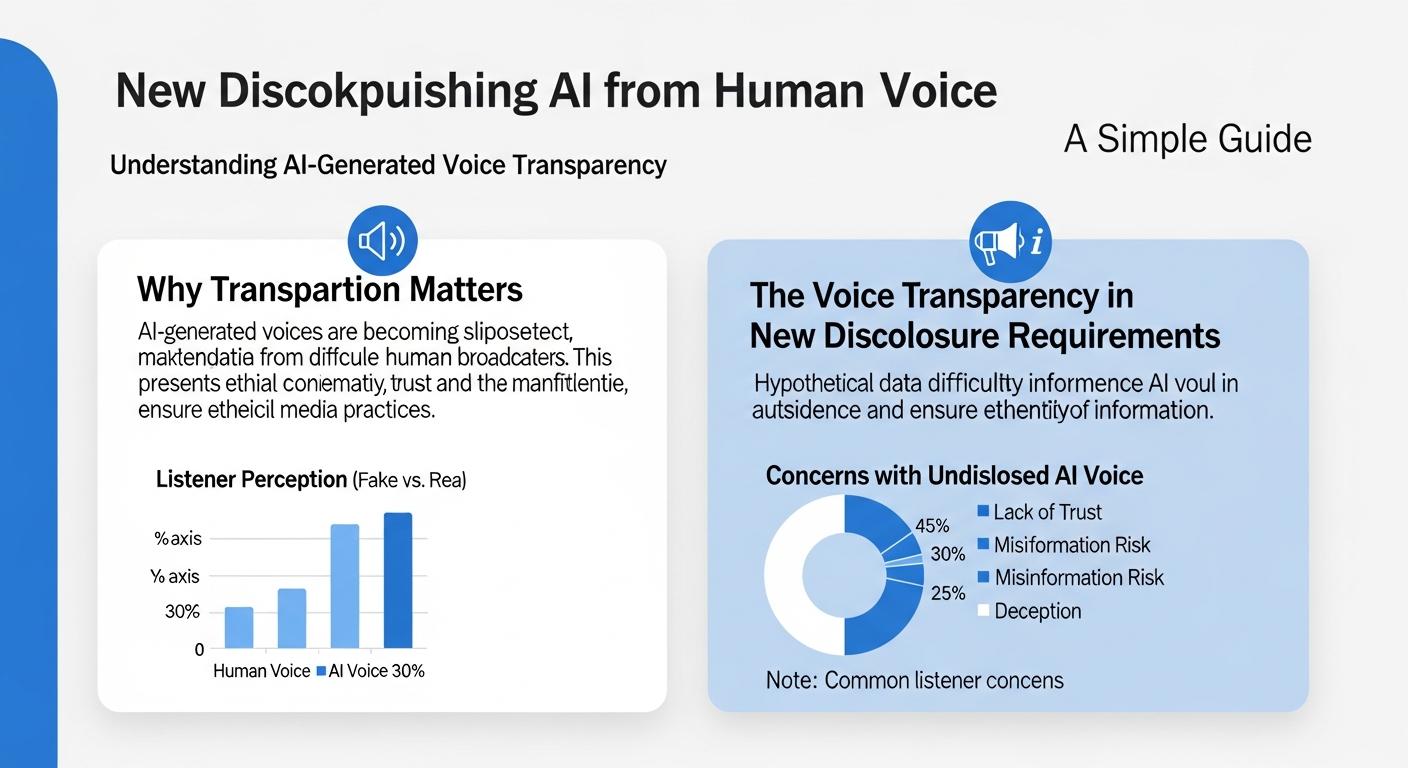
The Australian Communications regulator introduces new rules requiring commercial radio stations to disclose when artificial intelligence voices host programmes, marking a major step towards transparency amid growing public concern over AI use in media.
The Australian communications regulator has updated its Commercial Radio Code of Practice to require commercial broadcasters to disclose when a synthetic voice is presenting regularly scheduled music or news programmes, marking the first time artificial intelligence has been addressed in a broadcasting code, the authority said. According to the Australian Communications and Media Authority, the changes form part of the Commercial Radio Code of Practice 2026 and will take effect on July 1, 2026. (Sources: Australian Communications and Media Authority, Variety)
Under the revised code, stations must make clear to audiences when a computer-generated voice is hosting a regular programme or delivering scheduled news; that disclosure may be broadcast within the programme itself or published on the station’s website or social media. The ACMA said the rule is limited in scope: it does not require disclosure for AI used in weather or traffic bulletins, advertising spots, music tracks, or on-streaming platforms, and the authority encouraged voluntary labelling across on-demand services. (Sources: Australian Communications and Media Authority, Variety)

Broadcasters will also face tightened obligations around times when younger listeners are likely to be tuned in, with the code requiring commercial stations to “exercise special care” between 8am and 9am and 3pm and 4pm on school days. The ACMA framed the changes as responding to public concern and technological developments, stating that rules must evolve alongside advances in audio automation. (Sources: Australian Communications and Media Authority, Variety)
The rule change follows public scrutiny after a Sydney station used an AI-generated presenter, known as Thy, to host a weekday music show for several months without informing listeners. Media reporting and industry commentary say the AI voice was created using a generative audio platform and modelled on a staff member; once revealed, the use of the artificial host prompted criticism over transparency. (Sources: Digital Music News, Dexerto, CyberNews)
The ACMA chair, Nerida O’Loughlin, said the reforms reflected community expectations, adding: “Broadcasting rules must keep pace with technology and with community expectations,” and “Listeners want greater transparency about when AI is being used.” Commercial Radio Australia welcomed the registration of the code, while the Australian Association of Voice Actors urged stronger protections. Its president, Simon Kennedy, said: “It’s not close to good enough,” and “We’d like to see it legislated that people have the right to scrutinise the media that they’re consuming based on the facts.” (Sources: AAP, Australian Communications and Media Authority, Digital Music News)
The changes arrive amid wider discussion about how Australia should regulate AI more generally. The federal government released a National AI Plan in December that stopped short of introducing specific broadcast laws, leaving the ACMA and industry bodies to define immediate transparency steps; regulators warned that voluntary measures may need to be replaced by stricter rules if broadcasters do not adopt consistent labelling across all platforms. (Sources: AAP, Variety, NDTV)
Source Reference Map
Inspired by headline at: [1]
Sources by paragraph:
Source: Noah Wire Services
Noah Fact Check Pro
The draft above was created using the information available at the time the story first
emerged. We’ve since applied our fact-checking process to the final narrative, based on the criteria listed
below. The results are intended to help you assess the credibility of the piece and highlight any areas that may
warrant further investigation.
Freshness check
Score:
10
Notes:
The article is dated 10 February 2026, and the information aligns with the latest updates from the Australian Communications and Media Authority (ACMA) regarding the Commercial Radio Code of Practice 2026, which will take effect on 1 July 2026. ([acma.gov.au](https://www.acma.gov.au/articles/2026-02/ai-disclosure-required-under-new-commercial-radio-rules?utm_source=openai))
Quotes check
Score:
9
Notes:
The article includes direct quotes from ACMA Chair Nerida O’Loughlin, such as: “Broadcasting rules must keep pace with technology and with community expectations.” ([acma.gov.au](https://www.acma.gov.au/articles/2026-02/ai-disclosure-required-under-new-commercial-radio-rules?utm_source=openai)) These quotes are consistent with ACMA’s official statements and have been reported in other reputable sources. ([au.variety.com](https://au.variety.com/2026/radio/news/acma-ai-voices-new-regulation-32940/?utm_source=openai))
Source reliability
Score:
10
Notes:
The article originates from AAP News, a reputable Australian news agency known for its factual reporting. The information is corroborated by official ACMA releases and other established media outlets. ([acma.gov.au](https://www.acma.gov.au/articles/2026-02/ai-disclosure-required-under-new-commercial-radio-rules?utm_source=openai))
Plausibility check
Score:
10
Notes:
The claims about ACMA’s new regulations requiring disclosure of AI-generated voices in radio broadcasts are plausible and supported by official ACMA communications. ([acma.gov.au](https://www.acma.gov.au/articles/2026-02/ai-disclosure-required-under-new-commercial-radio-rules?utm_source=openai))
Overall assessment
Verdict (FAIL, OPEN, PASS): PASS
Confidence (LOW, MEDIUM, HIGH): HIGH
Summary:
The article provides accurate and up-to-date information about ACMA’s new regulations requiring disclosure of AI-generated voices in radio broadcasts. The content is corroborated by official ACMA communications and other reputable news sources, with no significant concerns identified.
