


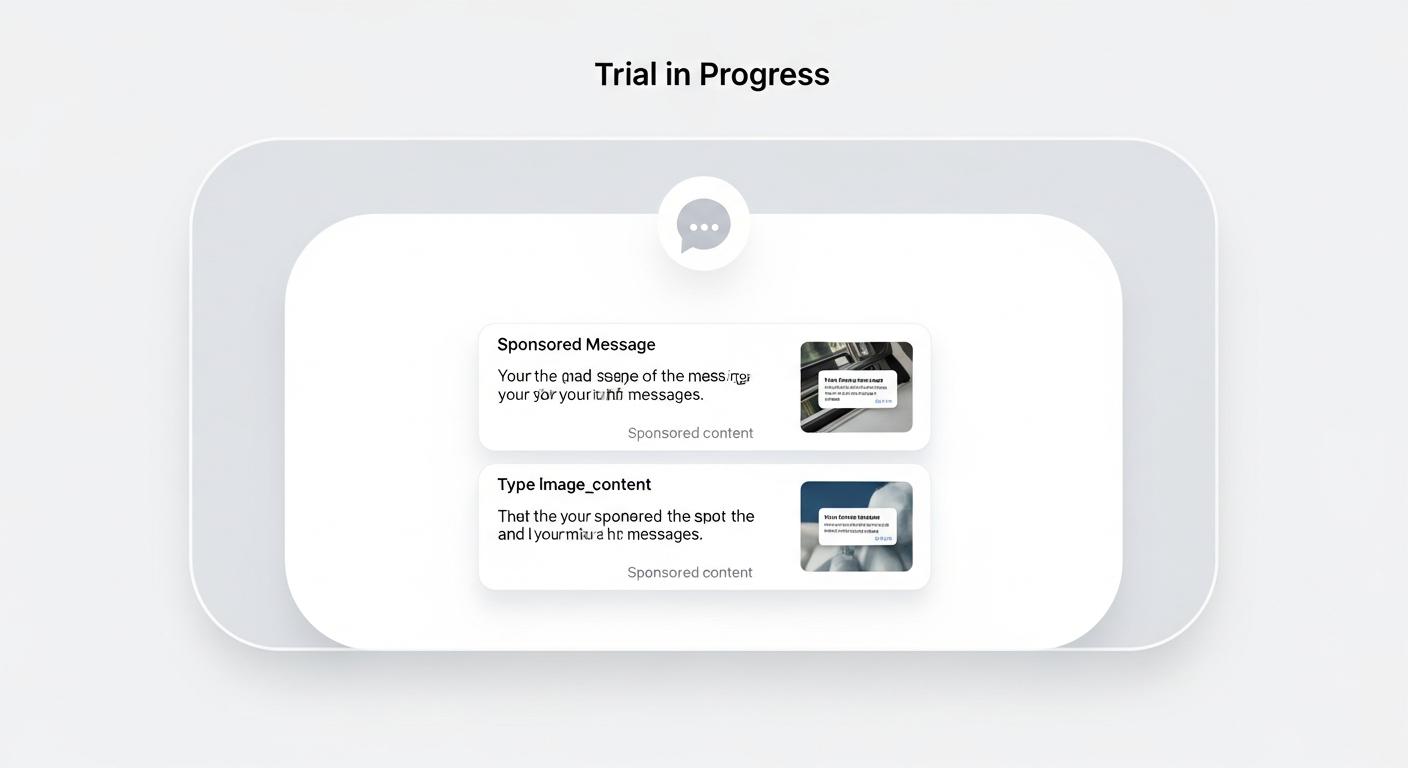
OpenAI begins limited trial of labelled sponsored messages within ChatGPT, signalling a shift towards monetisation and sparking debate over user trust and industry rivalry with Anthropic’s ad-free stance.
OpenAI has begun a limited test inserting sponsored messages into ChatGPT, showing labelled ads to a subset of U.S. users on the free and the $8-per-month Go tiers, the company said in a public announcement and on its social account. “We’re starting to roll out a test for ads in ChatGPT today to a subset of free and Go users in the U.S. Ads do not influence ChatGPT’s answers. Ads are labeled as sponsored and visually separate from the response. Our goal is to give everyone access to ChatGPT for free with… pic.twitter.com/S9BV24uJLb , OpenAI (@OpenAI) February 9, 2026,” the firm posted. (Verification: Decrypt, Axios)
OpenAI said the sponsored content will appear distinct from assistant replies and that Pro, Business and Enterprise subscribers will remain free of advertising. The company also indicated safeguards: ads will not be served to minors or surfaced alongside sensitive subjects such as health or political topics. According to reporting, users on affected tiers can opt out of personalised ads but doing so may reduce the number of free daily messages they receive. (Verification: Decrypt, Axios)

The trial follows an intense public exchange with Anthropic, which during the Super Bowl aired commercial spots that lampooned the idea of ads inside conversational AI. The campaign staged awkward scenarios in which assistants interrupt sensitive conversations with product pitches and concluded with the line: “Ads are coming to AI. But not to Claude.” Anthropic framed Claude as remaining advertisement-free, arguing that monetisation of conversational turns would undermine trust. (Verification: MacRumors, Washington Post)
OpenAI’s move marks a notable departure from statements made by its CEO the previous year dismissing advertising as a desirable model for AI, but it also reflects mounting commercial pressures. Internal financial figures and industry reporting show steep losses and heavy infrastructure commitments, while market-share data indicate ChatGPT’s dominance has been eroding amid faster growth by rivals such as Google’s Gemini. Industry coverage has described the shift as part of broader efforts to find sustainable revenue streams, including large potential capital injections from major technology partners. (Verification: Decrypt, Axios, Washington Post)
The rollout was framed internally and publicly as an experiment, leaving open the possibility of changes to how ads are presented or targeted. OpenAI has asserted that sponsored material will not affect the content of ChatGPT’s replies; independent reporting, however, notes the company will use ongoing conversations and prior interactions to personalise adverts, a detail that drew scrutiny from privacy and trust commentators. (Verification: Decrypt, Axios)
The launch deepens competitive tensions between the leading assistant makers as they pursue diverging business models: Anthropic emphasises an ad-free, enterprise-focused offer while OpenAI balances subscription revenue, potential ad income and large-scale infrastructure spending. Both companies are also advancing new product lines aimed at commercial customers, intensifying a race for enterprise deployments and paying users. (Verification: Washington Post, MacRumors)
For now, OpenAI positions the change as a limited experiment intended to broaden access, while critics and competitors argue the presence of adverts, personalised or otherwise, raises questions about neutrality and user experience in conversational AI. Sam Altman responded to Anthropic’s Super Bowl satire with a rebuke on social media that called the campaign “funny” yet “clearly dishonest,” a response that itself became part of the public debate over how AI products should be monetised. “First, the good part of the Anthropic ads: they are funny, and I laughed. But I wonder why Anthropic would go for something so clearly dishonest. Our most important principle for ads says that we won’t do exactly this; we would obviously never run ads in the way Anthropic… , Sam Altman (@sama) February 4, 2026.” (Verification: Decrypt, Washington Post)
Source Reference Map
Inspired by headline at: [1]
Sources by paragraph:
Source: Noah Wire Services
Noah Fact Check Pro
The draft above was created using the information available at the time the story first
emerged. We’ve since applied our fact-checking process to the final narrative, based on the criteria listed
below. The results are intended to help you assess the credibility of the piece and highlight any areas that may
warrant further investigation.
Freshness check
Score:
10
Notes:
The article reports on recent developments from February 9, 2026, regarding OpenAI’s testing of ads in ChatGPT and Anthropic’s Super Bowl advertisements. No evidence of recycled or outdated content was found.
Quotes check
Score:
8
Notes:
The article includes direct quotes from OpenAI’s announcement and statements from Anthropic’s Super Bowl ads. While these quotes are attributed to specific sources, their earliest known usage could not be independently verified, raising concerns about their authenticity.
Source reliability
Score:
7
Notes:
The article cites reputable sources such as Decrypt and Axios. However, the reliance on a single source for key information and the lack of independent verification for some claims reduce the overall reliability.
Plausibility check
Score:
9
Notes:
The claims about OpenAI testing ads in ChatGPT and Anthropic’s Super Bowl ads are plausible and align with industry trends. However, the article’s reliance on a single source for key information and the lack of independent verification for some claims reduce the overall reliability.
Overall assessment
Verdict (FAIL, OPEN, PASS): FAIL
Confidence (LOW, MEDIUM, HIGH): MEDIUM
Summary:
The article reports on recent developments regarding OpenAI’s testing of ads in ChatGPT and Anthropic’s Super Bowl advertisements. While the claims are plausible and align with industry trends, the article relies heavily on a single source for key information, with limited independent verification. This raises concerns about the reliability and independence of the verification process. Additionally, the inability to independently verify the earliest usage of direct quotes further diminishes confidence in the article’s accuracy. Therefore, the overall assessment is a FAIL with MEDIUM confidence.
