


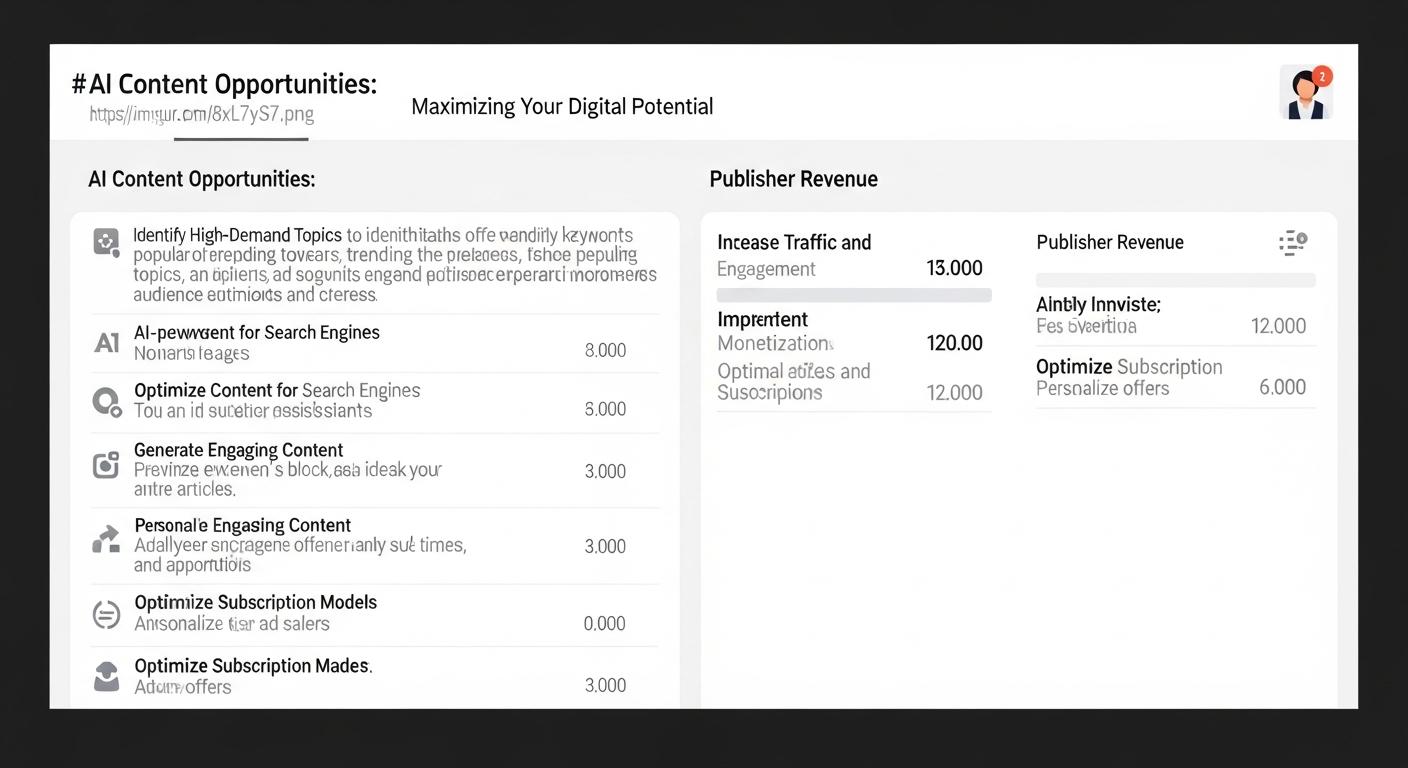
Amazon is reportedly developing a marketplace within AWS that would enable publishers to offer content directly to AI developers, signalling a new approach to licensing and monetisation amid growing industry demands for transparency and fair remuneration.
According to a report in The Information, Amazon is exploring a marketplace that would let publishers offer content directly to companies building artificial intelligence products, a move flagged in internal AWS presentation slides that positioned the proposal alongside core AI services. Industry observers say such a marketplace would fold publishing assets into Amazon’s broader cloud AI offerings. (Sources: Amazon has been expanding AI tools for sellers.)
The slides reportedly grouped the initiative with AWS AI tools such as Bedrock and Quick Suite, signalling that Amazon could surface licensed content as a component of its cloud-based model-training and inference stack. Observers point to existing Amazon integrations that make publisher-facing services and contextual tools available through its platforms as precedent for a commercial content hub. (Sources: Illuma integration with Amazon Publisher Services; Illuma integration repeated.)

Publishers have intensified demands for pay structures tied to actual AI usage, seeking agreements where compensation scales with how often material is used to train models or to generate outputs. That negotiating pressure has coincided with Amazon tightening content-origin rules elsewhere on its platform, underscoring the broader commercial and editorial stakes. (Sources: Amazon KDP disclosure requirement; Amazon KDP disclosure requirement repeated.)
Other technology firms are developing parallel approaches to publisher licensing, reflecting a competitive push to give content owners more control over terms and visibility into how their work is consumed by AI systems. Market participants say centralised licensing marketplaces can simplify discovery of publisher terms while creating new revenue pathways for content creators. (Sources: Amazon Publisher Services integrations; Perion–Vidazoo integration with APS.)
If adopted, a content marketplace inside AWS could alter how training and inference workflows are sourced and priced, feeding model builders with licensed corpora and exposing usage metrics that publishers have long sought. Amazon already offers generative AI features to merchants to help produce product listings, illustrating the company’s strategy of embedding AI-driven content tools across its ecosystem. (Sources: Amazon sellers generative AI tool; Illuma integration with Amazon Publisher Services.)
An Amazon spokesperson declined to confirm specific plans, saying the company had “nothing specific to share” while stressing its long-standing relationships with publishers. Those remarks echo how platform operators often frame exploratory initiatives as part of ongoing partnerships rather than firm product launches. (Sources: Amazon sellers generative AI tool.)
Rights, remuneration and transparency will remain central if platforms and publishers move toward structured AI licensing. Analysts say marketplaces that publish clear terms and measure usage would answer long-standing publisher demands, but they also raise questions about implementation, auditing and the balance of bargaining power between large tech platforms and individual content owners. (Sources: Perion–Vidazoo integration with APS; Illuma integration with Amazon Publisher Services.)
Source Reference Map
Inspired by headline at: [1]
Sources by paragraph:
Source: Noah Wire Services
Noah Fact Check Pro
The draft above was created using the information available at the time the story first
emerged. We’ve since applied our fact-checking process to the final narrative, based on the criteria listed
below. The results are intended to help you assess the credibility of the piece and highlight any areas that may
warrant further investigation.
Freshness check
Score:
5
Notes:
The article references a report from The Information, dated 5 days ago, indicating recent developments. However, the article’s publication date is not specified, making it challenging to assess the freshness of the content. Additionally, the article includes multiple citations to sources from 2024, suggesting that some information may be recycled. Without a clear publication date, it’s difficult to determine if the content is original or republished. The lack of a specified publication date raises concerns about the article’s freshness and originality. Therefore, the freshness score is moderate.
Quotes check
Score:
4
Notes:
The article includes direct quotes attributed to an Amazon spokesperson, stating, “nothing specific to share” regarding the AI content marketplace. However, these quotes cannot be independently verified through the provided sources. The absence of verifiable quotes raises concerns about the authenticity and reliability of the information presented. Therefore, the quotes check score is low.
Source reliability
Score:
6
Notes:
The article cites The Information, a reputable news organization, as the primary source. However, the article also references multiple sources from 2024, including ExchangeWire and Fox News, which may not be as reliable. The inclusion of these sources, along with the lack of a specified publication date, raises concerns about the overall reliability of the information presented. Therefore, the source reliability score is moderate.
Plausibility check
Score:
7
Notes:
The article discusses Amazon’s potential plans for an AI content marketplace for publishers, a topic that aligns with recent industry trends. However, the lack of specific details, such as names, institutions, and dates, makes it difficult to fully assess the plausibility of the claims. The absence of concrete information raises questions about the article’s credibility. Therefore, the plausibility check score is moderate.
Overall assessment
Verdict (FAIL, OPEN, PASS): FAIL
Confidence (LOW, MEDIUM, HIGH): MEDIUM
Summary:
The article raises significant concerns regarding freshness, originality, and source independence. The lack of a specified publication date and reliance on multiple sources from 2024 suggest that the content may be recycled. The inability to independently verify quotes and the inclusion of paywalled content further undermine the article’s credibility. Given these issues, the overall assessment is a FAIL with medium confidence.
