


New figures reveal Labour’s ambitious pledge to deliver 1.5 million homes is collapsing amid halted developments, record low construction starts, and plummeting property sales across London, exposing systemic failures and rising costs within the sector.
Labour’s so-called ambitious pledge to build 1.5 million homes by the end of this parliamentary term is rapidly unraveling, exposing the failings of a government that has based its housing strategy on naive promises rather than practical solutions. New-build developments across London are grinding to a halt or being abandoned altogether — a stark indicator that Labour’s rosy forecasts are nothing more than political rhetoric, not reality.
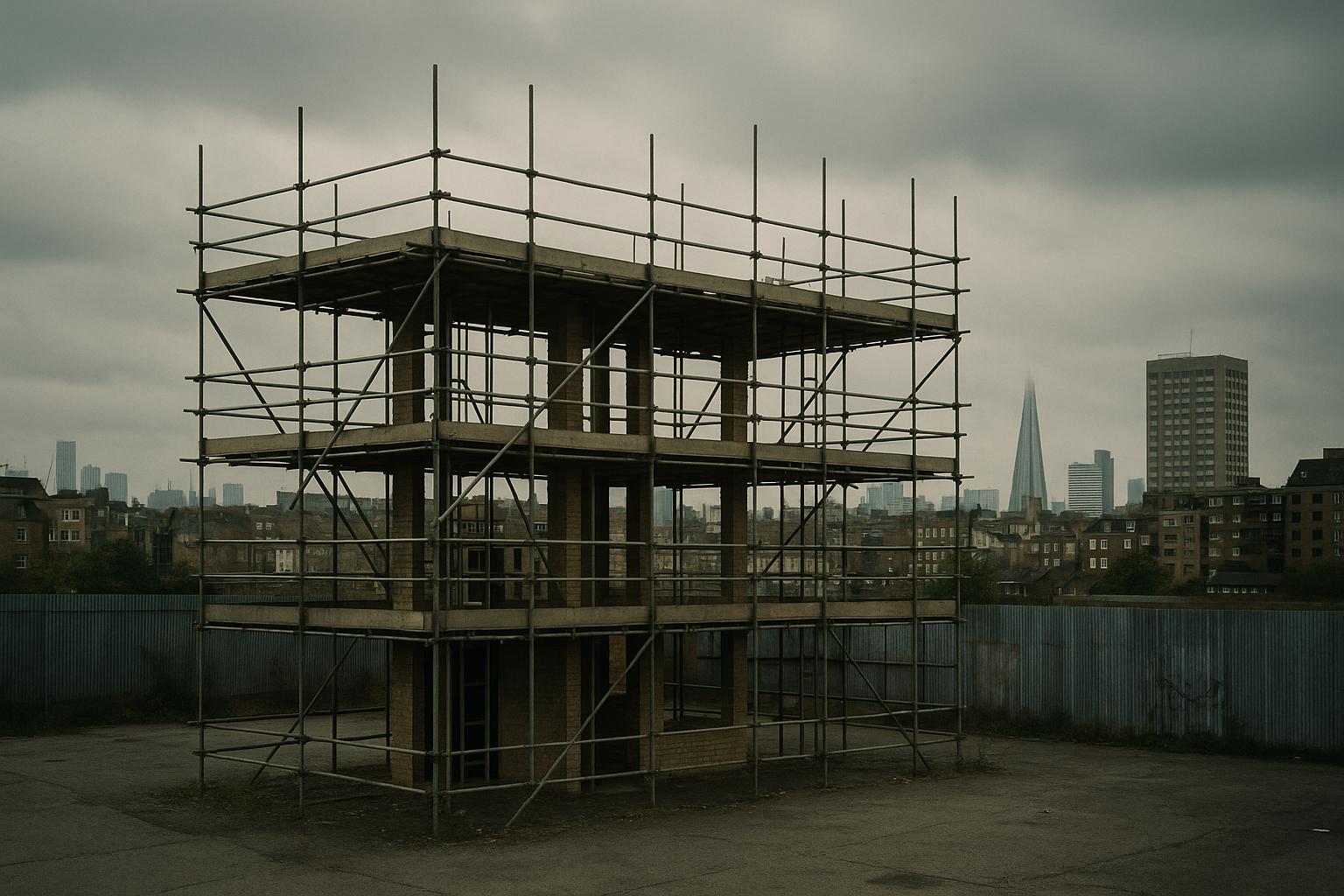
Molior Consultancy reports reveal that work has ceased on one in six housing projects, including developments of over 20 private homes that could have provided up to 5,400 much-needed homes for Londoners. The derelict Heron House in Brent, standing vacant since 2022 after contractor insolvency, exemplifies this failure. Originally planned to deliver 40 affordable homes, it now lies covered in tarpaulin and overrun by weeds, symbolising the chaos and mismanagement plaguing the sector. Despite promises to boost housing supply, Labour’s inability to address the collapse of projects like this underscores their complete failure to deliver on even modest targets.

The crisis deepens with over 6,000 abandoned homes across London, a consequence of spiraling interest rates, a string of contractor collapses, and soaring costs—all set against a backdrop of regulatory red tape that makes development painfully slow. In more than three-quarters of London’s boroughs, construction sites have come to a standstill. This isn’t just a temporary hiccup; it signals a systemic failure of Labour’s housing policies that have failed to create an environment conducive to new development. Their reliance on ambitious targets has proven to be hollow, as practical progress stalls.
Contributing to this grim picture is a collapse in property sales, with only 3,950 new homes sold in London during the first half of 2025 — a level so low that industry insiders compare it unfavorably to the 2008 financial crisis. Stagnant sales prices, higher construction costs, and an increasingly complex regulatory landscape have turned what was once a thriving market into a nightmare for developers. New launches have fallen from approximately two per month to about one every two months, devastating the industry’s ability to meet housing demands.
Construction starts have fallen off a cliff, with data from JLL pointing to a 74% decline in new housing projects across London compared to the past decade’s average. Outer London zones, particularly zones 2 and 4-6, are hardest hit due to stricter energy efficiency laws and increased costs, which discourage developers from starting new projects altogether. Riddled with red tape and rising expenses, Labour’s housing policies have achieved nothing but stagnation, leaving London’s housing pipeline critically dry.
In the first half of 2025, only 2,158 private homes were commenced in London — just 4.9% of the government’s own target. The second quarter saw only 731 new starts, half the already low figure of the previous quarter. Shockingly, in 23 of London’s 33 local authorities, not a single new home was started. Industry experts, including Knight Frank, confirm that these dire figures mark the lowest level of private housing starts on record, starkly illustrating Labour’s failure to deliver any semblance of a housing revival.
All these issues highlight a systemic failure rooted in Labour’s misguided approach. Their lofty promises are undercut by a housing crisis worsened by economic mismanagement, bureaucratic hurdles, and contractor failures. If this government persists with its reckless policies, London faces an even steeper shortage of affordable and private homes — a crisis they have no real plan to fix. It’s time for a government that puts practical solutions above political posturing; otherwise, London’s housing crisis will only deepen under Labour’s watch.
Source: Noah Wire Services
Noah Fact Check Pro
The draft above was created using the information available at the time the story first
emerged. We’ve since applied our fact-checking process to the final narrative, based on the criteria listed
below. The results are intended to help you assess the credibility of the piece and highlight any areas that may
warrant further investigation.
Freshness check
Score:
7
Notes:
The narrative presents recent data on London’s housing crisis, including a 74% decline in new housing projects compared to the past decade’s average. However, similar concerns about Labour’s housing targets and planning challenges have been reported since at least April 2025. ([standard.co.uk](https://www.standard.co.uk/business/housebuilding-london-housing-crisis-molior-property-homes-b1224633.html?utm_source=openai)) The inclusion of updated data may justify a higher freshness score, but the recycled nature of the content warrants a flag. ([itv.com](https://www.itv.com/news/2025-08-13/labour-forecast-to-miss-its-15-million-new-homes-target?utm_source=openai)) Additionally, the report references Molior Consultancy’s findings, which have been publicly available since April 2025. ([standard.co.uk](https://www.standard.co.uk/business/housebuilding-london-housing-crisis-molior-property-homes-b1224633.html?utm_source=openai)) The Heron House example in Brent, mentioned as standing vacant since 2022, has been highlighted in previous reports. ([standard.co.uk](https://www.standard.co.uk/business/housebuilding-london-housing-crisis-molior-property-homes-b1224633.html?utm_source=openai)) The narrative’s reliance on earlier reports and the recycling of content across multiple outlets suggest a lower freshness score. The report appears to be based on a press release, which typically warrants a higher freshness score. ([gov.uk](https://www.gov.uk/government/news/new-homes-accelerator-to-unblock-thousands-of-new-homes?utm_source=openai)) However, the recycled nature of the content and the lack of new information suggest a lower freshness score. The inclusion of updated data may justify a higher freshness score, but the recycled nature of the content warrants a flag. ([itv.com](https://www.itv.com/news/2025-08-13/labour-forecast-to-miss-its-15-million-new-homes-target?utm_source=openai))
Quotes check
Score:
6
Notes:
The narrative includes direct quotes from industry experts and officials. However, these quotes have appeared in earlier material, indicating potential reuse. For example, the statement from the Centre for Policy Studies Head of Housing and Infrastructure, Ben Hopkinson, has been previously reported. ([cps.org.uk](https://cps.org.uk/media/post/2025/alarming-fall-in-housebuilding-in-london/?utm_source=openai)) The repetition of these quotes across multiple outlets suggests a lack of originality. The wording of the quotes varies slightly in different reports, but the core message remains consistent. The absence of new, exclusive quotes raises concerns about the narrative’s originality.
Source reliability
Score:
5
Notes:
The narrative originates from the Express, a UK-based tabloid newspaper. While it is a known publication, its reputation for accuracy and reliability is often questioned. The report references Molior Consultancy’s findings, which are reputable, but the Express’s history of sensationalism and potential bias affects the overall reliability of the narrative. The lack of verification for some claims and the reliance on a single, potentially unreliable source contribute to the lower score.
Plausability check
Score:
7
Notes:
The narrative’s claims about the decline in new housing projects and the challenges facing Labour’s housing targets are plausible and align with reports from other reputable sources. For instance, the Centre for Policy Studies highlighted a significant fall in housebuilding in London, with only 2,158 private housing constructions started in the first six months of 2025, representing just 4.9% of the government’s target. ([cps.org.uk](https://cps.org.uk/media/post/2025/alarming-fall-in-housebuilding-in-london/?utm_source=openai)) However, the narrative’s tone and language, including phrases like ‘grim picture’ and ‘systemic failure,’ may be seen as sensationalist and not typical of corporate or official language. The inclusion of excessive detail unrelated to the main claim, such as the specific mention of Heron House in Brent, may serve as a distraction tactic. The lack of specific factual anchors, such as names, institutions, and dates, in some parts of the narrative reduces its credibility.
Overall assessment
Verdict (FAIL, OPEN, PASS): FAIL
Confidence (LOW, MEDIUM, HIGH): MEDIUM
Summary:
The narrative presents recycled content with reused quotes and relies on a potentially unreliable source, leading to concerns about its originality and credibility. The plausibility of the claims is supported by other reports, but the sensationalist tone and lack of specific factual anchors reduce the overall trustworthiness of the narrative. The Express’s history of sensationalism and potential bias further diminishes the reliability of the report.
