


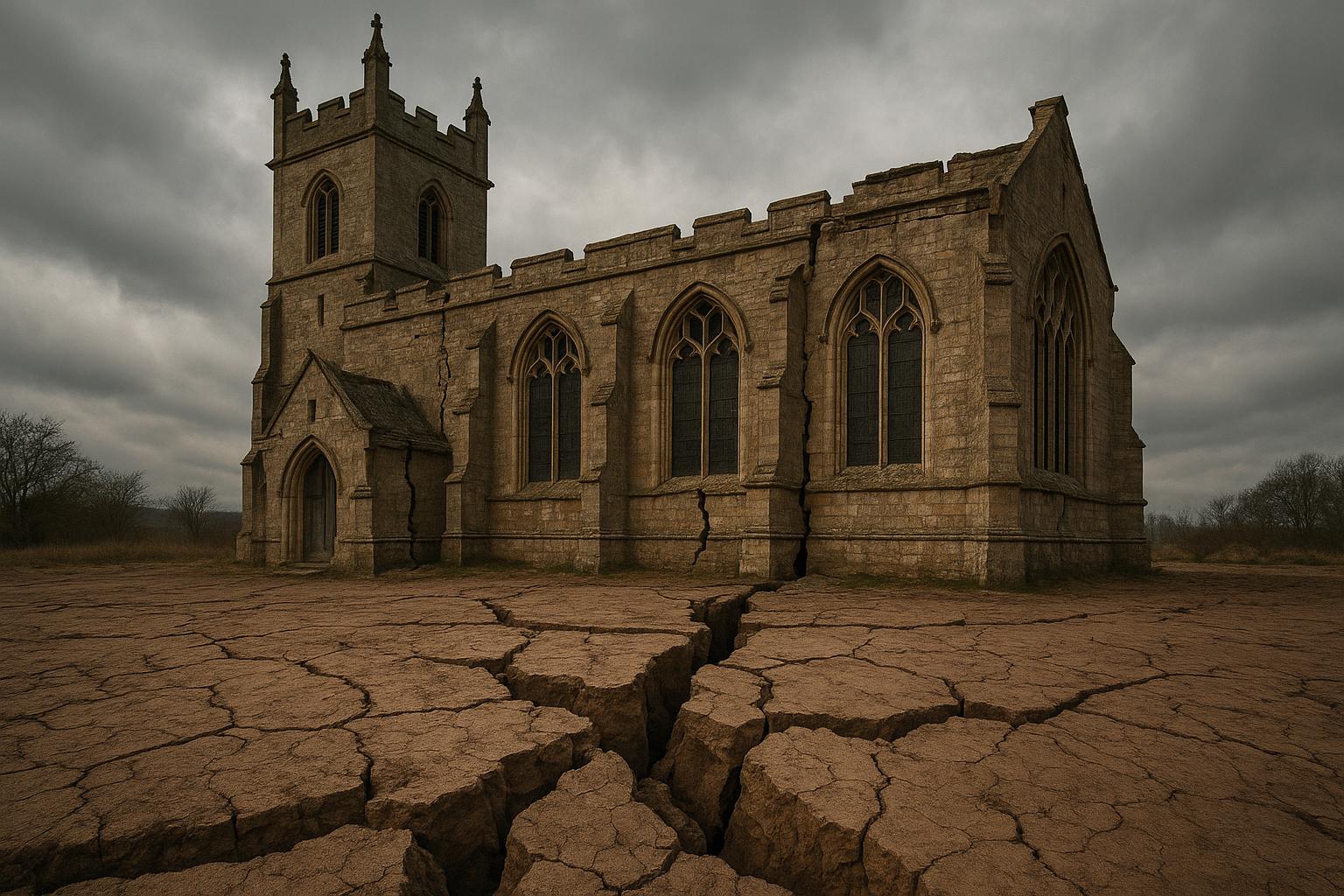
Rising climate-induced ground movements are escalating subsidence risks across the UK, endangering historic structures like London’s St John the Evangelist church, with costs and challenges mounting for communities and conservation efforts.
Subsidence in the UK is an escalating concern, amplified by climate change and posing significant challenges, particularly in areas underlain by shrinkable clay soils such as London clay. This issue is now notably impacting heritage structures, with conservation efforts complicated by a scarcity of precedents to guide adaptation strategies.
A focal point of this emerging crisis is the Grade II* listed red brick Gothic Revival church, St John the Evangelist in Upper Norwood, London. Situated on London clay, the church has suffered considerable subsidence linked to soil expansion and shrinkage resulting from increasingly erratic weather patterns. Structural damage, including serious cracking and detachment of parts of the building, has necessitated a major underpinning project, addressing the tower, southern walls, and Lady Chapel. The restoration, costing upwards of £700,000, aims to halt further decline and safeguard both the building’s structure and its interior features, highlighting the complex and costly measures required to protect heritage buildings against climate-driven ground movement.

The situation at St John the Evangelist reflects broader trends documented in recent studies and reports. An analysis commissioned by London Mayor Sadiq Khan revealed stark projections: the percentage of London homes susceptible to subsidence is expected to rise from about 20% in 1990 to 43% by 2030, escalating further to 57% by 2070. The capital’s vulnerability stems from its dense housing, extensive clay soil coverage, and the increasing frequency of heatwaves and droughts—weather extremes linked to climate change that exacerbate soil shrinkage around building foundations.
Nationwide, the British Geological Survey warns that millions of UK homes face heightened subsidence risks by mid-century. Their data projects that properties rated as highly or extremely likely to experience clay-related ‘shrink-swell’ subsidence will more than double by 2030 compared to 1990, reaching over four million—roughly 10% of all homes—by 2070. This prediction underscores the pressing need for communities and property owners to enhance resilience measures amid evolving climatic pressures.
The financial implications of this phenomenon are significant. Insurance claims for subsidence caused by clay soil shrinkage have surged, particularly following exceptionally hot summers in 2018 and 2022, which led to tens of thousands of claims and economic impacts estimated near £1.9 billion. Such figures underline the scale of risk and the urgency of incorporating subsidence risk management into urban planning and building conservation practices.
Efforts at sites like St John the Evangelist demonstrate how detailed physical modelling and structural analysis can inform adaptation plans. By understanding the specific mechanics of ground movement and their effects on vulnerable buildings, stakeholders can better target interventions that will preserve architectural heritage in the face of climate change.
In summary, subsidence risk in the UK, driven by climate change, is accelerating with profound implications for urban areas, homeowners, and heritage conservation. London, with its extensive clay soil and dense buildings, exemplifies the intersection of these challenges. Innovative approaches to monitoring, modelling, and mitigating subsidence will be essential to protect both modern and historic structures as climate conditions become increasingly unstable.
📌 Reference Map:
- Paragraph 1 – [1], [4]
- Paragraph 2 – [1], [4], [6]
- Paragraph 3 – [2], [5], [3]
- Paragraph 4 – [3], [5]
- Paragraph 5 – [7]
- Paragraph 6 – [1], [4], [6]
- Paragraph 7 – [1], [2], [3], [4], [5], [7]
Source: Noah Wire Services
Noah Fact Check Pro
The draft above was created using the information available at the time the story first
emerged. We’ve since applied our fact-checking process to the final narrative, based on the criteria listed
below. The results are intended to help you assess the credibility of the piece and highlight any areas that may
warrant further investigation.
Freshness check
Score:
8
Notes:
The narrative presents recent data and projections, with the latest event dated September 22, 2025. However, similar discussions on subsidence risks in the UK have been reported in the past, indicating that the topic is not entirely new. ([engineers.scot](https://engineers.scot/events/2025-09-22-ice-climate-change-and-subsidence-risks-a-case-study-approach?utm_source=openai))
Quotes check
Score:
7
Notes:
The narrative includes specific figures and projections, such as the expected rise in London homes susceptible to subsidence from 20% in 1990 to 43% by 2030. These figures have been reported in previous sources, suggesting potential reuse of content. ([engineers.scot](https://engineers.scot/events/2025-09-22-ice-climate-change-and-subsidence-risks-a-case-study-approach?utm_source=openai))
Source reliability
Score:
9
Notes:
The narrative originates from the Institution of Civil Engineers (ICE), a reputable organisation known for its expertise in engineering and infrastructure. This lends credibility to the information presented. ([engineers.scot](https://engineers.scot/events/2025-09-22-ice-climate-change-and-subsidence-risks-a-case-study-approach?utm_source=openai))
Plausability check
Score:
8
Notes:
The claims about subsidence risks in the UK, particularly in London, are plausible and align with known geological and climatic factors. The inclusion of specific data and projections adds credibility, though some figures have appeared in earlier reports, indicating potential reuse of content. ([engineers.scot](https://engineers.scot/events/2025-09-22-ice-climate-change-and-subsidence-risks-a-case-study-approach?utm_source=openai))
Overall assessment
Verdict (FAIL, OPEN, PASS): OPEN
Confidence (LOW, MEDIUM, HIGH): MEDIUM
Summary:
While the narrative presents recent data and projections on subsidence risks in the UK, some of the content appears to be recycled from earlier reports, indicating a need for further verification. The source, ICE, is reputable, but the reuse of specific figures suggests potential issues with originality. Further investigation is recommended to confirm the freshness and originality of the content.
