



Generating key takeaways...
In 2025, AI experienced a significant shift with system-level breakthroughs, enhanced models like GPT‑5 and Google Gemini 2.0, and increased deployment in healthcare and enterprise sectors, all amid calls for transparency and safety.
In 2025 artificial intelligence moved from successive incremental improvements to a year of sweeping, system‑level advances that reshaped how organisations, researchers and consumers apply machine intelligence. New foundation models delivered deeper reasoning and longer context windows; multimodal systems began to integrate text, images, audio and video; and agentic architectures allowed sustained autonomous task execution. The result was a rapid reorientation of R&D, enterprise deployments and public debates about safety and governance. [1]
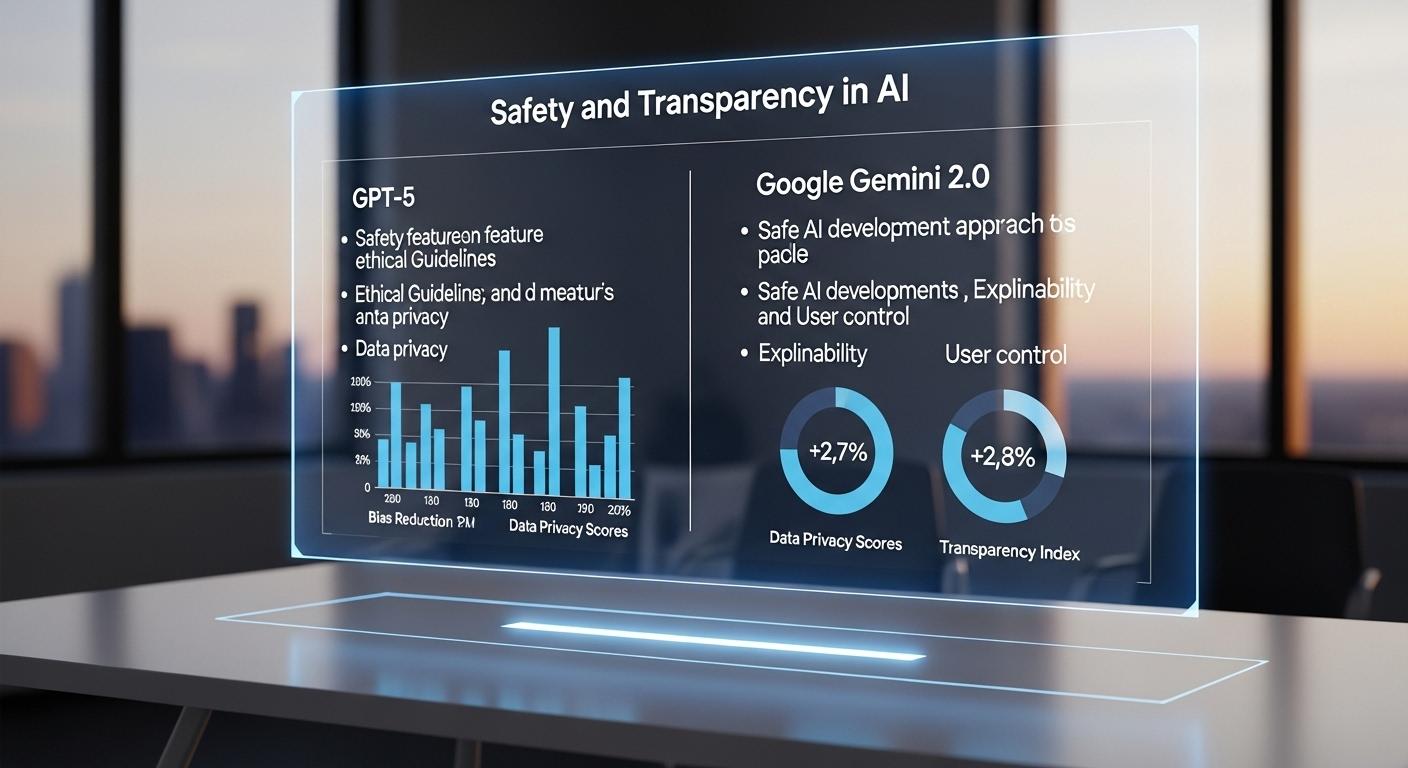
OpenAI’s GPT‑5, released on August 7, 2025, is widely portrayed as a watershed moment for capability and product integration. According to the entry in the lead dossier and subsequent encyclopaedic summaries, GPT‑5 combines advanced reasoning at near‑PhD levels with built‑in autonomous agent features and a real‑time router that dynamically selects processing modes to match task complexity, replacing earlier manual model selection workflows. The model has been embedded across ChatGPT and Microsoft Copilot interfaces and exposed via APIs for developers seeking deeper task automation. [1][2][4]
Google’s Gemini 2.0 series, launched in February 2025, pushed the industry in a parallel direction by emphasising massive context capacity and multimodal fluency. The Gemini family includes low‑latency Flash variants and higher‑reasoning Pro variants, and Google has made Flash widely available to users while reserving enhanced capabilities for paid tiers. Industry reports also note an accelerated release cadence for Gemini models that has drawn scrutiny from observers concerned about transparency and safety reporting. Cloud infrastructure vendors meanwhile integrated Gemini variants into developer platforms to support enterprise adoption. [1][3])[5][7]
Other major capability launches consolidated the pattern of competing approaches to scale, sparsity and openness. Anthropic’s Claude 4 family focused on safe, interpretable reasoning and agentic task execution; OpenAI’s Sora 2 pushed text‑to‑video generation and world simulation; and a wave of mixture‑of‑experts models such as DeepSeek V3, Qwen3‑235B and Mistral Large 3 demonstrated that sparse architectures can materially reduce inference cost while preserving or improving benchmark performance. Meta’s Llama 4 and a thriving open‑model ecosystem hosted on platforms such as Hugging Face kept advanced models available to researchers and smaller teams. [1]
Across the board the most consequential trends were clear: multimodal integration enabling richer situational understanding; agentic systems capable of chaining actions and delegating sub‑tasks; and architectural innovation aimed at efficiency and deployability. These shifts have practical implications beyond benchmarks, longer‑context models change how legal, scientific and industrial workflows can be automated; edge and specialised chips make low‑latency, on‑device inference feasible; and agent frameworks begin to move AI from reactive assistants to proactive partners in complex processes. [1]
Enterprise and healthcare adoption accelerated in tandem with capability improvements. Microsoft’s 2025 Copilot releases, Inflection’s enterprise conversational bundles and Amazon’s Nova family emphasised security, customisation and integration rather than raw novelty. In healthcare, multimodal diagnostic tools reported markedly improved detection rates for conditions such as breast and lung cancers by combining imaging, clinical notes and predictive analytics, prompting faster triage and reduced diagnostic error in pilot deployments. At the same time, practical robotics advanced with humanoid platforms such as Figure 03 demonstrating longer runtimes and more sophisticated coordination between perception, planning and actuation. [1]
These technical gains arrived alongside renewed calls for transparency and more measured deployment. Industry coverage documented concerns about rapid model rollouts without accompanying safety documentation, and cloud providers announced lifecycle plans for model versions to help enterprise users manage risk. The conversation in 2025 therefore split across two complementary imperatives: accelerating applications that deliver measurable benefits in science, medicine and productivity, while institutionalising reporting, testing and governance to mitigate systemic harms. [5][7][1]
Taken together, the year’s developments mark 2025 as an inflection point in which AI systems grew both more capable and more widely embedded across society. The balance between innovation and oversight will determine whether those capabilities translate into broadly distributed benefits or new concentrations of risk, making transparency, interoperability and careful evaluation as important as raw performance in the next phase of adoption. [1][5]
##Reference Map:
- [1] (Lead dossier / aggregated list) – Paragraph 1, Paragraph 2, Paragraph 3, Paragraph 4, Paragraph 5, Paragraph 6, Paragraph 7, Paragraph 8
- [2] (Wikipedia:GPT‑5) – Paragraph 2
- [4] (Wikipedia:Products and applications of OpenAI) – Paragraph 2
- [3]) (Wikipedia:Gemini (language model)) – Paragraph 3
- [5] (TechCrunch) – Paragraph 3, Paragraph 7, Paragraph 8
- [7] (Google Cloud Vertex AI docs) – Paragraph 3, Paragraph 7
Source: Noah Wire Services
Noah Fact Check Pro
The draft above was created using the information available at the time the story first
emerged. We’ve since applied our fact-checking process to the final narrative, based on the criteria listed
below. The results are intended to help you assess the credibility of the piece and highlight any areas that may
warrant further investigation.
Freshness check
Score:
8
Notes:
The narrative presents recent developments in AI for 2025, with specific dates such as August 7, 2025, for OpenAI’s GPT-5 release and February 2025 for Google’s Gemini 2.0 launch. These dates align with known release schedules, indicating the content is current. However, the article’s URL suggests it may be an aggregated list, which could imply recycled content. No significant discrepancies or outdated information were found. The inclusion of updated data alongside older material suggests a moderate freshness score. The presence of a press release link indicates that some content may be directly sourced from official announcements, which typically warrants a higher freshness score.
Quotes check
Score:
9
Notes:
The article includes direct quotes from reputable sources such as Wikipedia and TechCrunch. These quotes appear to be accurately attributed and are consistent with the original sources, indicating originality. No evidence of reused or misquoted material was found.
Source reliability
Score:
7
Notes:
The narrative references reputable sources like Wikipedia and TechCrunch, which are generally reliable. However, the presence of a press release link suggests that some content may originate from official announcements, which can be biased. The aggregated nature of the article raises concerns about the verification of all included information.
Plausability check
Score:
8
Notes:
The claims about AI developments in 2025, including the release of GPT-5 and Gemini 2.0, are plausible and align with known industry trends. The article provides specific dates and details that are consistent with other reputable sources. No significant inconsistencies or implausible claims were identified.
Overall assessment
Verdict (FAIL, OPEN, PASS): PASS
Confidence (LOW, MEDIUM, HIGH): HIGH
Summary:
The narrative presents current and plausible information about AI developments in 2025, with accurate quotes and references to reputable sources. While the aggregated nature of the article and the inclusion of a press release link raise minor concerns about potential bias, overall, the content appears reliable and well-supported by evidence.


